
Blog Search Results


187 results for all hallows eve
found
within the Blog
6 displayed out of 187 (0.65seconds)Page 14 of 32

John Chau, missionary to the Sentinelese: martyr or madness?
Posted by Luke J. Wilson on 3rd December 2018 in Missions | sentinelese,John Chau,missionary,martyrdom,martyr,india,current events,tribes people
You've probably seen it in the news lately: John Chau, the American guy who tried to evangelise the secluded Sentinelese tribe off the coast of India. Much of the debate in secular media has centered around the grief of his friends and family; how he could have brought outside disease to the tribespeople and potentially killed them all (despite this not being their first contact with outsiders, with no known ill effect), or that he ventured there completely in ignorance with no preparation or wisdom — something which the missionary agency, all Nations, has recently debunked.
But the question I want to look at is this: was Chau's mission total madness or is...
The Historic Practice of Abortion and How Ancient Christians Responded
Posted by Luke J. Wilson on 1st July 2022 in Abortion | abortion,roe v wade,church history,current events,theology,politics,Why Are Christians Against Abortion?
It’s no secret that the majority of Christians are against abortion, no matter where you look in the world. But nowhere has the issue come to more of a head than in the US recently with the overturning of Roe v Wade, which had made abortion legal across the country. Now abortion is no longer a federal constitutional right, but individual states now have the authority to determine the legality and rulings around abortion.
Christian opposition to abortion in America has always been a heated topic, especially in recent decades, but this isn’t a novelty within the Church in America, or globally, and has been a position of the faithful for about 2000 years. even...
The Deity of Christ in the Gospel of Matthew - Part 1
Posted by KingsServant on 22nd December 2022 in Apologetics | islam,islam vs christianity,debate,gospels,apologetics,deity of christ
The titles “Jehovah” and “God” given to Jesus in Matthew 1
This is a guest post by “KingsServant”, see Part 2 here.
In this series of articles, I want to present the case that Matthew teaches Jesus is God, from the arguments I made in 2 moderated debates with a Muslim apologist, Mohammed Abd al Razack, commonly known as Al Yemeni. Although I will be going into far more detail, not having to deal with the tight time controls of a debate format.
The moderated debate on YouTube with me (KingsServant)
Matthew’s teaching of the Trinity and in particular that Jesus is God is by no means limited to the baptismal formula given by Christ after h...
Before The Pumpkins: The Day Two Women Defied Rome
Posted by Luke J. Wilson on 29th October 2025 in Halloween | halloween,martyrdom,Perpetua,Felicity
In the last post, we looked at Polycarp — a faithful bishop who faced the flames rather than deny his Lord. His courage in the face of certain death became a rallying light for generations of believers after him. But his story is only one among many in the long line of the cloud of witnesses who ran the race before us (Hebrews 12:1). Today, we step forward a few decades to another account of extraordinary faith — that of two women, Perpetua and Felicity.
Perpetua left an account of her own martyrdom (technically a Passion) which is considered historically reliable. What makes it extraordinary is that Perpetua herself wrote a portion of it in Latin b...
Kirk Cameron And The Biblical Case For Annihilationism
Posted by Luke J. Wilson on 15th December 2025 in Hell | annihilationism,conditional immortality,Kirk Cameron,hell,controversy,controversial topics
Christian conversations about hell have never been especially calm, but the recent online reaction to Kirk Cameron’s comments in favour of annihilationism has been particularly revealing. Social media has erupted with accusations of heresy, doctrinal collapse, and theological compromise.
It’s the “Rob Bell Incident” all over again (if anyone remembers that).
The infamous John Piper tweet about Rob Bell
A lot of comments I saw were wondering what Ray Comfort thinks of this, as he and Kirk worked closely together in ministry for about 25 years, and while Ray wasn’t as dismissive as John Piper was of Rob Bell, he still calls out Kirk’s new vi...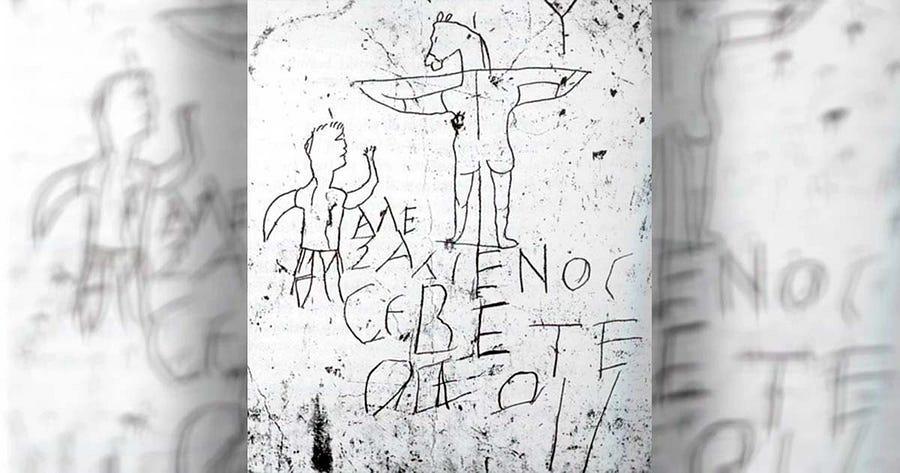
The World's Oldest Anti-Christian Meme
Posted by Luke J. Wilson on 9th March 2026 in Archaeology | Alexamenos graffito,archaeology,history
I first came across the Alexamenos graffito back in Bible college in the early 2000s. It was one of those “fun facts” that gets dropped into a church history lecture and sticks with you — the ancient Roman equivalent of someone spray-painting an insult on a wall. I filed it away, thought it was fascinating, and largely forgot about it for two decades.
Then, recently, I discovered something about it I had never known. There’s a response to it. Scratched in a different room, in a different hand.
So I started digging into this more to verify the information and discovered more historical curiosities surrounding the graffiti than I ever knew existed wh...
Powered by WebBoss.io 3.7.1
Copyright © 2026 The Sacred Faith: Timeless Truths for Modern Minds. All Rights Reserved.
