
Blog Search Results


143 results for third day
found
within the Blog
6 displayed out of 143 (0.22seconds)Page 14 of 24

Lent day 28: Athanasius: Life of Anthony: Chaps. 71-80
Posted by Luke J. Wilson on 1st April 2017 in Lent | Lent,great lent,fasting,early church fathers,devotional,daily reading,Athanasius,Bishop of Alexandria,Confessor,Doctor of the Church,Anthony the Great,miracles,Greek Philosophy,demons,healing,deliverance,the cross,foolishness of the cross
day Twenty-eight: St. Athanasius: Life of Anthony: Chaps. 71-80
Who: Bishop of Alexandria; Confessor and Doctor of the Church; born c. 296; died 2 May, 373 AD. He was the main defender of orthodoxy in the 4th-century battle against the Arianism heresy. Certain writers received the title “Doctor” on account of the great advantage their doctrine had on the whole Church, Athanasius especially for his doctrine on the incarnation.
What: The biography of Anthony the Great’s life, which helped to spread the concept of Christian monasticism, particularly in Western Europe.
Why: From the letter’s own prologue: “The life and conversation of our holy Father...
Lent day 29: Athanasius: Life of Anthony: Chaps. 81-94
Posted by Luke J. Wilson on 3rd April 2017 in Lent | Lent,great lent,fasting,early church fathers,devotional,daily reading,Athanasius,Bishop of Alexandria,Confessor,Doctor of the Church,Anthony the Great,miracles,death,persecution,arianism
day Twenty-nine: St. Athanasius: Life of Anthony: Chaps. 81-94
Who: Bishop of Alexandria; Confessor and Doctor of the Church; born c. 296; died 2 May, 373 AD. He was the main defender of orthodoxy in the 4th-century battle against the Arianism heresy. Certain writers received the title “Doctor” on account of the great advantage their doctrine had on the whole Church, Athanasius especially for his doctrine on the incarnation.
What: The biography of Anthony the Great’s life, which helped to spread the concept of Christian monasticism, particularly in Western Europe.
Why: From the letter’s own prologue: “The life and conversation of our holy Father,...
Lent day 30: Cyril of Jerusalem: Catechetical Lectures: Lecture XIX
Posted by Luke J. Wilson on 4th April 2017 in Lent | Lent,great lent,fasting,early church fathers,devotional,daily reading,Doctor of the Church,lectures,liturgy,catechism,Bishop of Jerusalem
day Thirty: St. Cyril of Jerusalem: Catechetical Lectures: Lecture XIX
Who: Bishop of Jerusalem and Doctor of the Church, born about 315; died probably 18 March, 386. Little is known of his life, except from his younger contemporaries, Epiphanius, Jerome, and Rufinus, as well as from the fifth-century historians, Socrates, Sozomen and Theodoret.
What: Each of the lectures deal with a different topic to teach converts the mysteries of the Church, particularly: rites of the renunciation of Satan and his works, of anointing with oil, of baptism, of anointing with the holy chrism, and of partaking of the body and blood of Christ.
Why: Cyril delivered to new conve...
Lent: day 2 - Mathetes to Diognetus, pt. 1
Posted by Luke J. Wilson on 3rd March 2017 in Lent | Lent,great lent,fasting,early church fathers,devotional,daily reading,epistle of mathetes to diognetus
day two: Epistle of Mathetes to Diognetus: Chaps. 1-6
Who: Anonymous author, “mathetes” is not a name, but is the Greek word for “a disciple”
What: possibly one of the earliest examples of a Christian apologetic defending the faith from its accusers, written to someone interested in learning more about the faith and its customs
Why: The Christian faith was under attack and ridicule in the early centuries, many things about the Church were misunderstood and so various Christians took to writing apologetic's (defences) to clarify doctrines and beliefs from being maligned.
When: Estimated between AD 130 and late 2nd century
I've only ever come acros...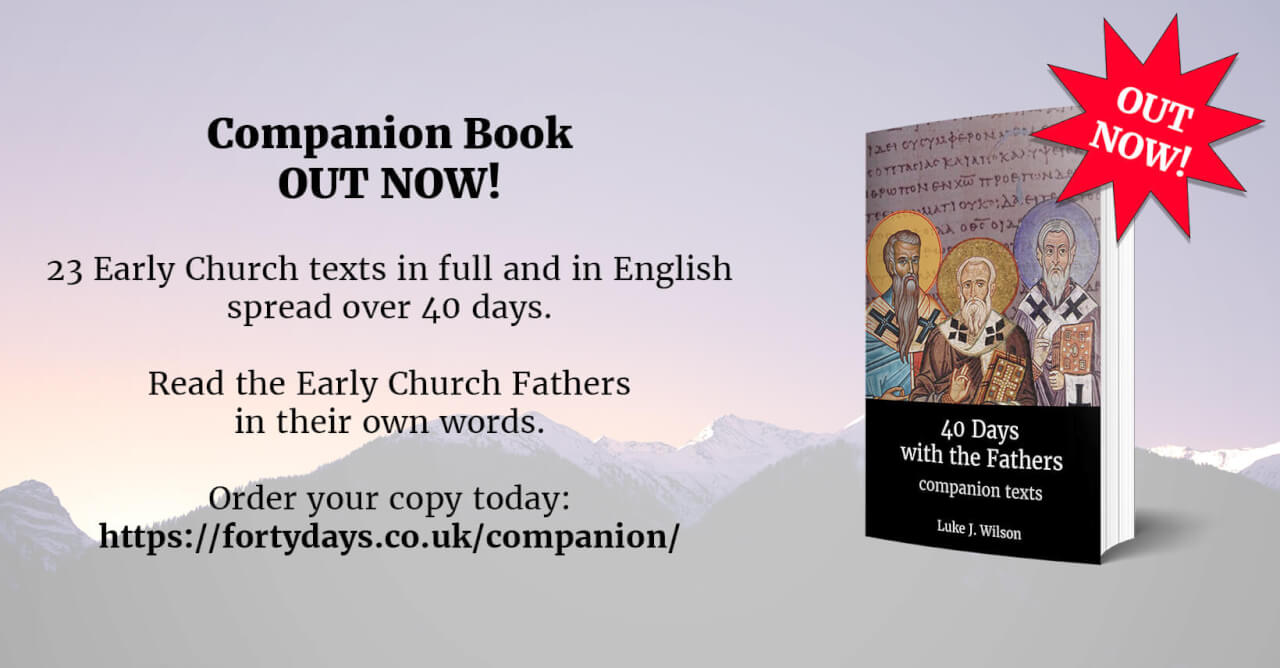
40 days with the Fathers: Companion Texts OUT NOW!
Posted by Luke J. Wilson on 8th May 2019 in Early Church | early church,early church fathers,book,40 days,my book
40 days with the Fathers: Companion Texts is now available to buy as Paperback or Kindle!
I am happy to say that the new book is now available in paperback and Kindle format on Amazon! Other eBook formats will be available soon as it rolls out.
This book is the companion to my other book (40 days with the Fathers: A Daily Reading Plan), and includes twenty-three Early Church texts in full—including all additional footnotes from the original editors and translators so that you can get as close as possible to reading these ancient texts without needing to know ancient Greek or Latin.
It's structured in such a way to read a chapter a day over a 40 day period...
Is it the end of the world as we know it?
Posted by Luke J. Wilson on 27th September 2015 in Eschatology | blood moon,last days,end of the world,second coming,apocalypse,prophecy,false prophets,predictions
September 28th 2015 will be a supermoon and a red moon at that.
I last wrote about these four "blood moons" way back in April last year when certain self-styled prophets John Hagee and Mark Blitz's "End Times" teaching gained some popularity (and subsequent book promotions). One thing that I predicted in my previous article was that if nothing else comes from all of this "end is nigh" nonsense, is that these "prophets" would indeed profit from their books – as has been shown to be true in which the "Four Blood Moons" book has been in the top 20 on the New York Times Best-seller List, and has also recently been turned into a docu-drama!
Other than th...
Powered by WebBoss.io 3.7.1
Copyright © 2026 The Sacred Faith: Timeless Truths for Modern Minds. All Rights Reserved.
