
Blog Search Results


98 results for death
found
within the Blog
6 displayed out of 98 (0.04seconds)Page 15 of 17

Palm Sunday and the End Times
Posted by Luke J. Wilson on 2nd April 2023 in Eschatology | eschatology,end times,palm sunday
...tween his death and resurrection and the judgement on the nation of Israel. Jesus returned as King, and the Church began to spread the Good News of His Kingdom to the world. This is something we must continue to do until the consummation of the ages and final judgement comes upon the whole world.
In the second letter of Peter, the Church then, as well as now, are encouraged in this waiting period before the judgement which will come “like a thief in the night”. The visitation of God for judgement in AD 70 was predicated by signs which Jesus told his disciples to be watchful for (e.g. in Matt. 24), the final judgement will come unexpectedly so we are to live...
Did St. Nicholas Really Slap Arius?
Posted by Luke J. Wilson on 21st November 2023 in Christmas | christmas,arianism,st nicholas,meme
...after his death connect him to the Council, with the account of the violent incident appearing over a millennium later, in a 14th-century work by an anonymous writer.
Moreover, medieval versions of the story describe Nicholas slapping, not punching, an Arian heretic (not specifically Arius). This action is portrayed as a medicinal slap or rebuke, aimed at bringing the individual back to his senses rather than expressing contempt or a desire to harm. In Greek iconography, this moment is celebrated.
Icon of St. Nicholas and Arius
In the original tale, however, Nicholas’s actions were not lauded at the Council; instead, he faced consequences. Reportedly,...
Who was the real Santa Claus?
Posted by Luke J. Wilson on 17th December 2018 in Christmas | christmas,xmas,St Nicholas,early church,Nicea council,father Christmas,santa claus
...after his death. Seamen throughout Europe and Asia, as well as his own people, adopted him as their patron.
His relics were carried to Bari, Italy, in 1087, after the Moslem invasion of Asia Minor. Countless churches in England, France and Germany bear his name. In Germany he became associated with Christmas, and as a giver of gifts on that holyday he is known in America as the kind and generous "Santa Claus."
“Lord, giver of good gifts, make us generous to others, especially to the needy.”
The book of the Saints, Hoagland, V, Regina Press, pp. 288-290
From the excerpt above, it becomes clear how Nicholas became associated with gift-giving and charit...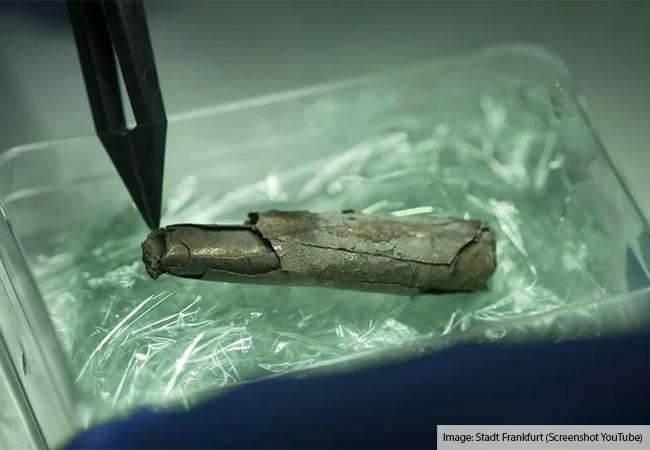
Implications Of The Frankfurt Silver Amulet: Insights Into Early Christian Practice And Belief
Posted by Luke J. Wilson on 6th January 2025 in Archaeology | amulet,liturgy,history,current events,early church
..., even in death, testify to a faith that endured against all odds.
An Open Door to Further Discoveries
The “Frankfurt Silver Inscription” is not merely an archaeological find — it is an important, and potentially game-changing, theological artefact. It serves as one of the earliest testimonies to Christian theology, liturgy, and daily devotion in northern Europe. Its discovery opens new horizons for archaeology, the historical sciences, and theology while raising many new questions.
What other artefacts might still be buried in this Roman cemetery? Could further finds reveal more about the lives of these early Christians? As theologians and historia...Was the omniscience of God a developed idea?
Posted by Luke J. Wilson on 21st April 2014 in The Nature of God | progressive revelation, Christocentric, Christotelic, Hermeneutics, omniscience, omnipresence, theology
...Or do we retroactively place our current theology of God on God?
Consider the Garden of Eden: '[T]he Lord God called to the man, and said to him, “Where are you?”' (Gen. 3:8-10)
Now today we make it into a rhetorical question, but was this always so? In this story, God is spoken of almost in a physical-bodily sense as walking in the garden, since "they heard the sound of the Lord God walking in the garden" as he moved about, and then tried to hide themselves from his view!
Next think of the tower of Babel - "The Lord came down to see the city and the tower, which mortals had built" (Gen 11:5) - Did he not just know already? Also this story...
Lent: Day 5 - Ignatius to the Ephesians
Posted by Luke J. Wilson on 6th March 2017 in Lent | Lent,great lent,fasting,early church fathers,devotional,daily reading,Ignatius of Antioch: Letter to the Ephesians,Ignatius
...e life in death; both of Mary and of God; first passible and then impassible, even Jesus Christ our Lord … God Himself being manifested in human form for the renewal of eternal life.
Considering the date of this letter, this in itself is a good apologetic against more recent false claims that Jesus was only “made” divine at the Council of Nicea, when the gathered bishops and Emperor Constantine decided to alter centuries of Church doctrine and make Jesus into more than he supposedly was. This is, of course, total nonsense and even a cursory reading of Church History would dispel this notion, but the internet being what it is makes these heresies survive....
Powered by WebBoss.io 3.7.1
Copyright © 2026 The Sacred Faith: Timeless Truths for Modern Minds. All Rights Reserved.
