
Blog Search Results


139 results for had
found
within the Blog
6 displayed out of 139 (0.04seconds)Page 15 of 24

The Early Concept of the Trinity: Tracing the Roots
Posted by Luke J. Wilson on 16th November 2023 in Trinity | trinity,early church,early church fathers,tri-unity,triune God,godhead
...t], as he had seen the blessed apostles, and had been conversant with them, might be said to have the preaching of the apostles still echoing [in his ears], and their traditions before his eyes” (Against Heresies 3:3). So, his letter provides important context when discussing this topic and what apostolic teaching was.
Likewise, Justin Martyr, writing around AD 150, in chapter 13 of his First Apology writes about the triune nature of God, and how Jesus is in “second place” within the Godhead:
Our teacher of these things is Jesus Christ, who also was born for this purpose, and was crucified under Pontius Pilate, procurator of Judæa, in the times of Tiber...
Who was the real Santa Claus?
Posted by Luke J. Wilson on 17th December 2018 in Christmas | christmas,xmas,St Nicholas,early church,Nicea council,father Christmas,santa claus
...ed father had to sell his three daughters into prostitution because he had no money for their marriage dowry, Nicholas threw a small bag of gold into the poor man's window on three different evenings, and his daughters were able to marry. Finally, he was discovered as the bearer of these gifts.
At one time, he saved three innocent young men from execution by the powerful civil governor, Eustathius. At another time he came to the aid of seamen who called for his help during a storm at sea off the coast of Lycia. Suddenly appearing on their ship, he manned the ropes and sails beside the weary sailors and brought the vessel to port. Another tale relates that duri...
Coffee with Jesus: John 1
Posted by Luke J. Wilson on 14th February 2023 in Devotional |
...which he had also made, and then makes it really clear in verse 14 and 15:
John 1:14–15The Word became flesh and made his dwelling among us. We have seen his glory, the glory of the one and only Son, who came from the Father, full of grace and truth. “This was he of whom I said, ‘He who comes after me ranks ahead of me because he was before me.’
John plainly says that this “Word became flesh” (the incarnation of Jesus) and then clearly points to the pre-existence of Jesus here by saying “he was before me”. This isn’t an issue of age either, as John was actually six months older than Jesus, physically speaking (Luke 1:26–27). This also poin...
The Mystery Of Epiphany And The Star Of Bethlehem
Posted by Luke J. Wilson on 6th January 2025 in Christmas | christmas,astronomy,astrology,epiphany
...When they had heard the king, they set out; and there, ahead of them, went the star that they had seen at its rising, until it stopped over the place where the child was.
A Sign of Revelation
Epiphany invites us to marvel not only at the star but at the God who uses creation to reveal His glory. Whether the Star of Bethlehem was a miraculous light or an astronomical event, it points to Jesus, the true Light of the World. In Jesus, God’s love is made manifest — not just to Israel but to all nations.
The Magi’s journey reminds us of our own pilgrimage of faith. Like them, we are invited to seek Christ, to bow in worship, and to offer Him our treasure...
From Dust to Redemption: The Meaning of Ash Wednesday
Posted by Luke J. Wilson on 5th March 2025 in Lent |
...re Easter had become a standard part of Church practice. This was based on the example of Jesus’ forty days in the wilderness (Matthew 4:1–2) and was intended to prepare believers spiritually for the Passion and Resurrection of Christ.
Athanasius, the great bishop of Alexandria, regularly wrote paschal (Easter) letters to the churches to encourage fasting, self-control, and moderation during this period. His writings provide valuable insight into how Lent was observed in the early Church and confirm that the practice was well established long before later claims that it had pagan origins. In one of his letters, written around AD 332, he describes the struct...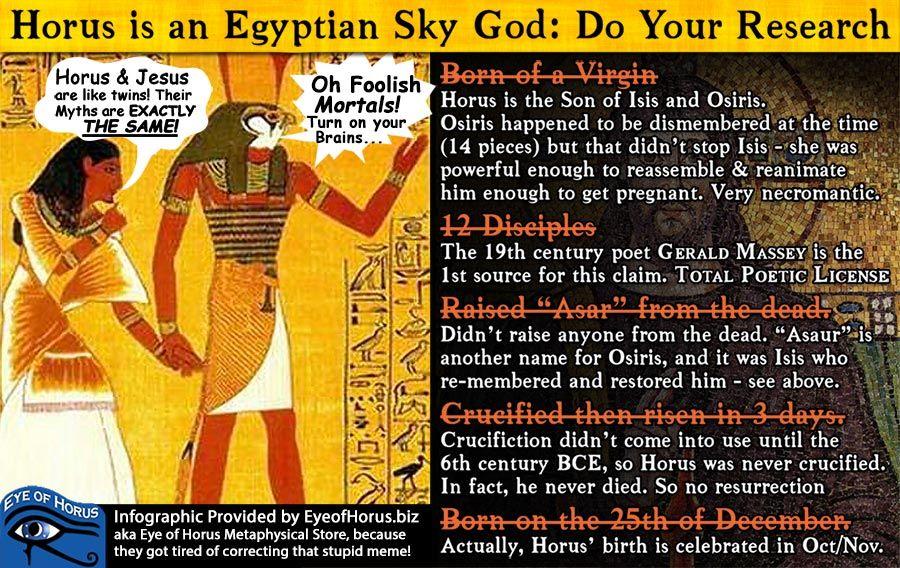
Horus, Jesus, and Egyptian Mythology: Separating Fact from Fiction
Posted by Luke J. Wilson on 22nd April 2023 in Mythology | Jesus,Horus,egyptian gods,mythology,Egyptian myths,apologetics
...esus, who had twelve disciples, there is no evidence in ancient Egyptian mythology that suggests Horus had a group of close followers or apostles. Instead, Horus was worshipped by the people of ancient Egypt, and the pharaohs considered themselves to be the embodiment of Horus on Earth. This connection between Horus and the pharaohs should not be mistaken for having disciples in the same way that Jesus did, since no one literally followed Horus and he didn’t teach anybody.
The idea of Horus having disciples is likely a modern reinterpretation of Egyptian mythology, influenced by false parallels drawn between Horus and Jesus.
The Death and Resurrection of Hor...
Powered by WebBoss.io 3.7.1
Copyright © 2026 The Sacred Faith: Timeless Truths for Modern Minds. All Rights Reserved.
