
Blog Search Results


67 results for human
found
within the Blog
6 displayed out of 67 (0.03seconds)Page 4 of 12
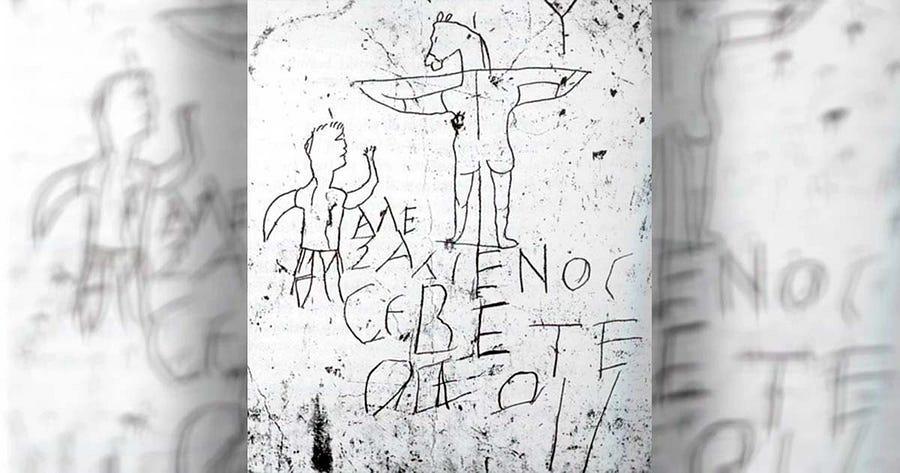
The World's Oldest Anti-Christian Meme
Posted by Luke J. Wilson on 9th March 2026 in Archaeology | Alexamenos graffito,archaeology,history
...iser than human wisdom, and the weakness of God is stronger than human strength” (1 Corinthians 1:25). The cross isn’t an unfortunate PR problem to be managed. It is, Paul insists, the very power of God. The thing that looks like weakness is the hinge of all of history.
That’s a scandalous claim. It was scandalous then, and still is even today for many people.
The Bit I Didn’t Know
Here’s where it gets really interesting. In another room of the same building, someone else by a different hand, a different ‘pen’, scratched their own inscription. In a mixture of Greek and Latin, it reads:
ΑΛΕΞΑΜΕΝΟϹ FIDELIS
Alexamenos is faithful. O...
A Prayer You Can Hold: A Maker’s Reflection on Beads, Scripture and Attention
Posted by Guest Author on 31st July 2026 in Prayer | guest post,prayer,faith,devotional
...recurring human instinct to give devotion rhythm and weight—to let the body help the mind and heart remain present.
For a Christian, however, that instinct is gathered into a particular faith—the faith confessed in the creeds. Our prayer is addressed to the God made known as Father, Son and Holy Spirit. It is shaped by Scripture and centred on Jesus Christ, the Word made flesh, crucified and risen. Prayer beads do not broaden that confession into something less definite. At their best, they help us stay with it.
A faith that takes flesh seriously
Christian prayer is never only an activity of the mind. We speak and sing. We stand, kneel and bow. We fold ou...
Lent: Day 15 - Justin Martyr: First Apology, Chaps. 36-47
Posted by Luke J. Wilson on 17th March 2017 in Lent | Lent,great lent,fasting,early church fathers,devotional,daily reading,Justin Martyr,apologetics
...nless the human race have the power of avoiding evil and choosing good by free choice, they are not accountable for their actions
He goes on to make the argument that if fate decides how people act, then it is fate which is the cause of evil, and not people, and this is not how God has made mankind to be. To borrow from the terminology of “fate”, Justin makes one final point that there is one thing in which the Christians “assert is inevitable fate” – that those who choose good, will be rewarded, and those who choose evil will be punished. By this, prophecy is not nullified by free will, and free will is not overcome by prophecy, but that all which...
Lent Day 28: Athanasius: Life of Anthony: Chaps. 71-80
Posted by Luke J. Wilson on 1st April 2017 in Lent | Lent,great lent,fasting,early church fathers,devotional,daily reading,Athanasius,Bishop of Alexandria,Confessor,Doctor of the Church,Anthony the Great,miracles,Greek Philosophy,demons,healing,deliverance,the cross,foolishness of the cross
...He took a human body for the salvation and well-being of man, that having shared in human birth He might make man partake in the divine and spiritual nature; or to liken the divine to senseless animals and consequently to worship four-footed beasts, creeping things and the likenesses of men? For these things, are the objects of reverence of you wise men. But how do you dare to mock us, who say that Christ has appeared as man...
He goes on to say that they talk endlessly about “the wanderings of Osiris and Isis, the plots of Typhon, the flight of Cronos, his eating his children and the slaughter of his father” as their form of wisdom, yet mock the cross...
Lent Day 36: Ambrose of Milan: Concerning the Mysteries: 5-9
Posted by Luke J. Wilson on 11th April 2017 in Lent | Lent,great lent,fasting,early church fathers,devotional,daily reading,Doctor of the Church,lectures,liturgy,catechism,Eucharist,Bishop of Milan,St Ambrose,mysteries,treatise,baptism,transubstantiation,real presence
..., nor the human heart conceived, what God has prepared for those who love him” (1 Cor 2:9), for the invisible things of God cannot be comprehended by the human mind.
As “water flowed from the rock” for the people of old (Num 20:11), Ambrose says, now “for you Blood flowed from Christ” – that water only satisfied them for a short time, the now the Blood of Christ satisfies us for all eternity; just as the Body of Christ is now far better than the manna, “for light is better than shadow” which these things prefigured.
Ambrose finishes of his lecture with a lengthy explanation about the Eucharist and how it really is the body and blood of Christ,...
American Gun Violence and the Early Church on War and Violence
Posted by Luke J. Wilson on 3rd October 2017 in Early Church | early church,early church fathers,gun violence,America,mass shooting
...d to take human life.”
— Cyprian ~250 AD
“The servants of God do not rely for their protection on material defenses but on the pine Providence.”
— Ambrose 338-397 AD
I don't have an answer to this cultural problem, and I'm not sure we can ever fully solve the issues of gun violence in the States now; but one thing that I do know is this: the Church in America needs to repent of its idolatry of guns, turn back to God and focus on the love of Christ again, and not on the weapons of destruction.
Even if the rest of society clings to their guns, the Church should be the ones clinging to the Prince of Peace instead, and rejecting anything tha...
Powered by WebBoss.io 3.7.1
Copyright © 2026 The Sacred Faith: Timeless Truths for Modern Minds. All Rights Reserved.
