
Blog Search Results


93 results for book
found
within the Blog
6 displayed out of 93 (0.04seconds)Page 8 of 16

Unveiling the Trinity: Exploring the Nature of Jesus and the Incarnation
Posted by Luke J. Wilson on 4th November 2023 in Trinity | trinity,incarnation,two powers in heaven
...d, in the book of Daniel, we encounter Messianic visions that describe the Son of Man, who is granted authority and a kingdom similar to God's own. This foreshadows the incarnation and the fulfilment of Daniel's vision.
Daniel 7:13-14
"I continued watching in the night visions,
and I saw One like a son of man
coming with the clouds of heaven.
He approached the Ancient of Days
and was escorted before Him.
He was given authority to rule,
and glory, and a kingdom;
so that those of every people,
nation, and language
should serve Him.
His dominion is an everlasting dominion
that will not pass away,
and His kingdom is one
that will not be destroyed."...
Scientist Uncovers Hidden 1,750-Year-Old New Testament Translation with Ultraviolet Imaging
Posted by Luke J. Wilson on 17th April 2023 in Archaeology | Syriac bible,Codex Sinaiticus,textual criticism,history,archaeology,Old Syriac
...he Gospel book was undoubtedly created no later than the sixth century. Comparisons with dated Syriac manuscripts help narrow the time frame to the first half of the sixth century.
An OeAW statement released earlier this month reveals that the text was created in the third century and replicated in the sixth century. Over a millennium ago, an ancient Israeli scribe erased a Syriac Gospel book to repurpose it, since parchment was a rare resource in the desert during the Middle Ages and frequently reused.
Kessel explains that Syriac Christianity encompasses multiple translations of the Old and New Testaments. Until recently, only two manuscripts containing the O...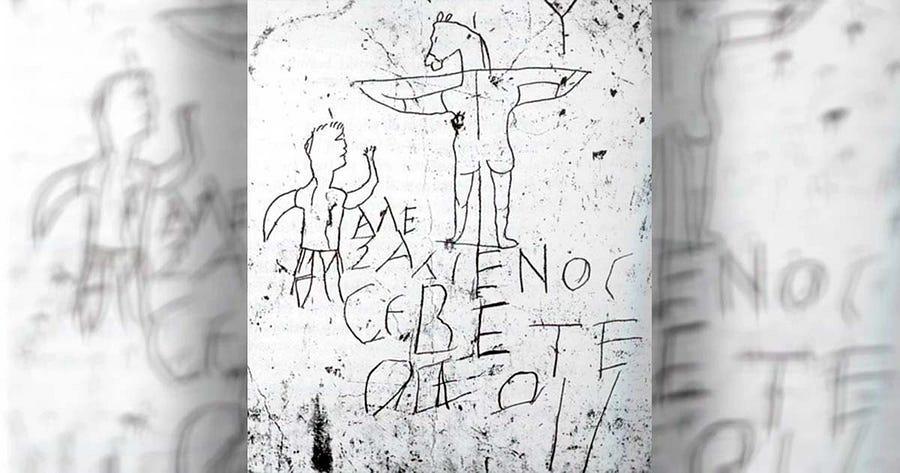
The World's Oldest Anti-Christian Meme
Posted by Luke J. Wilson on 9th March 2026 in Archaeology | Alexamenos graffito,archaeology,history
...holding a book, with donkey’s ears and hooves. It was labelled Onokoitēs by the pagans: “the donkey-begotten” (or literally “he who lies in an ass’s manger” as an insult to Christ). Tertullian writes about it with weary exasperation, sarcasm, and the tone of someone tired of having to address the same ridiculous smear again and again.
So the Alexamenos graffito wasn’t an original insult. It was someone deploying a culturally loaded shorthand that the entire Roman world already recognised. Which, if anything, makes it more historically significant — it shows us that these slurs weren’t confined to philosophical treatises or literary debate...
The Author of Life Knew Death For Our Sake!
Posted by Luke J. Wilson on 25th March 2016 in Easter | Easter,Good Friday,Holy Week,crucifixion,resurrection,reconcilliation
...A week or so ago, I stayed the night at a local monastery with a friend. We got to see, and be partially involved in the day to day life of the Monks there, especially during mealtimes. We sat and ate in silence together while someone read to us, which was actually more enjoyable than I expected it to be. I can't remember what the book was called now, but it was to do with the Passion and what the crucifixion meant, and the point they were reading about was when the Roman soldier stabbed Jesus in the side.
This is where it got interesting and gave me something to think about that I'd never heard taught before. Normally most preachers and sermons talk about the...
Immanuel, God with us
Posted by Luke J. Wilson on 19th December 2016 in Christmas | christmas,xmas,nativity,book,David H. Petersen,author,God With Us,Immanuel,Bethlehem,house of bread,bread of life
...d With Us book cover
It also just occurred to me whilst I was writing this, that the Bread of Life was born in the House of Bread — the literal meaning of Bethlehem!
I never saw the connection before.
Also, as a final note, here's an interesting article on the prophetic fulfilment of Bethlehem too, for your spiritual nourishment: Bethlehem: House of Bread. Enjoy!
John 6:35
Jesus said to them, “I am the bread of life. Whoever comes to me will never be hungry, and whoever believes in me will never be thirsty.
Have a good Christmas ...
Spiritual Disciplines of the Early Church: Ancient Practices for the 21st Century
Posted by Luke J. Wilson on 17th June 2019 in Early Church |
...ding this book by Abbot Christopher Jamison, Finding Sanctuary: Monastic steps for Everyday Life.
Constant Prayer
Keeping within the monastic tradition for spiritual disciplines are Prayer Ropes.
Prayer ropes, like Rosaries, are simply a tool to help keep you focused in prayer. The traditional ropes, often found more in the Eastern tradition of the faith, have knots in the shape of small crosses on them all around, and you simply run the rope between your fingers and thumb praying as you come to each knot (or bead). If specific prayer is difficult or you don’t know what to say, there’s the Lord’s Prayer of course, or a very simple ancient prayer cal...
Powered by WebBoss.io 3.7.1
Copyright © 2026 The Sacred Faith: Timeless Truths for Modern Minds. All Rights Reserved.
