
Blog Search Results


72 results for last supper
found
within the Blog
6 displayed out of 72 (0.34seconds)Page 9 of 12

On the Feast of the Nativity, a sermon by Leo the Great
Posted by Luke J. Wilson on 22nd December 2018 in Christmas | nativity,christmas,xmas,leo the great,sermon
In the days leading up to Christmas, I wanted to share a sermon from a man known as Leo the Great (aka Pope Leo I), who was a Pope from 440-61 AD. He was one of the most significant and important men in Christian antiquity, as he tried to combat the heresies which seriously threatened church unity in the West, such as Pelagianism. This sermon of his about the incarnation of Christ and what it means for us has always stuck with me since I first read it last April when writing my own book on the Early Church Fathers.
It's not that long, so take the time to read it through and let the words sink in as we prepare for Christmas to remember and celebrate the birth...
Will the Real Heretics Please Stand Up (Book Review)
Posted by Luke J. Wilson on 30th January 2019 in Book Review | book review,Francis chan,David Bercot,early church,five stars
Straight off, this book will challenge you in your thinking and quite possibly in your practice and outworking of life as a Christian—especially if you are from an evangelical/Baptist/non-denominational background.
Will the Real HereticsPlease Stand Up
The book starts of taking you carefully through some of the practices and beliefs of the early church and those who knew the Apostles personally. It all feels very hopeful and like you're being led onward in a journey towards a certain goal, much of which I'm sure you'll find agreeable in what Bercot points out as discrepancies between early Christianity and today.
Then we get to a few points about the Re...
Does Jesus mean Hail Zeus?
Posted by Luke J. Wilson on 13th June 2016 in Etymology | apologetics,refuting nonsense,hail zeus,does Jesus mean Zeus,earth pig latin,etymology,linguistics
A meme doing the rounds on the internet
You may not have come across the image above before, or the similar variants of it, but it pops up on social media groups every so often. The underlying argument is quite ridiculous, but there does seem to be a sub-culture with Christianity which promotes this as fact quite vigorously. Having seen this get shared at least three times on Facebook in the last month, I decided to add a new category to the blog: Apologetics.
In here will be articles for defence of the faith, though sadly this particular one needs to be against those who are already meant to be a part of the same faith! But many people seem to accept...
The Eighth Day
Posted by Luke J. Wilson on 26th October 2016 in Eschatology | eighth day,early church,new creation,baptism,resurrection,eschatology,sabbath,Lord's Day,Festival of Booths
What is the “eighth day” you may ask; surely we know there are only seven days in a week!
But in ancient times, Sunday – which was also known as the first day of the week, was also referred to as the eighth day by Christians.
This day was considered a holy day from the earliest of times by Christians (despite some weak arguments that Constantine, or the Pope, “changed the Sabbath” some 400 years later), and this was because it was the day on which Christ rose from the dead!
I will make a beginning of the eighth day, that is, a beginning of another world. For that reason, also, we keep the eighth day with joyfulness, the day on which Jesus rose aga...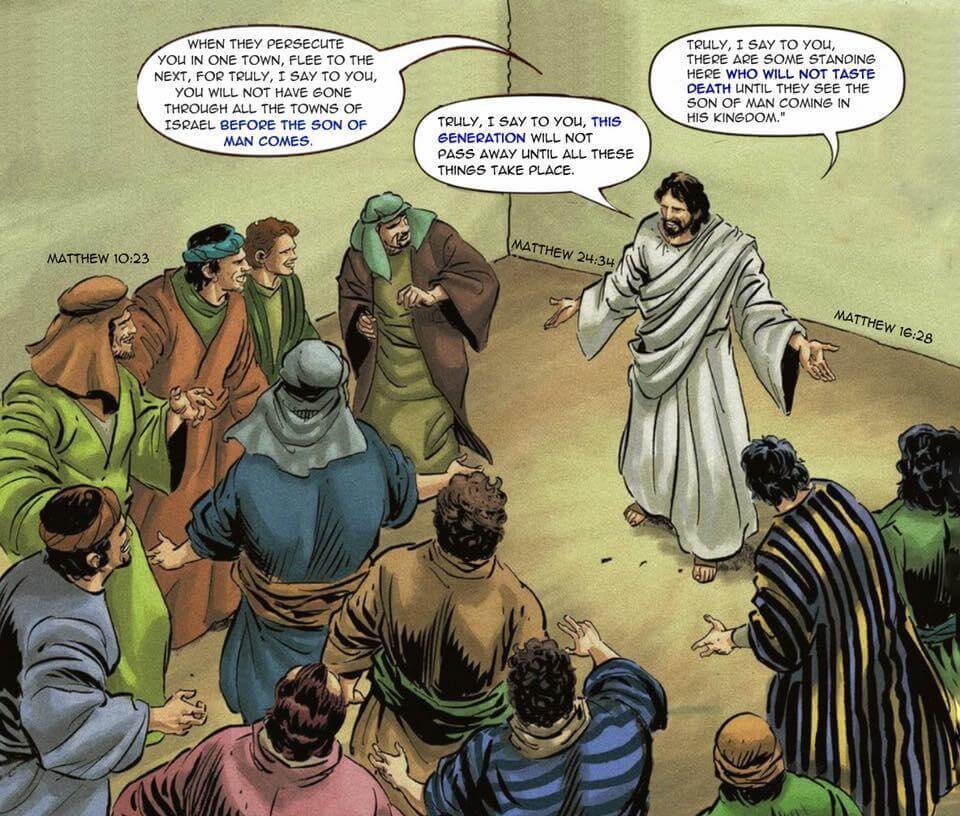
The Coming Kingdom of the Son of Man
Posted by Luke J. Wilson on 20th July 2016 in Eschatology | second coming,preterism,Kingdom of God,Coming kingdom,olivet discourse,Gospels,end times,end of the world,end of the age
The importance of context of what's being said, and to whom, in Scripture.
I came across this image the other day (in the header above; see larger here) that links together three parts of Matthew’s Gospel to highlight the connection which many often miss, or read as separate events. I like the image because it shows that when Jesus spoke these things, he would have been saying them directly to the disciples and others who were listening to his teaching, and not in some cryptic, ambiguous dictation to a prophetic scribe, devoid of all context and meaning to those around him at the time.
Update Feb 2017: I am adding some additional information to this to dis...
Lent, Lament and Lockdown
Posted by Luke J. Wilson on 3rd April 2020 in Coronavirus | lent,coronavirus,covid-19,lamentations,lament,lockdown
Lent is a time of self denial and of giving things up, and also a period of lament in the lead up to Easter where we remember the Passion and death of Christ before we celebrated the glorious resurrection.
Often this is a personal affair on the discipline side of things, even if it's a practice shared within your church community, but this year has been so very different. With the outbreak of the coronavirus, or COVID-19, the whole world has slowly gone into lockdown country by country, creating a strange sort of global “Lent” where everyone is having to practice self control and self denial. This has been underpinned with a sense of lament at the way thi...
Powered by WebBoss.io 3.7.1
Copyright © 2026 The Sacred Faith: Timeless Truths for Modern Minds. All Rights Reserved.
