
Blog Search Results


140 results for tribes people
found
within the Blog
6 displayed out of 140 (0.42seconds)Page 9 of 24
When did Christians become so whiny?
Posted by Luke J. Wilson on 25th April 2014 in Christianity | persecution, news, Christians, whiny, Google, homosexuality, Early Church, Love, Church Fathers
The Church is so whiny at times. At least in the West it seems, from the various news outlets which like to showcase the "worst" (and actual worst) of the bunch. Sometimes I read articles and wonder why do certain Christians care so much about this!? It's usually a non-issue really, often under the guise of "principles" or "persecution."
Now I realise that some of the articles I linked to above could also relate to serious issues that we, as Christians, should face and discuss. But even from a quick search on Huffington Post and the BBC News for "Christian", the majority of articles (as of writing) from America relate to homosexuality in some form, and for...
What does the word "Catholic" mean?
Posted by Luke J. Wilson on 8th March 2021 in Etymology | catholic,church fathers,church history,etymology,roman catholic,eastern orthodox,Great Schism,Muratorian Fragment
For many people today, non-Christians and (low church) Christians alike, when they hear the word “Catholic”, certain images spring to mind: the Pope, the rosery, Catholic school, big old churches buildings, choirboys, maybe monks or statues of Mary even; and sadly more recently, sex abuse scandals.
But, generally speaking, all of these are actually aspects of Roman Catholicism — a particular branch of Christianity, and not what the word “catholic” truly means as we’ll see when examining how the early church used the word and what the original Greek word means.
καθολικός (katholikos)
The Greek word where we get the English word “c...
Jesus Like You've Never Seen Before - Discoveries from Early Christian Art
Posted by Luke J. Wilson on 13th May 2023 in Archaeology | archaeology,icons,Jesus,history,historical
I recently made a video on TikTok about what Jesus looks like in religious art and icons across various cultures, showing that people see Jesus as relatable to them and their people groups, and thus often depict Jesus looking the same as their own race. There was a comment made claiming that the Christ Pantocrator icon is exactly what Jesus looked like, and thus all others are wrong. If you’re wondering about the icon name, Pantocrator (Greek: Παντοκράτωρ) literally means “ruler of all”, but usually gets translated as “Almighty” or “all-powerful”.
The oldest known icon of Christ Pantocrator,6th-century encaustic icon fromSaint Catheri...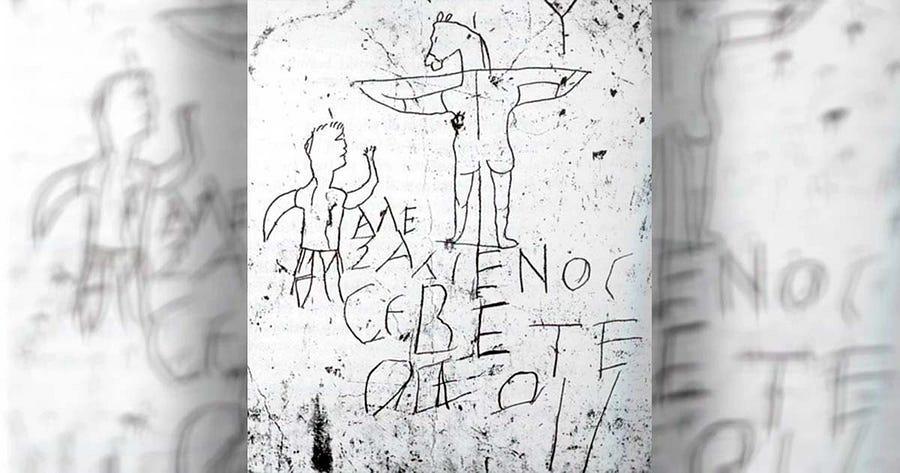
The World's Oldest Anti-Christian Meme
Posted by Luke J. Wilson on 9th March 2026 in Archaeology | Alexamenos graffito,archaeology,history
I first came across the Alexamenos graffito back in Bible college in the early 2000s. It was one of those “fun facts” that gets dropped into a church history lecture and sticks with you — the ancient Roman equivalent of someone spray-painting an insult on a wall. I filed it away, thought it was fascinating, and largely forgot about it for two decades.
Then, recently, I discovered something about it I had never known. There’s a response to it. Scratched in a different room, in a different hand.
So I started digging into this more to verify the information and discovered more historical curiosities surrounding the graffiti than I ever knew existed wh...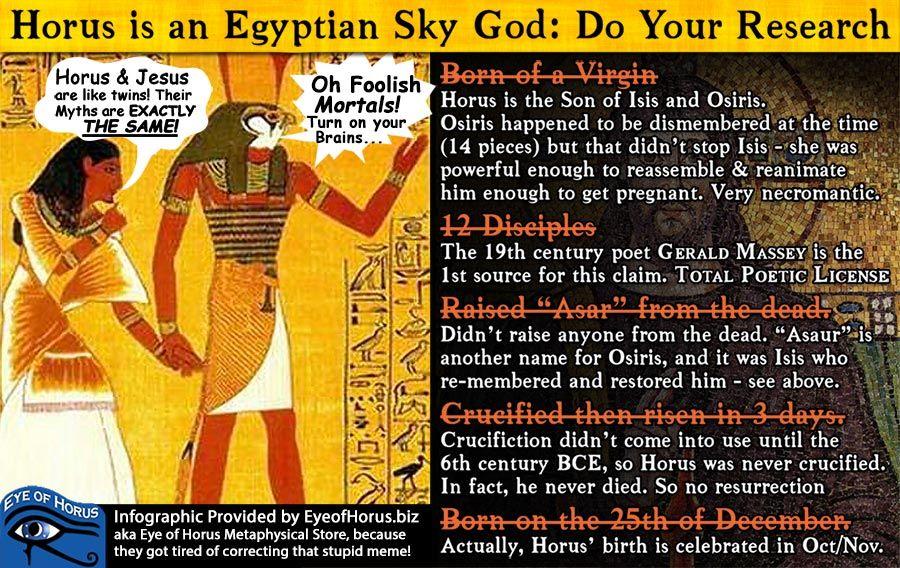
Horus, Jesus, and Egyptian Mythology: Separating Fact from Fiction
Posted by Luke J. Wilson on 22nd April 2023 in Mythology | Jesus,Horus,egyptian gods,mythology,Egyptian myths,apologetics
If you've ever found yourself immersed in the world of ancient Egyptian mythology or perhaps watching a documentary on the subject (or even just browsing social media around Christmas time), you might have come across the claim that the story of Jesus shares striking similarities with the story of Horus, an ancient Egyptian deity.
While it might seem convincing at first that there's a direct connection between the two, it's essential to understand that the similarities are often exaggerated in popular culture, and many scholars consider them vastly different. In this article, we'll explore the life of Horus, his birth, the miracles he performed, and the truth b...
Was Jesus worshipped in the New Testament?
Posted by Luke J. Wilson on 14th November 2023 in Worship | jesus,incarnation,worship,muslim,islam,islam vs christianity,Pliny the Younger
Often a claim from critics of the faith, and especially Muslims arguing against Christianity, is that Jesus wasn't thought of as God early on and more to the point, wasn't ever worshipped in the accounts of the New Testament.
This is a very cursory look at a few places within the Gospels where Jesus was clearly worshipped, either by his followers or others he encountered, and didn't rebuke or correct people for doing something wrong.
Worshiping Jesus:
1. Matthew 14:33 - The Proclamation of Divinity
And those in the boat worshiped him, saying, “Truly you are the Son of God.”
In the aftermath of a storm on the Lake of Galilee which Jesus calmed with a...
Powered by WebBoss.io 3.7.1
Copyright © 2026 The Sacred Faith: Timeless Truths for Modern Minds. All Rights Reserved.
