
Blog Search Results


Did you mean:
old testament
?
126 results for Old Testament
found
within the Blog
6 displayed out of 126 (1.39seconds)Page 10 of 21

Lent Day 35: Ambrose of Milan: Concerning the Mysteries: 1-4
Posted by Luke J. Wilson on 10th April 2017 in Lent | Lent,great lent,fasting,early church fathers,devotional,daily reading,Doctor of the Church,lectures,liturgy,catechism,Eucharist,Bishop of Milan,St Ambrose,mysteries,treatise
...from the Old Testament, Ambrose makes a comparison to show how baptism was prefigured in various places throughout the Scriptures. On visiting the prophet and being tOld to dip in the river to cure his leprosy, Naaman refused at first until eventually he went ahead with and did it; and on coming up out of the waters cleansed and healed, he “understood that it is not of the waters but of grace that a man is cleansed”, Ambrose points out. And so it is with baptism; it is not the water that is anything special or “magical”, but it is purely by the grace of God alone by which we are cleansed of our sins through baptism, and given a clean conscience, as Pete...
Does Christmas have pagan origins?
Posted by Luke J. Wilson on 19th December 2019 in Christmas | christmas,xmas,origins,pagan,pagan roots,church fathers,church history,Saturnalia,Epiphany,Annunciation,Tertullian,Origen,john chrysostom,incarnation,liturgical calendar,church calendar,festivals
...For most people, the question of the origins of Christmas is probably far from their minds. Some may recognise and give a cursory glance towards the Biblical narrative on the birth of Jesus as something to do with it (although a 2017 study showed that almost 1 in 20 Brits thought Easter was the birth of Jesus!);—but in some Christian circles the question (accusation?) that “Christmas is pagan” is at the forefront of their minds.
Table of Contents
When was December 25th celebrated?
The Christian Calendar
Concluding Thoughts
Bonus Information
Further Reading & Sources:
As time goes on and we move further and further into the future,...
The Coming of Jesus: Introduction
Posted by Luke J. Wilson on 26th May 2014 in Second Coming Series | Second Coming,Return of Christ,Return of Jesus,Preterism,Prophecy,Last Days,Left Behind,Introduction
...in in the Old Testament, as the prophetic language used to describe similar events, and understanding that language, has huge impacts on how we understand what Jesus was saying when he spoke in a similar manner. Both Old and New Testaments are connected and can't be taken separately from one another when trying to understand the imagery used in the Gospels, Epistles and Revelation.
So, welcome! This is an introduction to a six/seven part series on this topic to give an overview of what I'll be looking at over the next few posts. I haven't got the structure completely down yet (so there may be other parts depending how each one goes), but I'm aiming to do s...
The Coming of Jesus: The Olivet Discourse – Part 1
Posted by Luke J. Wilson on 19th October 2014 in Second Coming Series | Second Coming,Return of Christ,Return of Jesus,Preterism,Prophecy,Last Days,Left Behind,Eschatology,Matthew 24,Olivet Discourse,birth pangs,Josephus,history
...Hello again, it's been a while since I've wrote anything, and longer since getting back to this series on the Second Coming of Jesus. This isn't for lack of motivation, but rather because this is such a huge topic that I've been reading and thinking about this next part for a very long time to make sure I know what I'm saying, and am well read enough to do the topic justice. Having said that, there will always be far more to say on this than I can give time for here, but I hope to give enough of an overview to expound this prophecy faithfully without being too technical as to cause confusion! You can also catch up on the previous parts...
The Coming of Jesus: Revelation Fulfilled?
Posted by Luke J. Wilson on 31st December 2015 in Second Coming Series | Revelation,Second Coming,Preterism,apocalypse,armageddon,fulfilled prophecy,Return of Christ,Return of Jesus,Eschatology
...vily from Old Testament prophetic writings. Not only that, but the believer’s it was addressed to were expected to understand this letter just by it being read to them in their churches, as we can see from Rev 1:3 –
Blessed is the one who reads aloud the words of the prophecy, and blessed are those who hear and who keep what is written in it; for the time is near.
And so, we must try to interpret it in the same manner that the original audience would have understood it, with all of the historical circumstances and context that they were living in and through. It might also be worth noting here, more for informations sake than anything, that Revelat...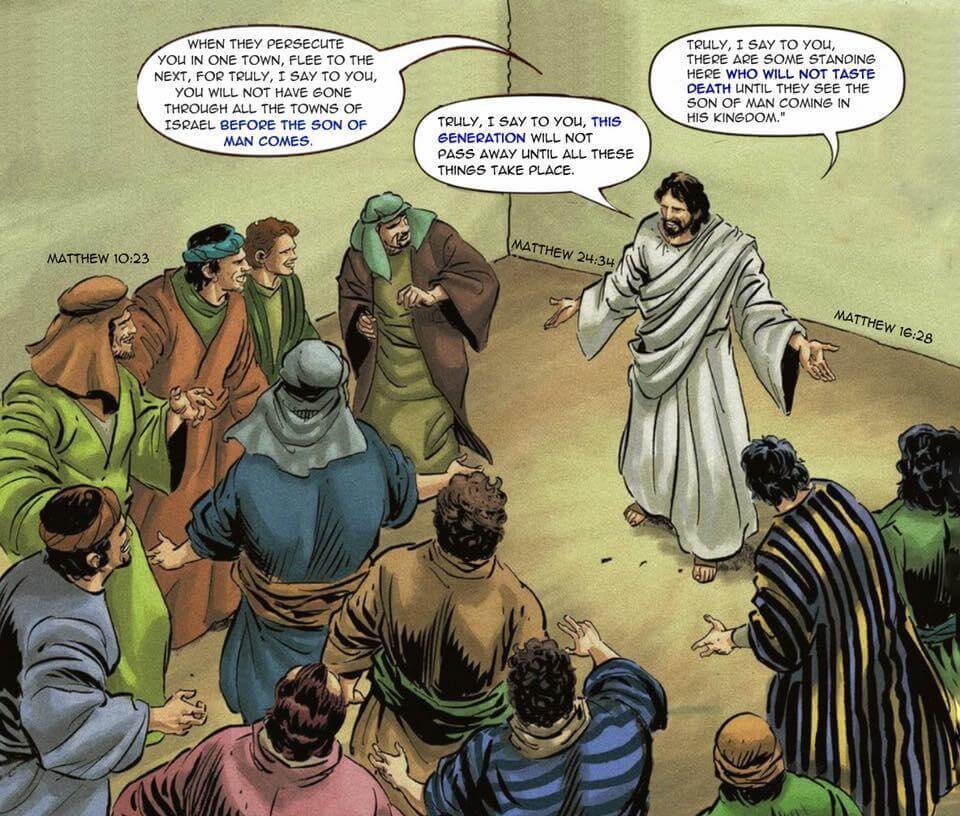
The Coming Kingdom of the Son of Man
Posted by Luke J. Wilson on 20th July 2016 in Eschatology | second coming,preterism,Kingdom of God,Coming kingdom,olivet discourse,Gospels,end times,end of the world,end of the age
...es in the Old Testament, often called the Day of the Lord. The same is true here, Jesus is once again teaching about the impending doom of Jerusalem as punishment. Hence the urgency towards his disciples to flee towns that won't listen and go to where they do accept the Gospel.
Matthew 24:34
Matthew 24:34
Matthew 24 is a similar conversation, but with some more details.
Whilst walking by the temple, the disciples point out the magnificence of the building, and Jesus responds by saying "Truly I tell you, not one stone will be left here upon another; all will be thrown down." (v.2)
So obviously, the disciples ask the poignant question: "Tell us, when...
Powered by WebBoss.io 3.7.1
Copyright © 2026 The Sacred Faith: Timeless Truths for Modern Minds. All Rights Reserved.
