
Blog Search Results


Did you mean:
left behind
?
84 results for Left Behind
found
within the Blog
6 displayed out of 84 (0.85seconds)Page 11 of 14

Ancient “curse” amulet drastically changes perspective on Biblical dating
Posted by Luke J. Wilson on 26th March 2022 in Archaeology | current events,archaeology,curse amulet,Jerusalem Post
On Thursday at ancient Shiloh, Dr. Scott Stripling, director of excavations for the Associates for Biblical Research (ABR), presented new findings which may well be one of the most significant discoveries in biblical archaeology in recent times!
More than thirty years ago, Prof. Adam Zertal discovered a small lead amulet, only two centimetres square, from wet-sifting material taken from an excavation on Mount Ebal. This came from a square altar dated from the 13th century BC, which had been built on top of an older and circular altar. Prof. Zertal believed this was the same altar Joshua built when he entered the land of Israel:
Josh. 8:30Then Joshua built on M...
Why Read The Early Church Fathers?
Posted by Luke J. Wilson on 8th December 2017 in Early Church | church history,daily devotional,daily reading,early church,early church fathers,new book,amazon
Why read the Early Church Fathers?
Maybe for some of you reading this, the question might better be phrased as: who are the Church Fathers?
No doubt you will be familiar with some of their names: Augustine, Jerome, Clement, Ignatius, Polycarp, Justin Martyr et al. You may have even read portions or quotes by some of these men. But that still doesn't really explain to you who they are and why you should care, much less actually read any of their works.
My new book deals with a selection of some of the most influential Early Church Fathers, sometimes also referred to as the Apostolic Fathers (if they lived between AD 70-150), or collectively as the Ante Nicene...
Humble without the #hashtag
Posted by Luke J. Wilson on 6th November 2015 in Christianity | Christmas,Starbucks,Joshua Feuerstein,red cups,Xmas cups,holiday cups,Jesus,feed the homeless,feed the hungry,hashtag,humble,merrychristmasstarbucks
As much as it a pains me to give this guy any more exposure, sometimes you need to in order to expose something.
First, you need to watch the latest video from Joshua Feuerstein to understand what I'm talking about here:
I do this not to further his “cause” or “movement” but rather to counteract it. Mainly with something more practical, but hopefully also with more common sense too.
It's things like this that give Christianity a bad name. I mean really, is this really what Christians should be worried about? Why not do something more useful like feed the homeless and start a movement that'll actually benefit society AND do something Jesus...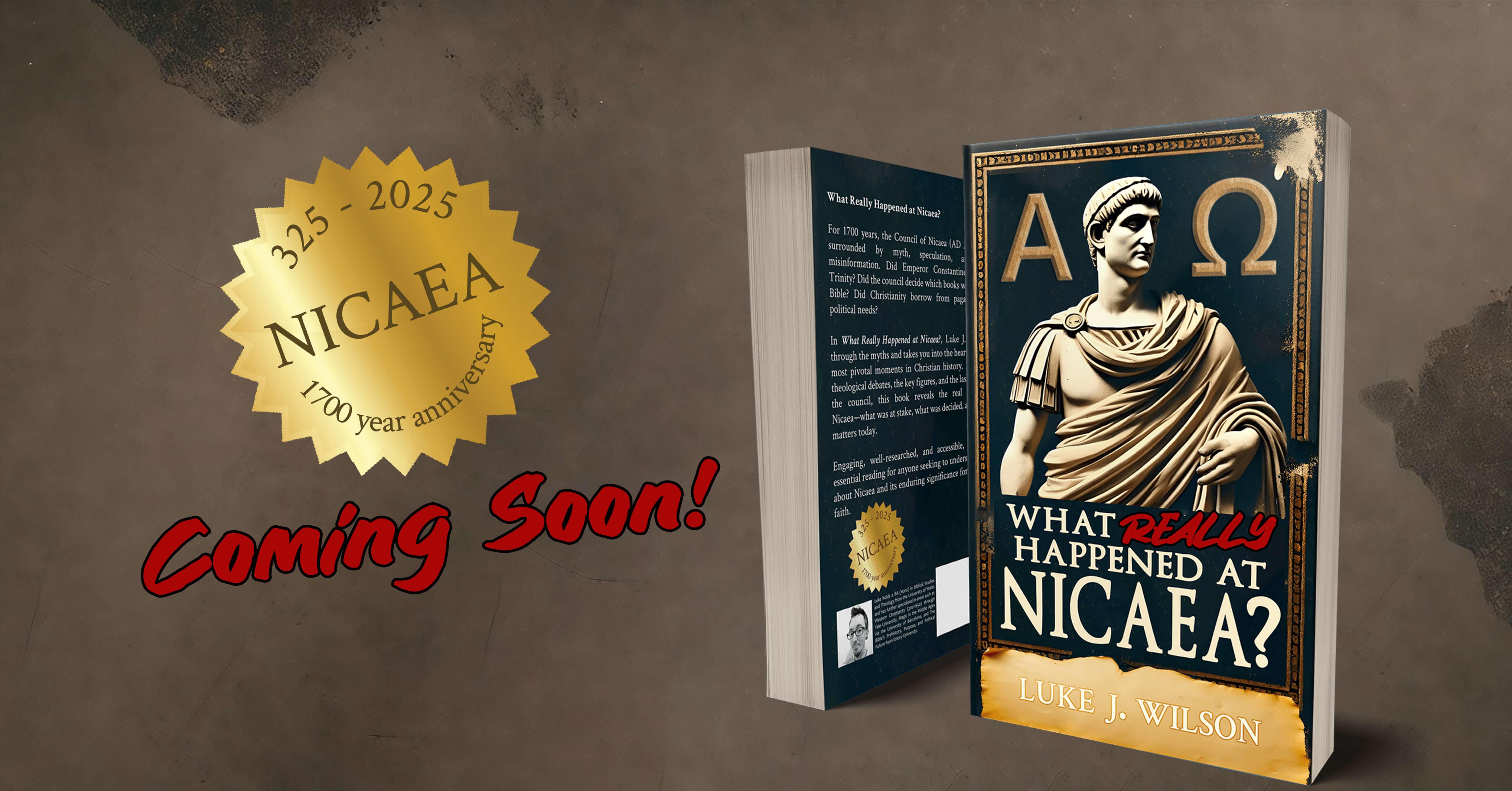
Announcing My New Book: What Really Happened at Nicaea?
Posted by Luke J. Wilson on 23rd February 2025 in Book Release | nicene council,nicene creed,controversy,constantine,book release
For 1700 years, the Council of Nicaea has been surrounded by myths, misunderstandings, and outright fabrications. From claims that Constantine “invented” the Trinity to the idea that the council decided the books of the Bible, there’s no shortage of misinformation floating around.
That’s why I’m excited to announce my upcoming book, What Really Happened at Nicaea? This book sets the record straight, taking you inside the actual events of 325 AD—what was debated, what was decided, and why it still matters today.
If you’ve ever wondered:✅ Did Constantine rewrite Christianity?✅ Was Jesus’ divinity really up for debate?✅ Did Nicaea creat...
What is Truth?
Posted by Luke J. Wilson on 29th July 2026 in Faith & Reason | truth,incarnation,pilate,philosophy,theology
��Pilate asked him, ‘What is truth?’ (John 18:38)
What is “truth”? A question famously asked by Pilate to Jesus during his trial. Ironically, Pilate was speaking to the embodiment of Truth itself.
John 14:6Jesus said to him, ‘I am the way, and the truth, and the life.’
Here’s a little ‘riddle’ to think about while you read this; see if you agree or not: “all truth is fact, but not all facts are truth”. I’ll explain it at the end if you’re confused.
Jesus is the ultimate Truth, but in a world and society that is becoming increasingly more relative, how do we test the truth and know what’s real or not? Especially with the su...
Does Jesus mean Hail Zeus?
Posted by Luke J. Wilson on 13th June 2016 in Etymology | apologetics,refuting nonsense,hail zeus,does Jesus mean Zeus,earth pig latin,etymology,linguistics
A meme doing the rounds on the internet
You may not have come across the image above before, or the similar variants of it, but it pops up on social media groups every so often. The underlying argument is quite ridiculous, but there does seem to be a sub-culture with Christianity which promotes this as fact quite vigorously. Having seen this get shared at least three times on Facebook in the last month, I decided to add a new category to the blog: Apologetics.
In here will be articles for defence of the faith, though sadly this particular one needs to be against those who are already meant to be a part of the same faith! But many people seem to accept...
Powered by WebBoss.io 3.7.1
Copyright © 2026 The Sacred Faith: Timeless Truths for Modern Minds. All Rights Reserved.
