
Blog Search Results


93 results for history
found
within the Blog
6 displayed out of 93 (0.05seconds)Page 11 of 16

Why Read The Early Church Fathers?
Posted by Luke J. Wilson on 8th December 2017 in Early Church | church history,daily devotional,daily reading,early church,early church fathers,new book,amazon
Why read the Early Church Fathers?
Maybe for some of you reading this, the question might better be phrased as: who are the Church Fathers?
No doubt you will be familiar with some of their names: Augustine, Jerome, Clement, Ignatius, Polycarp, Justin Martyr et al. You may have even read portions or quotes by some of these men. But that still doesn't really explain to you who they are and why you should care, much less actually read any of their works.
My new book deals with a selection of some of the most influential Early Church Fathers, sometimes also referred to as the Apostolic Fathers (if they lived between AD 70-150), or collectively as the Ante Nicene...When did Christians become so whiny?
Posted by Luke J. Wilson on 25th April 2014 in Christianity | persecution, news, Christians, whiny, Google, homosexuality, Early Church, Love, Church Fathers
...ch/church-history/timeline/1-300/what-were-early-christians-like-11629560.html
http://www.originalchristianity.net/?p=2333...
Who is the New Jerusalem?
Posted by Luke J. Wilson on 6th January 2016 in Second Coming Series | Revelation,New Jerusalem,The Church,Holy City,Early Church,Early Church Fathers,Eusebius,Origen,Barnabas,millennium,millennial reign,1000 years,New Heaven and Earth
...of world history after the judgement, second death, sheep and goats etc (in other words – there’s no one left except for God’s own people), why then do the nations still need healing?
Secondly, and maybe the most striking detail, is the mention that there will no longer be any curse. All throughout Scripture, there is one main thing which is always referred to as a “curse” – death (sometimes also synonymous with sin). And that is precisely what Jesus liberated us from by his own death on a cross!
Galatians 3:13
Christ has redeemed us from the curse of the Law by becoming a curse for us
While I recognise that the general (and possibly...
The Coming of Jesus: Our Future Hope - What Now?
Posted by Luke J. Wilson on 22nd January 2016 in Second Coming Series | second coming,70 weeks,70ad,what now?,what next,preterism,fulfilled prophecy,eighth day
...Christian history, the millennium came to be viewed as metaphorical of spiritual realities, and the earlier views pertaining to 70 AD were forgotten it seems. Futurism crept in in later centuries or so, but was roundly condemned by some prominent early Christian leaders of the time. It came up again shortly after the Reformation in the 1500s as Rome tried to defer Protestant claims of the Pope being the antichrist, but It only really made a comeback in the Church in recent history in the 1800s through the teaching of Darby and Scofield.
From all this though, I can no longer accept full futurism as a valid doctrine of “end times”. I'm open to the histori...
What does the word "Catholic" mean?
Posted by Luke J. Wilson on 8th March 2021 in Etymology | catholic,church fathers,church history,etymology,roman catholic,eastern orthodox,Great Schism,Muratorian Fragment
...very wide history with a lot of nuances, and although the Roman Church has laid claim to the name, it is certainly not it’s only meaning or definition. Some qualification of terms is often needed (or should be) when speaking to Christians of various denominational backgrounds, in order to help people to see the wider, and more historical context, of the “one holy, catholic and apostolic Church”.
Footnotes
[1] The Greek words which make up our English word “universal” in this sense, had been around as a concept in Greek long before Christianity. Aristotle (d. 322 B.C.) wrote in this On Interpretation, 17a: “I call universal (καθόλ...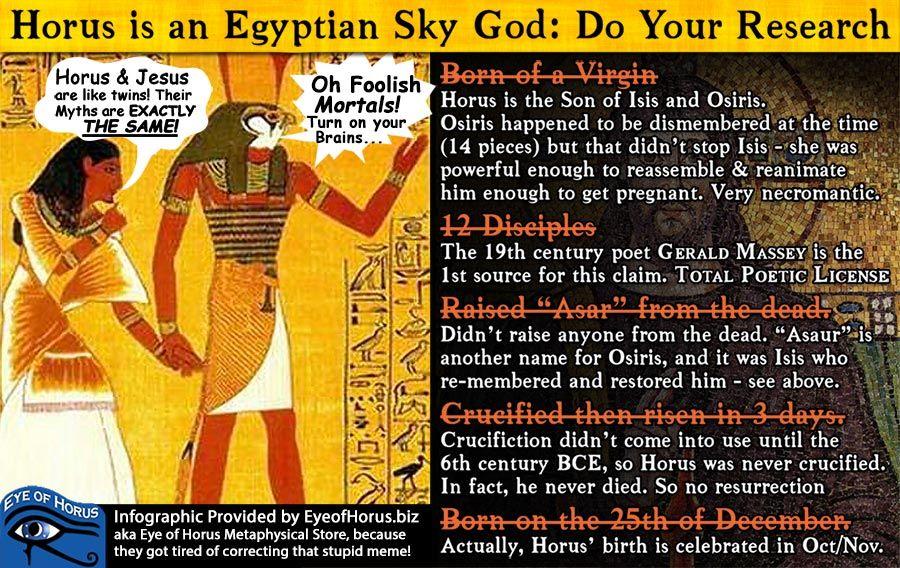
Horus, Jesus, and Egyptian Mythology: Separating Fact from Fiction
Posted by Luke J. Wilson on 22nd April 2023 in Mythology | Jesus,Horus,egyptian gods,mythology,Egyptian myths,apologetics
...If you've ever found yourself immersed in the world of ancient Egyptian mythology or perhaps watching a documentary on the subject (or even just browsing social media around Christmas time), you might have come across the claim that the story of Jesus shares striking similarities with the story of Horus, an ancient Egyptian deity.
While it might seem convincing at first that there's a direct connection between the two, it's essential to understand that the similarities are often exaggerated in popular culture, and many scholars consider them vastly different. In this article, we'll explore the life of Horus, his birth, the miracles he performed, and the truth b...
Powered by WebBoss.io 3.7.1
Copyright © 2026 The Sacred Faith: Timeless Truths for Modern Minds. All Rights Reserved.
