
Blog Search Results


210 results for early church fathers
found
within the Blog
6 displayed out of 210 (0.87seconds)Page 12 of 35
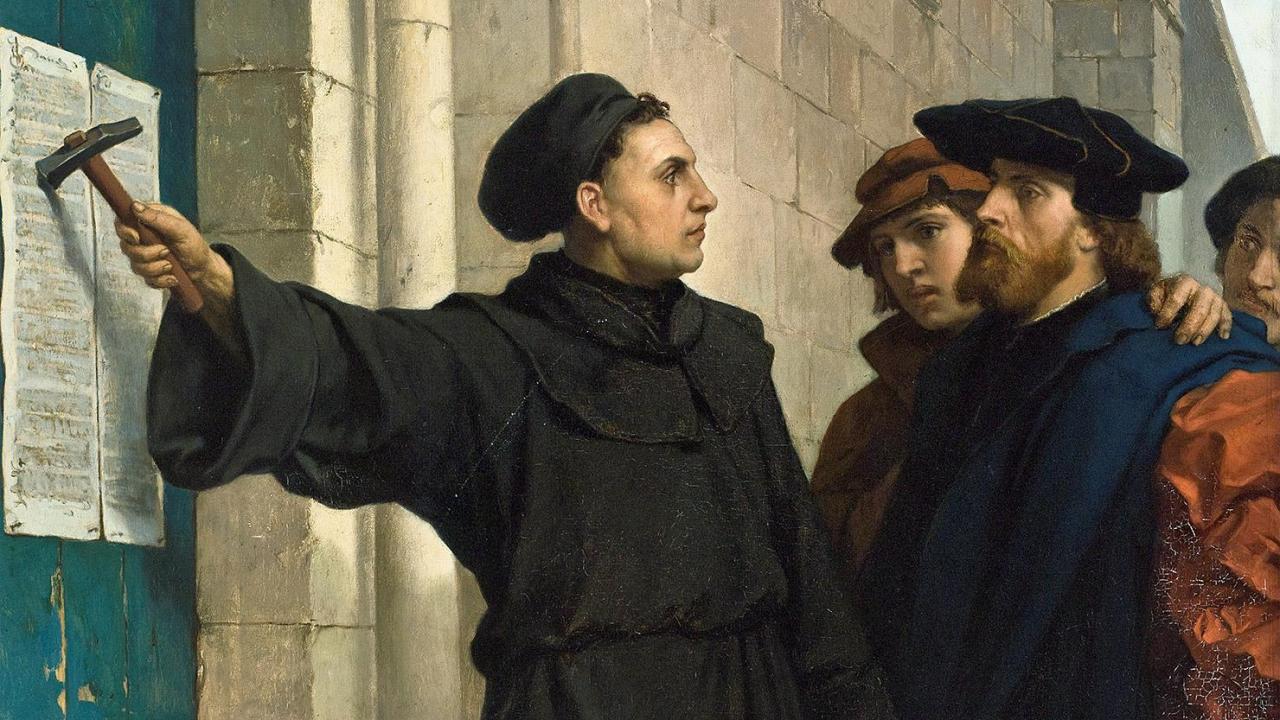
Nails, Theses, and Myth: The Truth About Luther's Famous Door
Posted by Luke J. Wilson on 5th June 2025 in Blogging | reformation,Luther,Protestantism,roman catholic
As we commemorated the 500th anniversary of the Protestant Reformation this year, the familiar image of Martin Luther striding up to the church door in Wittenberg — hammer in hand and fire in his eyes — has once again taken centre stage. It’s a compelling picture, etched into the imagination of many. But as is often the case with historical legends, closer scrutiny tells a far more nuanced and thought-provoking story.
The Myth of the Door: Was the Hammer Ever Raised?
Cambridge Reformation scholar Richard Rex is one among several historians who have challenged the romanticised narrative. “Strangely,” he observes, “there’s almost n...
Women should be silent?
Posted by Luke J. Wilson on 8th April 2014 in Women | women,silence,1 Corinthians,1 Timothy,authority,doctrine,marriage
1 Timothy 2:12 - "I permit no woman to teach or to have authority over a man; she is to keep silent."
Here's an often tricky subject, depending on who you speak to about it.
Before I begin, it should be noted here that these words ("woman" and "man") could also be translated as "wife" and "husband", which then changes the thrust of this command quite drastically.
This verse, and others similar, are often taken by people to mean that it only applies in a church setting (ignoring the fact that we are the church - 1 Cor 12:27; Rom 12:5). A little while ago when discussing this topic, an argument was put forth about the 'Woman at the Well' preaching to other...
Lent Day 33: Cyril of Jerusalem: Catechetical Lectures: Lecture XXII
Posted by Luke J. Wilson on 7th April 2017 in Lent | Lent,great lent,fasting,early church fathers,devotional,daily reading,Doctor of the church,lectures,liturgy,catechism,Bishop of Jerusalem,Eucharist,Communion,Real Presence,Transubstantiation
Day Thirty-three: St. Cyril of Jerusalem: Catechetical Lectures: Lecture XXII
Who: Bishop of Jerusalem and Doctor of the church, born about 315; died probably 18 March, 386. Little is known of his life, except from his younger contemporaries, Epiphanius, Jerome, and Rufinus, as well as from the fifth-century historians, Socrates, Sozomen and Theodoret.
What: Each of the lectures deal with a different topic to teach converts the mysteries of the church, particularly: rites of the renunciation of Satan and his works, of anointing with oil, of baptism, of anointing with the holy chrism, and of partaking of the body and blood of Christ.
Why: Cyril delivered to ne...
The Historic Practice of Abortion and How Ancient Christians Responded
Posted by Luke J. Wilson on 1st July 2022 in Abortion | abortion,roe v wade,church history,current events,theology,politics,Why Are Christians Against Abortion?
It’s no secret that the majority of Christians are against abortion, no matter where you look in the world. But nowhere has the issue come to more of a head than in the US recently with the overturning of Roe v Wade, which had made abortion legal across the country. Now abortion is no longer a federal constitutional right, but individual states now have the authority to determine the legality and rulings around abortion.
Christian opposition to abortion in America has always been a heated topic, especially in recent decades, but this isn’t a novelty within the church in America, or globally, and has been a position of the faithful for about 2000 years. Even...
The Eighth Day
Posted by Luke J. Wilson on 26th October 2016 in Eschatology | eighth day,early church,new creation,baptism,resurrection,eschatology,sabbath,Lord's Day,Festival of Booths
What is the “eighth day” you may ask; surely we know there are only seven days in a week!
But in ancient times, Sunday – which was also known as the first day of the week, was also referred to as the eighth day by Christians.
This day was considered a holy day from the earliest of times by Christians (despite some weak arguments that Constantine, or the Pope, “changed the Sabbath” some 400 years later), and this was because it was the day on which Christ rose from the dead!
I will make a beginning of the eighth day, that is, a beginning of another world. For that reason, also, we keep the eighth day with joyfulness, the day on which Jesus rose aga...
A Historic Easter Change Is Coming — But Will Protestants Get On Board?
Posted by Luke J. Wilson on 29th January 2025 in Easter | current events,easter,history,ecumenical,roman catholic,eastern orthodox,Anglican
Pope Francis has recently expressed the Catholic church’s willingness to accept a unified date for Easter, a move aimed at fostering greater Christian unity, particularly with the Orthodox church. This long-standing issue arises from the different calendars used by Western and Eastern Christian traditions — the Gregorian and Julian calendars — leading to discrepancies in Easter celebrations. Talks between Catholic and Orthodox leaders have intensified, hoping a common date could be agreed upon. However, this raises important questions for Protestant denominations regarding whether they would adopt the unified date or risk falling out of alignment w...
Powered by WebBoss.io 3.7.1
Copyright © 2026 The Sacred Faith: Timeless Truths for Modern Minds. All Rights Reserved.
