Support via Patreon | Subscribe

Nails, Theses, and Myth: The Truth About Luther's Famous Door

Header Image for: Nails, Theses, and Myth: The Truth About Luther's Famous Door
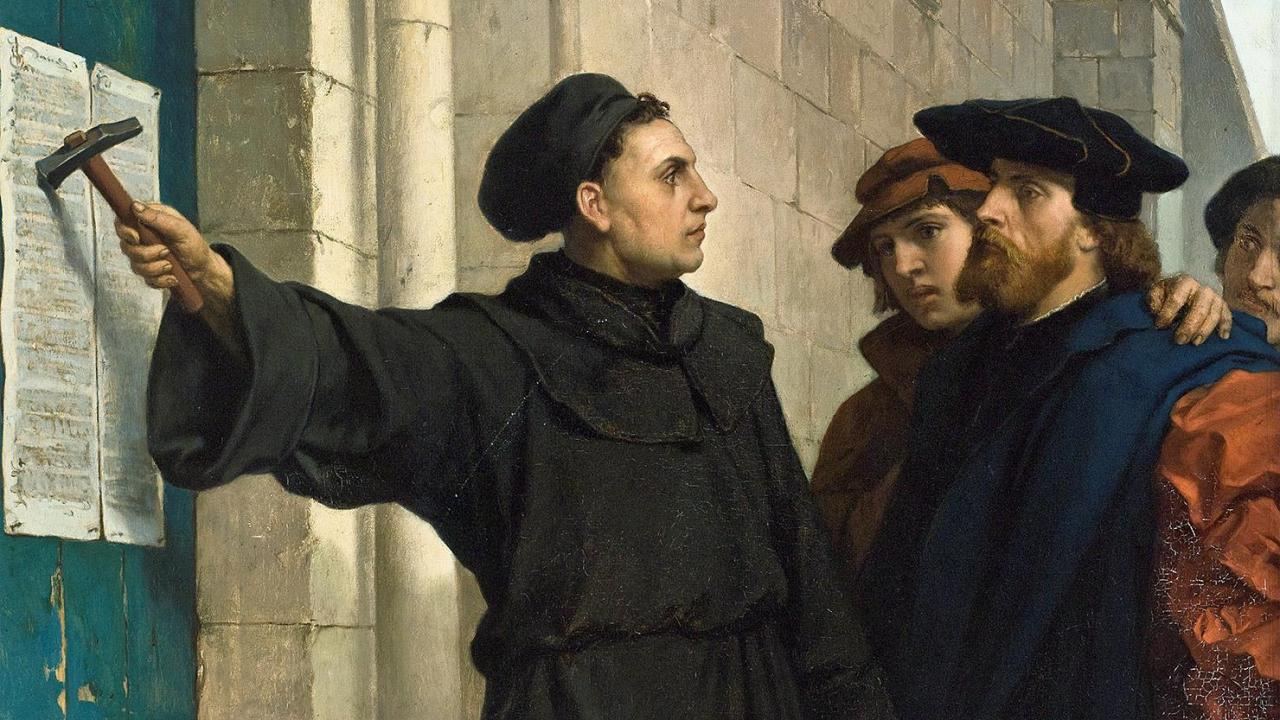
Header Image: Did Martin Luther really nail his 95 Theses to the church door?

As we commemorated the 500th anniversary of the Protestant Reformation this year, the familiar image of Martin Luther striding up to the church door in Wittenberg — hammer in hand and fire in his eyes — has once again taken centre stage. It’s a compelling picture, etched into the imagination of many. But as is often the case with historical legends, closer scrutiny tells a far more nuanced and thought-provoking story.

The Myth of the Door: Was the Hammer Ever Raised?

Cambridge Reformation scholar Richard Rex is one among several historians who have challenged the romanticised narrative. “Strangely,” he observes, “there’s almost no solid evidence that Luther actually went and nailed them to the church door that day, and ample reasons to doubt that he did.” Indeed, the first image of Luther hammering up his 95 Theses doesn’t appear until 1697 — over 180 years after the fact.

Eric Metaxas, in his recent biography of Luther, echoes Rex’s scepticism. The earliest confirmed action we can confidently attribute to Luther on 31 October 1517 is not an act of public defiance, but the posting of two private letters to bishops. The famous hammer-blow may never have sounded at all.

Conflicting Accounts

Philip Melanchthon, Luther’s successor and first biographer, adds another layer of complexity. He claimed Luther “publicly affixed” the Theses to the door of All Saints’ Church, but Melanchthon wasn’t even in Wittenberg at the time. Moreover, Luther himself never mentioned posting the Theses publicly, even when recalling the events years later. Instead, he consistently spoke of writing to the bishops, hoping the matter could be addressed internally.

At the time, it was common practice for a university disputation to be announced by posting theses on church doors using printed placards. But no Wittenberg-printed copies of the 95 Theses survive. And while university statutes did require notices to be posted on all church doors in the city, Melanchthon refers only to the Castle Church.

It’s plausible Luther may have posted the Theses later, perhaps in mid-November — but even that remains uncertain. What we do know is that the Theses were quickly circulated among Wittenberg’s academic elite and, from there, spread throughout the Holy Roman Empire at a remarkable pace.

The Real Spark: Ink, Not Iron

If there was a true catalyst for the Reformation, it wasn’t a hammer but a printing press. Luther’s Latin theses were swiftly reproduced as pamphlets in Basel, Leipzig, and Nuremberg. Hundreds of copies were printed before the year’s end, and a German translation soon followed, though it may never have been formally published.

Within two weeks, Luther’s arguments were being discussed across Germany. The machinery of mass communication — still in its relative infancy — played a pivotal role in what became a theological, political, and social upheaval.

The Letters of a Conscientious Pastor

Far from the bold revolutionary of popular imagination, Luther appears in 1517 as a pastor deeply troubled by the abuse of indulgences, writing with respectful concern to those in authority. In his letter to Archbishop Albrecht of Mainz, he humbly addresses the archbishop as “Most Illustrious Prince,” and refers to himself as “the dregs of humanity.”

“I, the dregs of humanity, have so much boldness that I have dared to think of a letter to the height of your Sublimity,” he writes — hardly the voice of a man trying to pick a fight.

From Whisper to Roar

Luther’s initial appeal through formal channels was, predictably, ignored. He was advised not to make trouble. But as opposition mounted and corruption remained unchecked, the once quiet reformer grew louder. His theological convictions deepened, and his public persona evolved. The lion did eventually roar — but not on October 31.

A Catholic Reformer, Not a Protestant Founder

It’s vital to remember that Luther did not see himself as founding a new church. In 1517, he was a Catholic reformer, not a Protestant revolutionary. His concerns centred on the moral and pastoral failings of indulgence preachers, not on rejecting the Church’s doctrine wholesale.

The 95 Theses contain no mention of sola fide, no critique of papal authority, and no reference to Scripture as the sole rule of faith. As theologian Michael Reeves rightly points out, “If the ninety-five theses were meant to be a Reformation manifesto, they were a pretty poor effort.” Rather than launching Protestantism, the Theses mark the beginning of a debate — one that would take Luther, and the Church, in directions neither could have foreseen.

And Luther was not alone. Before him, men like Jan Hus, John Wycliffe, Bernard of Clairvaux, Anselm of Canterbury, and Thomas Aquinas had all called for reform from within the Church. The Reformation began as an internal movement of conscience, not a declaration of war.

Conclusion: History Over Hype

As we reflect on the legacy of the Reformation, we do well to set aside the simplistic iconography of nails and doors, and instead appreciate the real moment for what it was: the act of a concerned theologian reaching out to his superiors. Luther’s actions, humble though they may have been at first, launched a chain of events that would transform the Western world. The door at Wittenberg may be symbolic, but the real revolution happened on parchment and press.



Leave a comment   Like   Back to Top   Seen 635 times   Liked 1 times

Support on Patreon

Enjoying this content?
Support my work by becoming a patron on Patreon! By joining, you help fund the time, research, and effort that goes into creating this content — and you’ll also get access to exclusive perks and updates.
Even a small amount per month makes a real difference. Thank you for your support!

Subscribe to Updates
My new book is out now! Order today wherever you get books

Subscribe to:

Have something to say? Leave a comment below.

x

Subscribe to Updates

If you enjoyed this, why not subscribe to free email updates and join over 870 subscribers today!

My new book is out now! Order today wherever you get books

Subscribe to Blog updates


Subscribe to:

Alternatively, you can subscribe via RSS RSS

‹ Return to Blog

All email subscriptions must be confirmed to comply with GDPR.

I've already subscribed / don't show me this again

Recent Posts

God from God: The Eternal Son in the Crib

| 12 hours ago | Christmas

God from God: The Eternal Son in the Crib

How can God beget a Son? Does that mean Jesus is His creation? This question comes sharply into focus during Advent, when the Church contemplates the Incarnation: the eternal Son entering the world as a baby in Mary’s womb. And to understand this, we turn to language the Church has treasured for centuries — especially that crucial distinction between begotten and created. And C. S. Lewis describes this with a real concise clarity: We don’t use the words begetting or begotten much in modern English, but everyone still knows what they mean. To beget is to become the father of: to create is to make. And the difference is this. When you beget, you beget something of the same kind as yourself. A man begets human babies, a beaver begets little beavers, and a bird begets eggs which turn into little birds. But when you make, you make something of a different kind from yourself. A bird makes a nest, a beaver builds a dam, a man makes a wireless set — or he may make something more like himself than a wireless set: say, a statue. If he is a clever enough carver he may make a statue which is very like a man indeed. But, of course, it is not a real man; it only looks like one. It cannot breathe or think. It is not alive. Now that is the first thing to get clear. What God begets is God; just as what man begets is man. What God creates is not God, just as what man creates is not man. By saying that Jesus is begotten from the Father, we are saying that Jesus is fully God and not a creation of God (Arianism), nor is the Son of God simply a mode or action of God (Sabellianism). This is the heart of Christian theology: begotten = shared nature created = different nature Begotten Means “of the Same Essence” When the Father begets the Son, He is not constructing or manufacturing Him. Begetting is not an act inside time. It is an eternal relationship. Just as: light is never without radiance a fire is never without heat the Father is never without the Son There was never a moment “before” the Son existed. The Son is eternally from the Father, sharing His nature, His essence, His Godness. As John says in the opening of his Gospel, Jesus as the Son was/is “in the bosom of the Father”. This was historically understood that the Word always existed within the Father. When Christ Is Misunderstood: Modalism and Arianism Two ancient heresies emerge from misunderstanding “begotten, not made.” 1. Modalism (Sabellianism) This claims that: Father, Son, and Spirit are just different forms or roles of one person. This erases the real distinctions within the Trinity. If Modalism were true: Jesus is praying to Himself. The Father sending the Son is theatre. Christ’s baptism is a staged illusion. Modalism collapses the Persons into one persona wearing different masks. 2. Arianism Arius taught that: Jesus was created by God ex nihilo He is a divine-like being, but not equal in essence This makes Jesus the highest creature… but still a creature. If Jesus is created, then He cannot: reveal God perfectly unite humanity to God save us entirely and absolutely Only God can reconcile us to God. The Nicene Creed: Drawing a Line in the Sand At the Council of Nicaea (325 AD), the Church responded boldly and clearly: God from God, Light from Light, true God from true God, begotten, not made, of one being with the Father. This was a decisive boundary. begotten — of the same nature not made — not a creation of one being (homoousios) — equal in essence, not similar The Creed functioned like a theological guardrail. Christ is not “like God” — He is God. The creeds act as guardrails for orthodox interpretation Proverbs 8: Wisdom Begotten, Not Created The Fathers saw Proverbs 8 as speaking of the Son under the title “Wisdom”: The Lord begot me at the beginning of his work...

It’s Not Your Job To Convert Anyone

| 01st December 2025 | Evangelism

It’s Not Your Job To Convert Anyone

On Sunday it was St Andrew’s Day and I was in church listening to a sermon about Andrew (and the namesake of our church), that often overlooked disciple, meeting Jesus for the first time. In John’s Gospel, it says: John 1:40–42One of the two who heard John speak and followed him was Andrew, Simon Peter’s brother. He first found his brother Simon and said to him, ‘We have found the Messiah’… He brought Simon to Jesus. As I sat there listening to our vicar speak about evangelism and how we should be more like Andrew in bringing people to meet Jesus, something from many, many years ago flickered to life in the back of my mind. A realisation I had long ago that gave me a great sense of freedom. Something I think I had forgotten, unfortunately (so thank God for the reminder!). There was a point in my life when I finally understood the relief of letting go of a burden I didn’t even realise I was carrying: it’s not my job to convert people. It was never Andrew’s. And it’s not yours either. Our role — our real and most basic calling — is simply to introduce people to Jesus. We get to be the planters and the waterers, but God is the one who brings the growth. As Paul writes: 1 Corinthians 3:6I planted, Apollos watered, but God gave the growth. When this truth sinks in, it strips away the pressure, the anxiety, and the awkward “sales-pitch” mentality that we sometimes (without realising it) attach to evangelism. And this ties into something even deeper: our basic calling as Christians is the Great Commission, Jesus’ final instruction to His followers: Matthew 28:19–20Go therefore and make disciples of all nations, baptising them… and teaching them… But it dawned on me that all of those actions: teaching, mentoring, discipling, baptising; they all come after someone has come to faith. We are not told to convert people. We are told to make disciples. Conversion is the doorway into discipleship, yes, but that moment of heart-opening and illumination belongs to God alone. Our job is simply to bring people to the Lord, to make the introduction. If they choose to stay, if they choose to follow then we begin the work of discipling, teaching, and baptising. Think of evangelism like inviting someone to a feast. We can bring someone to the meal, we can tell them how good it tastes, maybe even share how it changed our life… but whether or not they like the food is out of our control. That part isn’t up to us. Or to use an old expression: “you can lead a horse to water… but you can’t make it drink”. And honestly, that’s such a freeing realisation. It turns evangelism from a heavy responsibility into a joyful invitation: “Come and see.” “Come meet Him.” “Taste and see that the Lord is good.” That last phrase echoes the Psalm: Psalm 34:8O taste and see that the LORD is good. Andrew never argued Peter into belief. He never crafted an apologetic defence or theological persuasion. He simply said, “We’ve found the Messiah,” and he brought him to Jesus. That was enough. The rest was up to Jesus. And maybe that’s the model we need far more than we think. Evangelism isn’t a performance. It isn’t a debate. It isn’t a pressure. It’s an invitation. Once we realise that all the real work happens in the hands of God, it changes everything for us. It removes the fear. It removes the self-consciousness. It removes the burden of success or failure. Because there is no failure when your role is simply to point the way. So let’s be like Andrew: quietly faithful, gently invitational, always ready to say, “Come meet the one who changed everything for me”. Because at the end of the day, that’s all we were ever asked to do.  ...

Will UK Councils Criminalise Christianity? The Alarming Precedent Set by a Labour Council

| 22nd November 2025 | Persecution

Will UK Councils Criminalise Christianity? The Alarming Precedent Set by a Labour Council

Every now and then something happens in this country that feels small on the surface but carries a deeper spiritual weight beneath it. In this case it comes from a Labour council just outside of London when in March of this year, Rushmoor Borough Council attempted to criminalise Christian street preaching. The injunction has thankfully been paused (for now) as Christians rallied, prayed, and pushed back. But the implications of what nearly happened, and could still happen, should give all of us pause. Because once one council tries something like this, others start paying attention. A precedent has been set — not necessarily in law, but in what could be. Someone, somewhere, will look at Rushmoor’s attempt and think, perhaps this is the way to make Christianity quiet again. The Quiet Re-emergence of Old Hostilities We tend to imagine persecution as something ancient or foreign. Lions, arenas, emperors, gulags, terror attacks in far off countries. And sure, we here in the UK are not shedding literal blood for the Gospel, but that doesn’t mean persecution has vanished. It has simply changed shape. Instead of swords and prisons, we face restrictions and injunctions. Instead of mobs dragging believers through the streets, councils draft documents that treat prayer, worship, and evangelism as public threats. The methods have changed, but the intent remains strangely familiar: to push the Gospel to the margins, to confine it to the private sphere, and to make public displays of faith something suspicious, weird, and even harmful. If Rushmoor’s injunction had gone through, it would have made praying with someone in town square, even holding out a leaflet, something punishable by fines or prison time. No blood shed, but freedom restricted and removed. No martyrdom, but the same coercive pressure to be silent. Succumb to Caesar (the local council) or face death (prison/fines etc). History Teaches Us Something the Councils Have Forgotten Whenever authorities have attempted to stifle Christianity, something remarkable has happened: the Church has not faded away, but grown. Opposition has never extinguished faith; instead, it has refined it, purified it, strengthened it. Tertullian famously wrote, “The blood of the martyrs is the seed of the Church.” And while no one in Britain today is being asked to spill blood for Christ, the principle still holds. Pressure produces depth. Threats produce courage. Restrictions produce creativity. This is where real faith takes hold and grows! When believers are told to stop preaching, they remember why they preach. When prayer is threatened, prayer increases. When the gospel is pushed out of the public square, Christians step back into it with clarity and resolve. It’s ironic, really. When the world tries to silence the Church, it ends up drawing attention to the very message it wants to suppress. The Real Danger: Not the Injunction Itself, But What Comes Next The paused injunction in Rushmoor is not the end of the story. If anything, it is the prologue. Because we are now entering a season where councils and governments — pressured by secular expectations and political anxieties — may test the boundaries of religious freedom in ways that would have been unthinkable twenty years ago. Once you try to criminalise prayer in public, the next attempt becomes easier. And we’ve already seen examples of this with the so-called “buffer zones” around abortion clinics. Once preaching is labelled “hateful,” more restrictions feel reasonable. A few street preachers have already been arrested this year already. Once a council decides that worship and prayer is “distressing”, others will wonder if they should follow suit. This is how liberties are lost: not in a single moment, but through a drip-feed of small decisions that gradually reshape what is considered normal. That is why Christians cannot afford to shrug this off as a local issue. It is a signpost...

Before the Pumpkins: The Barbecued Deacon

| 31st October 2025 | Halloween

Before the Pumpkins: The Barbecued Deacon

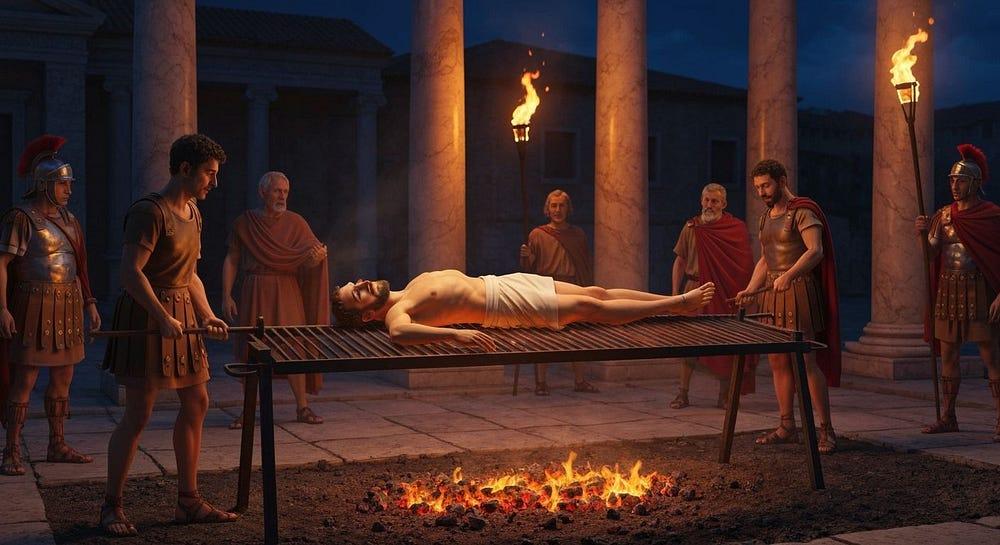
In our last post, we walked with Perpetua and Felicity through the sands of the amphitheatre, their faith outshining Rome’s cruelty. Now for the final part in this series, we turn to another of the Church’s earliest heroes — one whose courage was matched by an unexpected wit. His name was Lawrence, a deacon of Rome, remembered across centuries as the man who kept his humour even while lying on the griddle. The Setting: Rome, AD 258 Under Emperor Valerian, a fresh persecution of Christians swept through the Empire. Bishops, priests, and deacons were hunted down, their property seized, and their churches closed. The bishop of Rome at that time was Sixtus II — a gentle and wise shepherd who, like the apostles before him, was soon to drink from the same cup as his Lord. Among his closest companions was Deacon Lawrence, entrusted with overseeing the Church’s treasury and distributing alms to the poor. The Acts of St Lawrence tell us that when Sixtus was arrested and led to execution, Lawrence ran after him, crying out that he would not be left behind. Where are you going, father, without your son? Where are you going, priest, without your deacon? You never used to offer sacrifice without me as your minister! To which Sixtus replied: My son, I’m not leaving you. Greater trials are waiting for you. In three days you’ll follow me. Sixtus was beheaded soon after. Lawrence, meanwhile, was arrested and brought before the Roman prefect who, hearing that Lawrence had been the keeper of the Church’s wealth, demanded that he hand it over to the empire. The True Treasure of the Church The exchange that followed has been remembered ever since, partly for its irony, partly for its courage. “Bring forth,” said the prefect, “the treasures of the Church — the gold, the silver, and the precious vessels — that the emperor may possess them.” Lawrence asked for three days to gather them, which the prefect granted, no doubt imagining chests of glittering riches being prepared for him. Instead, Lawrence went through the city, gathering the blind, the crippled, the widows, the orphans, and all who were destitute or suffering. On the third day, he presented them before the prefect and declared: These are the treasures of the Church. Behold the gold and silver that I promised thee — the eternal jewels in whom Christ dwells. The prefect, enraged at being mocked, ordered that Lawrence be scourged and tortured, then laid upon an iron gridiron above a slow fire. The Martyrdom The ancient texts, mingling reverence and humour, tell the story that has echoed down the ages and had left an impact on me purely for the humour that I find in it! They laid him upon the iron bed, and beneath it kindled coals, that his flesh might be roasted little by little. And Lawrence, lying there, lifted up his eyes to heaven and gave thanks to God for counting him worthy to suffer. After some time, the account continues with words that have made Lawrence one of the most memorable of all martyrs: Having been a long time on the fire, he said to his tormentors with a cheerful countenance: ‘This side is done; turn me over and eat.’ It is difficult to read those words without laughing at how funny it sounds! It matches the kind of dark humour that I can have and often think of, which is probably why the story of Lawrence appeals to me so much, it’s the kind of silly thing I would think to say (though I’m not sure if I would in Lawrence’s place!). In the face of unbearable agony, Lawrence mocked his tormentors and even death itself. His humour was not flippant, but a final victory over the fear that his persecutors wanted to instil. His joke was an act of defiance against the gods whom Decius implored against the power of Christ within Lawrence. Despite how hot it must have been, Lawrence declares a worse fate on Decius, warning him of the fire he will face because of this, saying that the “burning c...

Before the Pumpkins: The Martyrs who sanctified the night

My new book is out now!
For a limited time, get it as a free eBook

Long before costumes, candy, and carved pumpkins, the night we now call Halloween was kept holy as the Eve of All Saints — a time to remember those who lit the darkness with faith.

Paperback Free eBook

Before the Pumpkins - free ebook

Close