
Blog Search Results


158 results for man made tradition
found
within the Blog
6 displayed out of 158 (0.77seconds)Page 15 of 27

Four Blood Moons and everyone loses their minds
Posted by Luke J. Wilson on 16th April 2014 in Christianity | blood moon,prophecy,End Times,Second Coming,Return of Christ,news,predictions,HuffPost,Rapture,John Hagee,false prophets
According to NASA, there are about two lunar eclipses per year. This time there happens to be four all within 18 months - something astronomers call a tetrad.
I'm slightly surprised I've not seen much about this yet (maybe a good thing?), but it does seem as though this is an event certain Christians have been waiting for - and writing books about! I came across this on a recent Huffington Post article which gives this story also about church leaders saying these moons are "an omen of Armageddon and Second Coming of Christ", but I'm not so sure about that.
I did recognise one of the names mentioned, though: John Hagee, a Texas megachurch pastor. It was p...
Lent: Day 17 - Justin Martyr: First Apology: Chaps. 60-68
Posted by Luke J. Wilson on 20th March 2017 in Lent | Lent,great lent,fasting,early church fathers,devotional,daily reading,Justin Martyr,apologetics,Plato,trinity,baptism,sunday worship
Day Seventeen: St. Justin Martyr: First Apology, Chaps. 60-68
Who: Justin Martyr was a Philosopher who converted to Christianity and became a tireless evangelist and apologist. Justin wrote more Christianity than any other person prior to his time. He is classified herein as Eastern, since he a native of Samaria and his thought patterns were Eastern. However, he spent the last years of his life in Rome, where he was executed as a martyr (c. 165).
What: An apologetic (defence) essay to explain what Christians believe and do.
Why: Justin is demanding the Emperor to investigate accusations and unjust persecution against Christians so that they at least may fac...
Lent Day 27: Athanasius: Life of Anthony: Chaps. 61-70
Posted by Luke J. Wilson on 31st March 2017 in Lent | Lent,great lent,fasting,early church fathers,devotional,daily reading,Athanasius,Bishop of Alexandria,Confessor,Doctor of the Church,Anthony the Great,demons,healing,miracles,heresy,heretics,Arianism,deity of Christ
Day Twenty-seven: St. Athanasius: Life of Anthony: Chaps. 61-70
Who: Bishop of Alexandria; Confessor and Doctor of the Church; born c. 296; died 2 May, 373 AD. He was the main defender of orthodoxy in the 4th-century battle against the Arianism heresy. Certain writers received the title “Doctor” on account of the great advantage their doctrine had on the whole Church, Athanasius especially for his doctrine on the incarnation.
What: The biography of Anthony the Great’s life, which helped to spread the concept of Christian monasticism, particularly in Western Europe.
Why: From the letter’s own prologue: “The life and conversation of our holy Father...
What is Monarchical Trinitarianism?
Posted by Luke J. Wilson on 21st July 2024 in Trinity | trinity,monarchy of the Father,Monarchical Trinitarianism,church fathers,church history
Monarchical Trinitarianism, also referred to as the “Monarchy of the Father,” is a theological perspective that asserts the Father as the sole source (or monarch) within the Trinity. This view maintains a clear distinction of roles among the Father, the Son, and the Holy Spirit while upholding their unity in essence. It is essential to distinguish this from Monarchianism, a heretical belief condemned in the 4th century, which posited that God is a single person rather than three distinct persons.
The Eternal Begottenness of the Son
The term “created” used by the early pre-Nicene Fathers does not align with the Arian view, which posits that the Son was...
Before the Pumpkins: The Barbecued Deacon
Posted by Luke J. Wilson on 31st October 2025 in Halloween | halloween,martyrdom,martyr,Lawrence
In our last post, we walked with Perpetua and Felicity through the sands of the amphitheatre, their faith outshining Rome’s cruelty. Now for the final part in this series, we turn to another of the Church’s earliest heroes — one whose courage was matched by an unexpected wit. His name was Lawrence, a deacon of Rome, remembered across centuries as the man who kept his humour even while lying on the griddle.
The Setting: Rome, AD 258
Under Emperor Valerian, a fresh persecution of Christians swept through the Empire. Bishops, priests, and deacons were hunted down, their property seized, and their churches closed. The bishop of Rome at that time was Six...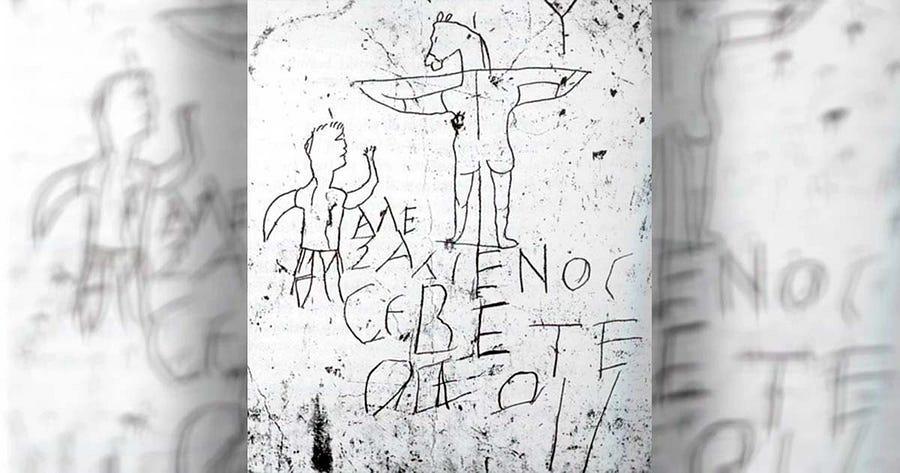
The World's Oldest Anti-Christian Meme
Posted by Luke J. Wilson on 9th March 2026 in Archaeology | Alexamenos graffito,archaeology,history
I first came across the Alexamenos graffito back in Bible college in the early 2000s. It was one of those “fun facts” that gets dropped into a church history lecture and sticks with you — the ancient Roman equivalent of someone spray-painting an insult on a wall. I filed it away, thought it was fascinating, and largely forgot about it for two decades.
Then, recently, I discovered something about it I had never known. There’s a response to it. Scratched in a different room, in a different hand.
So I started digging into this more to verify the information and discovered more historical curiosities surrounding the graffiti than I ever knew existed wh...
Powered by WebBoss.io 3.7.1
Copyright © 2026 The Sacred Faith: Timeless Truths for Modern Minds. All Rights Reserved.
