
Blog Search Results


171 results for good people
found
within the Blog
6 displayed out of 171 (0.32seconds)Page 20 of 29

A Prayer You Can Hold: A Maker’s Reflection on Beads, Scripture and Attention
Posted by Guest Author on 31st July 2026 in Prayer | guest post,prayer,faith,devotional
Guest Post By Fiach OBroin-Molloy
My own roots lie in the Catholic tradition, but my workbench has brought me into contact with Christians whose devotional lives differ from mine. I make Catholic rosaries, Anglican prayer beads and other forms of devotional beads by hand. That work has not taught me that distinctions between traditions do not matter. It has taught me that, beneath those distinctions, many of us know the same difficulty: we want to pray, but our attention is restless.
I have travelled, lived and worked in a number of countries, from parts of Africa to countries further east. Again and again, I encountered beads or knotted cords held, counted or...
The Temptations of Jesus: Worship and Glory
Posted by Luke J. Wilson on 25th February 2018 in Lent | temptation,wilderness,desert,worship,glory,devil,satan,forty days,lent
Here we are on the second Sunday of Lent, and this week I am looking at the next temptation Jesus faced in the desert against the devil, the one of worship and glory.
Let's take a look at the text:
Luke 4:5-8
Then the devil led him up and showed him in an instant all the kingdoms of the world. And the devil said to him, “To you I will give their glory and all this authority; for it has been given over to me, and I give it to anyone I please. If you, then, will worship me, it will all be yours.” Jesus answered him, “It is written,
‘Worship the Lord your God,
and serve only him.’” (cf. Matthew 4:8-10)
Last week we saw how Satan temp...
Jesus was a pagan copy, and other Christmas myths
Posted by Luke J. Wilson on 24th December 2017 in Christmas | christmas,jesus,incarnation,horus,osiris,mithras,egyptian gods,roman gods,zeitgeist,debunked
It's that time of year again when certain groups of people like to share memes and videos that apparently "prove" Jesus to be a carbon-copy of ancient Egyptian gods.
This has been debunked so many times, yet it's still so pervasive on social media, mindlessly shared over and over again. This myth about Jesus being a copy of other pagan "dying-and-rising gods" doesn't have its roots in Egyptian legend, but rather in the claims of a film called Zeitgeist.
A quick search online will bring up many websites which have gone through the claims of this film with a fine tooth comb, and debunked each one. Here's one such example, which lists out the major claims and giv...Was the omniscience of God a developed idea?
Posted by Luke J. Wilson on 21st April 2014 in The Nature of God | progressive revelation, Christocentric, Christotelic, Hermeneutics, omniscience, omnipresence, theology
Or do we retroactively place our current theology of God on God?
Consider the Garden of Eden: '[T]he Lord God called to the man, and said to him, “Where are you?”' (Gen. 3:8-10)
Now today we make it into a rhetorical question, but was this always so? In this story, God is spoken of almost in a physical-bodily sense as walking in the garden, since "they heard the sound of the Lord God walking in the garden" as he moved about, and then tried to hide themselves from his view!
Next think of the tower of Babel - "The Lord came down to see the city and the tower, which mortals had built" (Gen 11:5) - Did he not just know already? Also this story...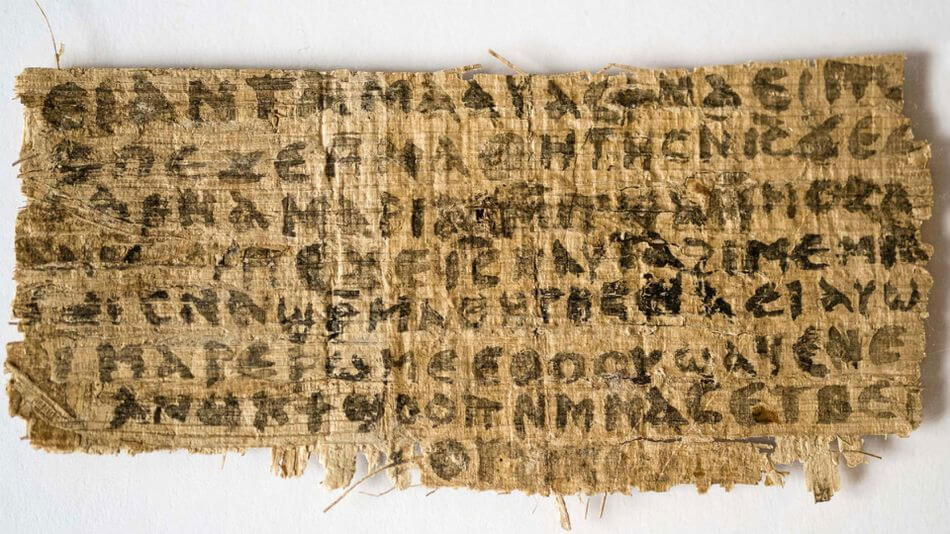
An ancient fragment mentions Jesus' wife!?
Posted by Luke J. Wilson on 10th April 2014 in General Interest | Jesus,wife,papyrus,fragment,Archaeology,Jesus wife,Gnosticism,early church
UPDATE (3rd May 2014): It is now believed to have been confirmed as a hoax/fake; read the full story on The Wall Street Journal.
Ancient and not a fake according to scientists
IMAGE: HARVARD UNIVERSITY, KAREN L. KING/ASSOCIATED PRESS
A little while ago, there was some hoopla in the news about a newly discovered fragment of papyrus from ancient times which contained the phrase "Jesus said to them, 'my wife...,'". Obviously, and not surprisingly, the media made a big deal out of this. Atheists and the like, saw it as a blow to Christianity and conspiracy theorists everywhere thought it confirmed their views that the Vatican and the Catholic Church wer...
Lent Day 30: Cyril of Jerusalem: Catechetical Lectures: Lecture XIX
Posted by Luke J. Wilson on 4th April 2017 in Lent | Lent,great lent,fasting,early church fathers,devotional,daily reading,Doctor of the Church,lectures,liturgy,catechism,Bishop of Jerusalem
Day Thirty: St. Cyril of Jerusalem: Catechetical Lectures: Lecture XIX
Who: Bishop of Jerusalem and Doctor of the Church, born about 315; died probably 18 March, 386. Little is known of his life, except from his younger contemporaries, Epiphanius, Jerome, and Rufinus, as well as from the fifth-century historians, Socrates, Sozomen and Theodoret.
What: Each of the lectures deal with a different topic to teach converts the mysteries of the Church, particularly: rites of the renunciation of Satan and his works, of anointing with oil, of baptism, of anointing with the holy chrism, and of partaking of the body and blood of Christ.
Why: Cyril delivered to new conve...
Powered by WebBoss.io 3.7.1
Copyright © 2026 The Sacred Faith: Timeless Truths for Modern Minds. All Rights Reserved.
