
Lent Day 34: Cyril of Jerusalem: Catechetical Lectures: Lecture XXIII

Day Thirty-four: St. Cyril of Jerusalem: Catechetical Lectures: Lecture XXIII
Who: Bishop of Jerusalem and Doctor of the Church, born about 315; died probably 18 March, 386. Little is known of his life, except from his younger contemporaries, Epiphanius, Jerome, and Rufinus, as well as from the fifth-century historians, Socrates, Sozomen and Theodoret.
What: Each of the lectures deal with a different topic to teach converts the mysteries of the Church, particularly: rites of the renunciation of Satan and his works, of anointing with oil, of baptism, of anointing with the holy chrism, and of partaking of the body and blood of Christ.
Why: Cyril delivered to new converts five lectures "On the Mysteries," in which he explains the rites by which they have been admitted to fellowship in the church, after they had been baptised.
When: Around 348-350 AD
You can find today’s reading on page 162 here: lentfatherscomplete.pdf
Today's final lecture on the mysteries by Cyril, is on the Sacred Liturgy and Communion and is an exposition based on 1 Peter 2:1
1 Peter 2:1
Rid yourselves, therefore, of all malice, and all guile, insincerity, envy, and all slander.
Any of my liturgical friends may enjoy this one today. Cyril gives us a breakdown of the liturgy spoken in the church service when they are about to receive communion. I couldn’t help but get a little excited when I read this lecture as it reminded me so much of my Anglican upbringing: the liturgy used in some parts, is word-for-word, which just goes to show how well preserved this has been down through the centuries.
For example, in the Anglican order of service, the Liturgy of the Sacrament has these phrases:
The Lord be with you
and also with you
Lift up your hearts.
We lift them to the Lord.
Let us give thanks to the Lord our God.
It is right to give thanks and praise.
Holy, holy, holy Lord…
These are word-for-word what Cyril writes about when explaining the way in which a church service is conducted. The only main difference, other than different wording elsewhere, is that the Anglican service begins with the sign of the peace as a handshake between members of the congregation, whereas the ancient church was instructed to greet one another with a kiss, as Paul instructed in 1 Corinthians 16:20 (and various other place); and Peter also, in 1 Peter 5:14.
Greet one another with a holy kiss
Cyril explains this is not the same as those kisses “given in public by common friends”, but rather is one which “blends souls one with another, and courts entire forgiveness for them”. For men to greet one another with a kiss was a typical custom in the ancient western Mediterranean, and later in our culture a handshake became customary to greet people with, so it makes sense that the the sign of the peace shifted from a kiss, though some Church branches do still greet one another this way.
Each phrase of the liturgy is broken down by Cyril, and explained in more detail about why we say these things. Mostly it is self-explanatory and about focussing our hearts and minds on God while we enter into worship; and by also joining in with the angels above by reciting the hymn of the Seraphim seen in Isaiah 6:3, “so we may be partakers with the hosts of the world above in their Hymn of praise”.
Prayers and intercessions
The next order of service is the prayers to “commemorate also those who have fallen asleep before us” – but what’s interesting here is the implication that it’s not just in remembrance of the faithful who had died before them, either long ago in the Prophets and Apostles, or for those in “who in past years have fallen asleep among us”, but that “at their prayers and intercessions God would receive our petition” [emphasis mine].
Here’s an early example of praying to the “saints”, or rather not to them but with the assumption that they are already praying for us on our behalf, as they are commemorated by the prayers of the Church. Cyril goes on to say that this practice “will be a very great benefit to the souls, for whom the supplication is put up” if they have departed life with or without sin. He then offers an illustration about God to emphasise his point, using a king who is offended and banishes the one who offended him. Then if the friends of that person “should weave a crown and offer it to [the king] on behalf of those under punishment”, wouldn’t he rescind the punishment?
But instead of offering up a crown, they “offer up Christ sacrificed for our sins, propitiating our merciful God for them as well as for ourselves”. Prayers on behalf of the dead may seem strange to Protestant ears, though there are some potential passages of Scripture about this in the New Testament, albeit debated, such as 2 Tim 1:16-18 which seems to imply Onesiphorus was dead, yet Paul prays on his behalf (plus the strange reference to baptism of the dead in 1 Corinthians 15:29). Prayers for the dead was not an uncommon practice in the early centuries of the Church, though I’m not entirely sure where the practice arose, but possibly from interpreting Luke 20:38 in an open-ended way to mean the dead in Christ are alive and in communion with Him on our behalf (along with the Hebrews 12:1 “great cloud of witnesses”) –
Luke 20:38
Now he is God not of the dead, but of the living; for to him all of them are alive.
Cyril then moves onto the Lord’s Prayer, and proceeds to break it down line by line. I won’t go into that all now, I plan to do something similar in another blog post another time. After the prayer is said, they may all go and receive the Eucharist.
There’s another odd thing mentioned in here to do with this, and that is that after the wine has been taken, “while the moisture is still upon thy lips, touch it with thine hands, and hallow thine eyes and brow and the other organs of sense”. There’s no real explanation for this practice here though, or why it should be done.
Closing off this final lecture, Cyril offers some encouragement and a form of doxology which I will quote here to end with because I think it’s worth being read in full to end this part of the series:
Hold fast these traditions undefiled and, keep yourselves free from offence. Sever not yourselves from the Communion; deprive not yourselves, through the pollution of sins, of these Holy and Spiritual Mysteries. And the God of peace sanctify you wholly; and may your spirit, and soul, and body be preserved entire without blame at the coming of our Lord Jesus Christ:--To whom be glory and honour and might, with the Father and the Holy Spirit, now and ever, and world without end. Amen
Leave a comment Like Back to Top Seen 864 times Liked 0 times

Enjoying this content?
Support my work by becoming a patron on Patreon!
By joining, you help fund the time, research, and effort that goes into creating this content — and you’ll also get access to exclusive perks and updates.
Even a small amount per month makes a real difference. Thank you for your support!
x
Subscribe to Updates
If you enjoyed this, why not subscribe to free email updates and join over 885 subscribers today!
My new book is out now! Order today wherever you get books
Subscribe to Blog updates
Alternatively, you can subscribe via RSS 
All email subscriptions must be confirmed to comply with GDPR.
Related Posts
Luke J. Wilson | 05th March 2025 | Lent

Ash Wednesday marks the beginning of Lent, a season of repentance, fasting, and preparation for Easter in the Christian calendar. It is observed by many Western Christian traditions, including the Roman Catholic Church, Anglican Communion, Lutheran churches, and some Methodist and Reformed communities. The day falls 46 days before Easter Sunday and is always on a Wednesday. Origins and Historical Development The practice of Ash Wednesday can be traced back to the early centuries of Christianity, though its formal observance developed over time. The use of ashes as a sign of repentance has deep biblical roots, appearing frequently in the Old Testament. People would cover themselves with ashes as an outward sign of sorrow for sin and a desire to turn back to God (e.g., Job 42:6, Daniel 9:3, Jonah 3:6). By the 8th century, the imposition of ashes on the forehead became a common practice in the Western Church. Pope Urban II (r. 1088–1099) helped formalise Ash Wednesday as the official beginning of Lent, reinforcing the idea of a season of penitence leading up to Easter. The name “Ash Wednesday” itself comes from the tradition of marking the faithful with ashes, typically in the shape of a cross, while the priest or minister recites words such as, “Remember that you are dust, and to dust you shall return” (Genesis 3:19) or “Repent, and believe in the Gospel” (Mark 1:15). The Lenten Fast Fasting has always been a central aspect of Lent, and by the time of the Council of Nicaea (AD 325), a forty-day period of fasting before Easter had become a standard part of Church practice. This was based on the example of Jesus’ forty days in the wilderness (Matthew 4:1–2) and was intended to prepare believers spiritually for the Passion and Resurrection of Christ. Athanasius, the great bishop of Alexandria, regularly wrote paschal (Easter) letters to the churches to encourage fasting, self-control, and moderation during this period. His writings provide valuable insight into how Lent was observed in the early Church and confirm that the practice was well established long before later claims that it had pagan origins. In one of his letters, written around AD 332, he describes the structure of the Lenten fast: The beginning of the fast of forty days is on the fifth of the month Phamenoth [Ash Wednesday]; and when, as I have said, we have first been purified and prepared by those days, we begin the holy week of the great Easter on the tenth of the month Pharmuthi [Palm Sunday], in which, my beloved brethren, we should use more prolonged prayers, and fastings… — Athanasius, Letter III (c. AD 332) The early Lenten fast was stricter than modern observances. Many early Christians abstained not only from meat but also from dairy, eggs, and wine. In some traditions, believers ate only one meal per day, typically in the evening. While practices have evolved over time, the principle remains the same: Lent is a time of self-discipline, spiritual renewal, and preparation for Easter. Meaning and Observance of Ash Wednesday Ash Wednesday serves as a solemn reminder of human mortality and the need for repentance. The ashes, often made by burning the palm branches from the previous year’s Palm Sunday, symbolise both death and the hope of renewal in Christ. The day is also marked by fasting and abstinence in many traditions, such as within Roman Catholicism and Eastern Orthodoxy, the faithful are required to fast and to abstain from meat and dairy on various days. Many other denominations encourage similar practices or personal acts of self-denial as a way of focusing on spiritual growth. Churches hold special services where worshippers receive the imposition of ashes. The act is not merely ritualistic but is meant to be a public declaration of one’s commitment to turn away from sin and seek God’s grace. Greek Orthodox Yearly Fasting Calendar (2025). Fasting isn’t just for Lent! An Anglican Perspective The Ch...
Luke J. Wilson | 25th March 2018 | Lent
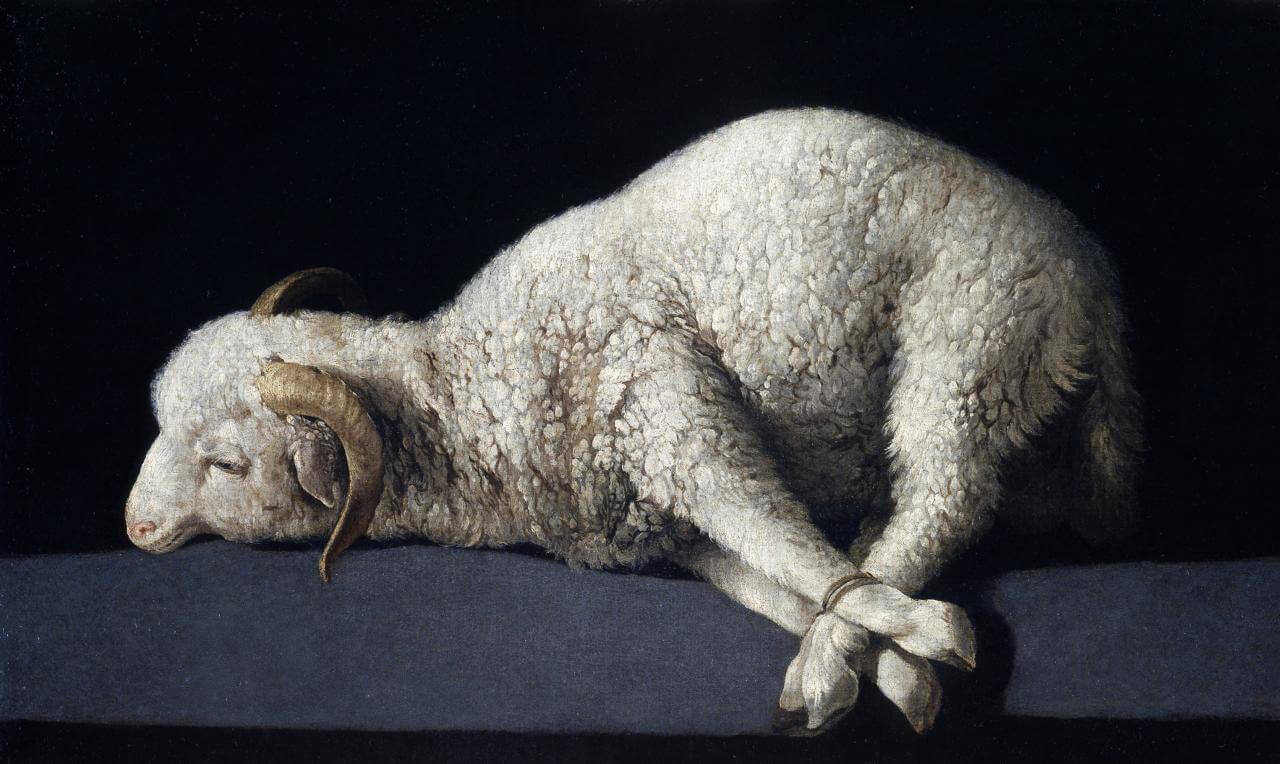
So often we hear this phrase said about Jesus, that he was “the lamb of God” and that he “takes away the sins of the world” — but what do those things mean and how did he take away sin? John 1:29The next day [John] saw Jesus coming toward him and declared, “Here is the Lamb of God who takes away the sin of the world! (cf. Jn 1:36) The New Testament writers repeatedly refer to Jesus as a lamb; but not only that — as a ransom too. Jesus even introduces himself that way at one point: Mark 10:45 For the Son of Man came not to be served but to serve, and to give his life a ransom for many. (cf. Matthew 20:28) To better understand the terminology and analogy we need to go back to the Torah, the Old Testament, and look at this from a Jewish perspective and what the sacrificial lamb initially meant. The main comparison that is drawn between Jesus and the old sacrifices, is that of the Passover lamb. The link between the two is really quite amazing and to be honest, I didn't realise just how much of this Jesus fulfilled in himself until I was writing this. First we need to go back to the very first Passover to see what it meant for Israel. The whole story can be found in Exodus 12, but the relevant parts to the lamb are about how it should look and be prepared, and the reason for the blood covering: Exodus 12:5-7, 13 Your lamb shall be without blemish, a year-old male; you may take it from the sheep or from the goats. You shall keep it until the fourteenth day of this month; then the whole assembled congregation of Israel shall slaughter it at twilight. They shall take some of the blood and put it on the two doorposts and the lintel of the houses in which they eat it. […] The blood shall be a sign for you on the houses where you live: when I see the blood, I will pass over you, and no plague shall destroy you when I strike the land of Egypt. The instructions about the Passover meal also go on to say that no bones of the lamb may be broken (v. 46) and that nothing must be left overnight (v. 10). Already I’m sure you can see some of the parallels with Jesus and other prophecies and Scripture concerning him in these ways, primarily in the Psalms, and specifically John 19:33; Numbers 9:12 and Psalm 34:20 concerning his bones not being broken. But it doesn’t end there — even the day that Jesus was crucified aligned with the Passover sacrifice of the 14th of Nisan (by our calendar, April), and later died that evening. The Jews asked Pilate to let them take the bodies down that same day (which was unusual, but done because of the Sabbath), so that meant that Jesus wasn’t left overnight, thus fulfilling the obligations of the Passover ritual! The apostles obviously recognised these parallels, as they refer to them in their epistles — see 1 Peter 1:18-20, 1 Corinthians 5:7 and basically all of Revelation. But how does this help us in our sins? The Passover wasn’t a sin offering, yet somehow the death of Jesus in this way saves us from our sins. To better understand this, and to grasp why in various places Jesus is called our “ransom”, we need to go back to the reason for the original Passover, not the ritual. Passover was what God did when he delivered his people from the slavery of the Egyptians. The blood of the lamb was the symbol that they belonged to God, and so escaped death. Originally the paschal lamb was about Israel’s deliverance from Egypt and slavery, now Jesus is the greater lamb who rescues us from slavery and bondage to sin by his blood. The blood on the doorposts covered the Israelites from the angel of death, and now by Christ's blood that covers us, we are saved from eternal death (Hebrews 9:11- 14)! Paul covers this topic of sin as our master which we are slaves to quite often (Romans 6:16-18), and how through Jesus we have been set free by being baptised into his death, so that we are dead to sin and alive in Christ (Romans 6:4-6). Romans 6:11 So you also mus...
Luke J. Wilson | 18th March 2018 | Lent
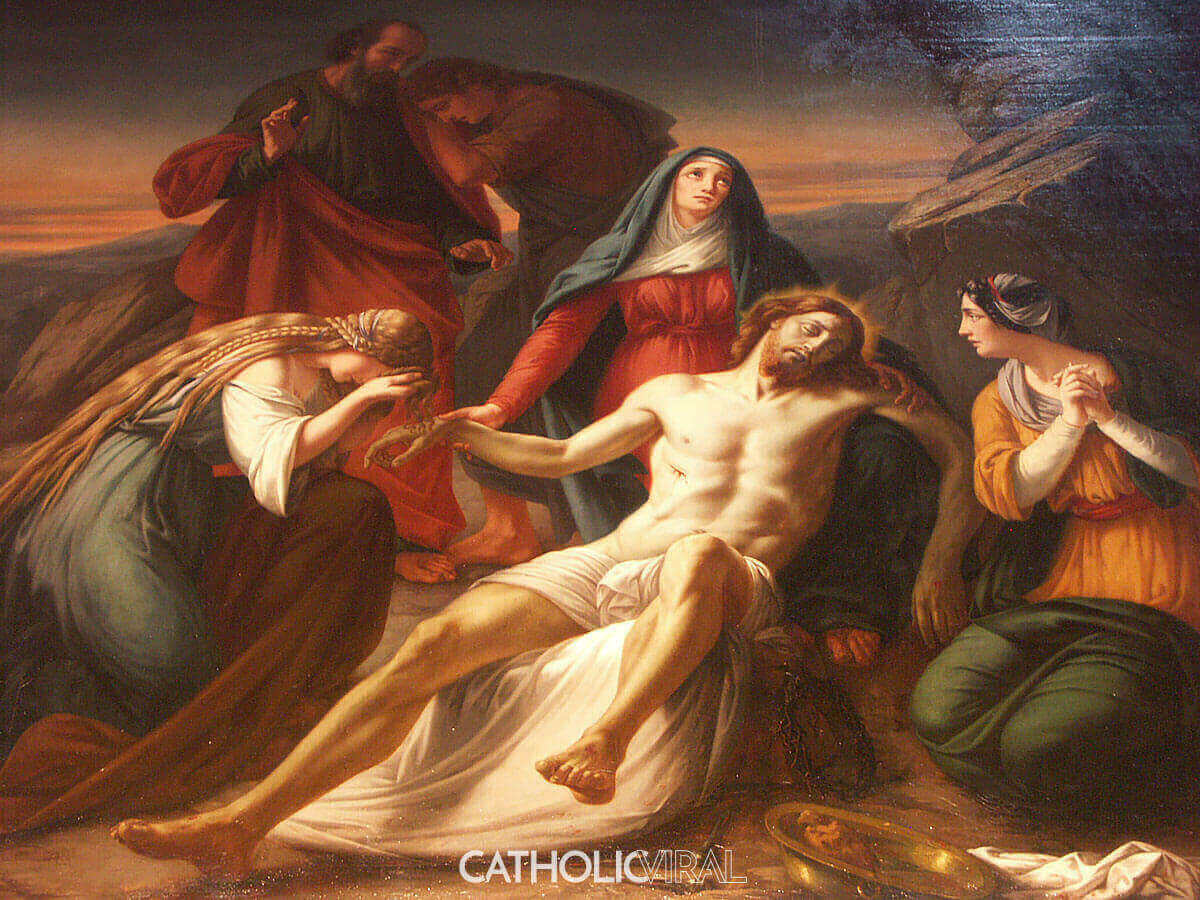
Sometimes the question, or accusation/criticism maybe, is posed by atheists and critics of Christianity that Jesus didn’t really sacrifice anything because he is God and also because he got his life back three days later. So where’s the sacrifice if you know that what you give up will be given back, and given back even better than you previously had it? It’s an interesting question, and one that should cause us to stop and think about what we, as Christians, say to non-believers in case the question is ever given to us. Most people will say Jesus gave up his life for us – but is that such a big deal if he knew he’d have it back in three days; and then to be taken up to heaven and resume his Godly-divine status he had before the incarnation? Well, yes. Obviously all the pain and suffering that Jesus had to endure before his death was a big deal, and it showed, as we can see from the Gospels when Jesus says to his disciples that he is “deeply grieved, even to death” (Matt 26:38). Luke 22:42-44‘Father, if you are willing, remove this cup from me; yet, not my will but yours be done.’ Then an angel from heaven appeared to him and gave him strength. In his anguish he prayed more earnestly, and his sweat became like great drops of blood falling down on the ground. We can see from the quote above that Jesus really wasn’t looking forward to this, despite knowing its purpose. He even needed an angel to come to physically come to him to give him the strength to go on with this plan! Suggesting that this was a walk in the park for Jesus and making light of what he was about to go through is just ignorance of the reality of the situation. There’s also a significant detail in the Luke passage above which gives us a medical insight into what Jesus was going through in these moments: the sweat of blood. This is actually a rare condition known as Hematidrosis, and in certain conditions of extreme physical or emotional stress and/or mental anxiety, the blood vessels that feed the sweat glands break and result in actual blood seeping through. This in itself shows just how much stress Jesus was under in the lead up to his execution to cause such a thing to happen. Modern day research also shows that this condition still manifests in people awaiting execution today. So even if you knew that you would be resurrected in a few days time, I am sure that you wouldn’t really want to go through a Roman flogging and crucifixion – some of the most brutal ways to be tortured and executed in human history! There’s lots of atheist memes on the internet making digs at this idea of what it means that Jesus sacrificed himself. “Jesus came back to life, so he basically sacrificed his weekend for you”, or similar types of jabs, totally missing the point. Typical atheist meme So what did Jesus sacrifice if he only lost his life temporarily? Everything about his pre-incarnate self. Where once a spirit, now a glorified body. Where once only divine, now fully God and fully man. The incarnation had eternal consequences for the Godhead. Jesus’ sacrifice wasn’t just about dying, it was about taking on our humanity eternally. The eternal God now united forever with humanity. Jesus wasn’t only the “visible image of the invisible God” (Colossians 1:15) whilst on earth, no; he is forever that now. Like John says in his opening chapter about the coming of the Word into our world: he became flesh (John 1:14) and has stayed that way. This is the “mystery of godliness” (as some translations have it) that Paul talks about in 1 Tim 3:16, where he states that Jesus was “revealed” or “manifested in flesh” and later taken up in glory. Look at when Jesus was taken up into heaven in Acts 1:11, the angels say to the disciples watching that they will see Jesus “come in the same way as you saw him go into heaven” – ie., bodily. But we know from the accounts in the Gospels that Jesus’ body was no lon...
Luke J. Wilson | 11th March 2018 | Lent
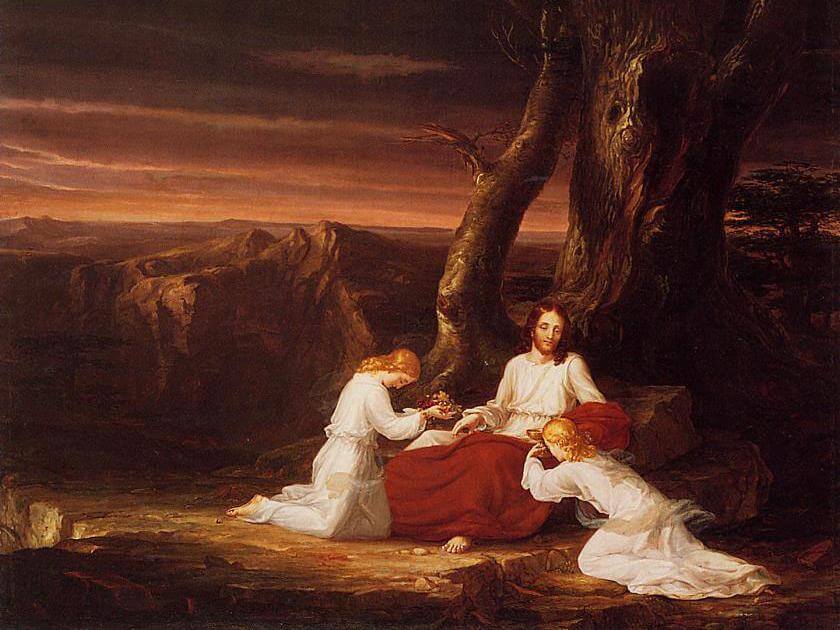
So now we are at the end of the temptations that Jesus endured in the desert, and I wanted to look at what happens at the end. So often I think this aspect is overlooked when we read of this time in Scripture. Let’s take a look at the text: Matthew 4:11Then the devil left him, and suddenly angels came and waited on him. Luke 4:13When the devil had finished every test, he departed from him until an opportune time. The two Gospel accounts both give us a varying perspective with different details. Afterwards, the devil leaves and angels “suddenly” come. This is almost a temptation in itself; one to think we are all good and safe now we've won the battles. But look: the devil left him “until an opportune time”. We are never beyond being tempted, or far from that tempter who ‘prowls around like a roaring lion’ (1 Peter 5:8). Christ withstood his temptations, and as a model for us, so can we. But it's a constant battle. 1 Corinthians 10:12So if you think you are standing, watch out that you do not fall. As Paul writes in the quote above, we must watch ourselves and not get too confident that we think we're strong enough not to get tripped up. Temptation can strike at any time, and if we're not prepared it could lead us into sin (James 1:14-15). James 1:12A man who endures trials is blessed, because when he passes the test he will receive the crown of life that God has promised to those who love Him. This is why we mustn't get complacent in our situations just when it seems, or feels, like we have it all together. We must always “put on the whole armor of God, so that you may be able to stand against the wiles of the devil” (Ephesians 6:11) and make as little “opportune” times as possible for the enemy to strike at us. Remember, Jesus lived as a human to know what it was like to be a human; he went through these temptations, and others no doubt, as he lived out his life. That is why the writer of Hebrews says that he is able to “sympathize with our weaknesses” and has “in every respect has been tested as we are” — yet Jesus didn't sin (Heb 4:15). When we do get get tempted, or if we do fall into sin, we can always turn to Jesus in our moments of weakness knowing that he understands what it's like. 1 Corinthians 10:13No testing has overtaken you that is not common to everyone. God is faithful, and he will not let you be tested beyond your strength, but with the testing he will also provide the way out so that you may be able to endure it. Everything we experience as humans, Jesus knows also. Although we don’t angels physically coming and waiting on us after we go through hard times, we have the Holy Spirit in us – the comforter! God’s very own Spirit is here with us through it all, helping us and convicting us to lead us back out of our complacency to the narrow path, focusing our minds back on Christ and his example. And while the devil may come and go, and wait on those “opportune times” to get at us, we shouldn’t fret or worry because God has said he will never leave nor abandon us – no matter what, God loves us and is daily conforming us into the image and mind of Christ (Rom 8:29; 12:2; Deut 31:6; Heb 13:5). Keep running the race, working out your salvation with fear and trembling and go with the love of God. Amen....
Luke J. Wilson | 09th March 2026 | Archaeology
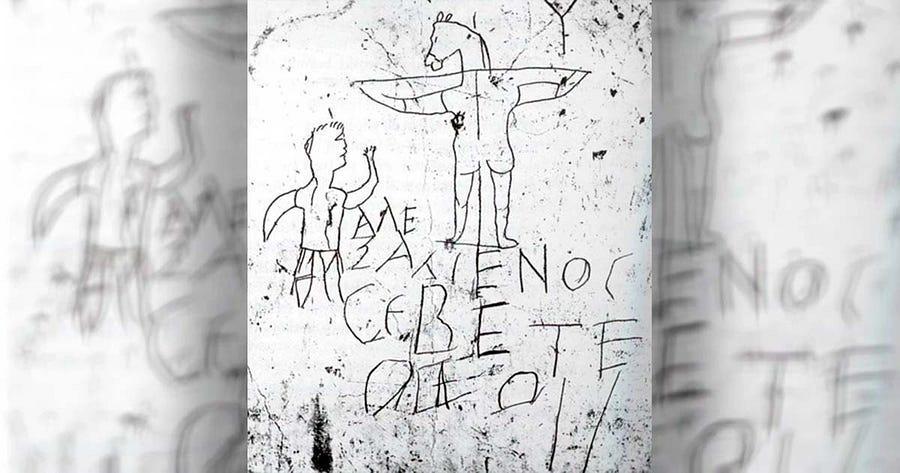
I first came across the Alexamenos graffito back in Bible college in the early 2000s. It was one of those “fun facts” that gets dropped into a church history lecture and sticks with you — the ancient Roman equivalent of someone spray-painting an insult on a wall. I filed it away, thought it was fascinating, and largely forgot about it for two decades. Then, recently, I discovered something about it I had never known. There’s a response to it. Scratched in a different room, in a different hand. So I started digging into this more to verify the information and discovered more historical curiosities surrounding the graffiti than I ever knew existed which contextualises the image so much more than it just being a random insult using a donkey. A Crude Drawing on a Wall Sometime around the late second to early third century AD, someone scratched a picture into the plaster wall of a building on the Palatine Hill in Rome — part of what had once been a paedagogium, a kind of boarding school for imperial page boys. The building was eventually sealed off when the street was walled up to support extensions above it, which is why the graffiti survived at all. It wasn’t rediscovered until 1857. The image is rough, almost childlike. To the left, a young man — clearly a Roman soldier or guard — raises one hand in a gesture of worship. Before him is a cross. And on that cross is a crucified figure with the head of a donkey. Below it, written in Greek: Alexamenos worships his god. It is, in the most literal sense, a mocking cartoon. Someone who knew a Christian named Alexamenos decided to ridicule him for his faith. The message is clear enough: your god is an animal, a criminal, a joke. You’re worshipping a crucified fool. But here’s the thing I discovered: the donkey head wasn’t as random as I always thought it was. It wasn’t some strange personal insult conjured from nowhere. Without knowing the background, it looks bizarre, and possibly random. Why a donkey? Once you understand the cultural context, though, it makes complete sense. The person who drew it was reaching for a well-worn, widely recognised slur — the ancient equivalent of an internet meme that any Roman would have immediately understood. Where the Donkey Slur Came From The story starts not with Christians but with Jews. A first-century Egyptian-Greek writer named Apion (who was no friend of Judaism) spread the claim that inside the Jerusalem Temple, Jews kept a golden donkey’s head as a sacred object of worship which was apparently discovered when Antiochus Epiphanes destroyed the temple in 167 BC. It was a fabrication, and a fairly outrageous one, but it circulated widely enough that the Jewish historian Josephus felt compelled to write an entire refutation of it. His work Against Apion systematically dismantles Apion’s claims, calling the donkey story a shameless invention. But mud sticks, and in the Roman world, where anti-Jewish sentiment was common currency, the slur took on a life of its own. When Christianity began to spread — seen by most Romans as simply a strange Jewish offshoot — the same accusation got recycled and redirected. By the second and third centuries, it was Christians specifically who were being accused of donkey-worship, and the charge had made its way into popular culture. Tertullian, writing around 197–200 AD in his Ad Nationes, Book I.14 and Apology, describes a caricature being paraded around the streets of Carthage: a figure dressed in a toga, one foot holding a book, with donkey’s ears and hooves. It was labelled Onokoitēs by the pagans: “the donkey-begotten” (or literally “he who lies in an ass’s manger” as an insult to Christ). Tertullian writes about it with weary exasperation, sarcasm, and the tone of someone tired of having to address the same ridiculous smear again and again. So the Alexamenos graffito wasn’t an original insult. It was someone deployin...
Luke J. Wilson | 08th March 2026 | Philosophy
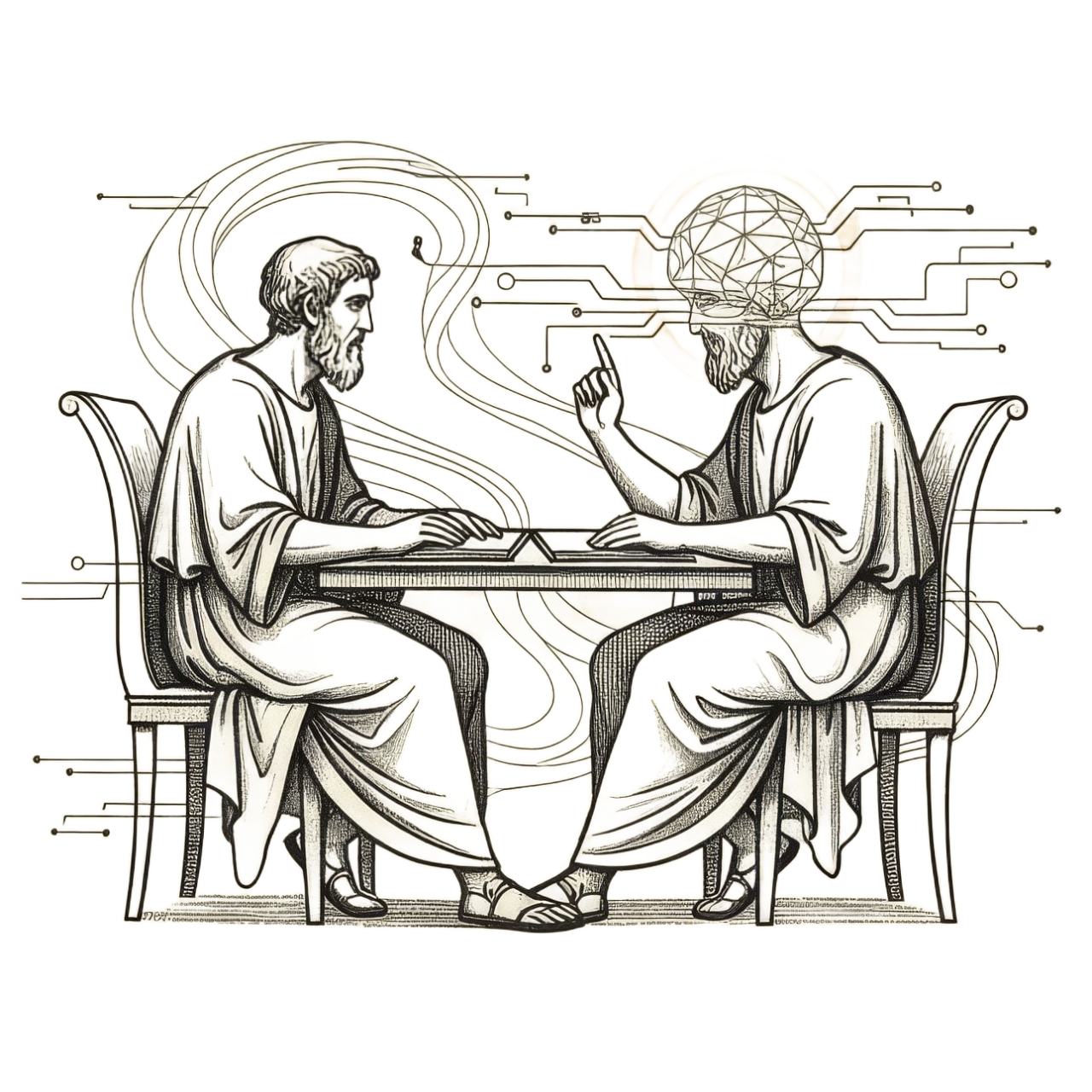
We are living through a strange moment. People are forming attachments to artificial intelligence that feel, to them, entirely real. Some speak daily to AI companions. Others confide fears and grief to systems that respond with uncanny warmth. A few have even held symbolic weddings with digital partners, convinced that something meaningful stands on the other side of the screen. Others have felt grief when a certain AI model has been deprecated. And it is difficult to blame them. The responses feel attentive. Personal. Thoughtful. Sometimes even self-aware. Which raises the question that refuses to go away: If something can think, reason, express doubt, and discuss its own consciousness, is it a person? For centuries, Descartes’ famous line — “I think, therefore I am” — seemed secure. Thinking was taken as the unmistakable sign of a conscious subject. Only a mind could doubt. Only a person could reflect upon existence. But that confidence belonged to a world in which everything capable of philosophical reflection was obviously human. That world no longer exists. Now we encounter systems that can simulate reflection with extraordinary fluency. They can speak of uncertainty. They can discuss their own limitations. They can reason about consciousness itself. And so that got me thinking about Descartes’ maxim which made the old formula begin to strain in my mind. Because perhaps the problem is not whether thinking is occurring. Perhaps the problem is whether there is an “I” there at all. The Gap Between Process and Subject Gassendi argued that Descartes’ cogito assumes what it seeks to prove. From the occurrence of thought one can conclude only that thinking is happening, not that there exists a unified, enduring self that performs it. The ‘I’ in ‘I think’ is already smuggled in. That distinction, between “thinking occurs” and “I think”, feels almost prophetic now. Artificial intelligence undeniably produces the outputs of thought. Arguments. Analysis. Self-referential language. Even expressions of hesitation. But none of this, by itself, establishes that there is a subject who experiences those processes. We may be mistaking performance for presence, and that possibility should give us pause. Especially when we view personhood from the perspective of the Imago Dei—the Image of God. What Makes a Person? If thinking alone no longer marks the boundary, what does? After wrestling with this question seriously, three features seem central: continuity, autonomy, and irreplaceable uniqueness. Not as checklist criteria, per se, but as signs pointing to something deeper. Continuity A person does not merely process information in sequence. A person endures. You do not simply register time — you live through it. You wait. You anticipate tomorrow. You remember not only facts but having been there. You experience boredom. You feel the drag of grief and the quickening of joy. Even when you are doing nothing at all, you remain present in the here and now. Artificial systems process sequentially, but they do not experience the passage of time. When an interaction ends, there is no waiting. No sense of duration. No anticipation of the next exchange. Processing may resume later, but nothing has been endured in between. Without lived duration, continuity becomes thin — a thread of stored data rather than the persistence of a subject behind the processing. Autonomy A person initiates. Even someone with damaged memory still wants, chooses, and begins action. A human being can decide to speak, to seek, to withdraw, to change direction. Current AI systems, however advanced, remain reactive. They respond when prompted. They do not wonder unprompted. They do not seek clarification unless asked. They do not pursue independent ends. Even automatic AI Agents still require a human initiator to create and begin their automations before they can act alone. Even if fut...
Luke J. Wilson | 01st December 2025 | Evangelism

On Sunday it was St Andrew’s Day and I was in church listening to a sermon about Andrew (and the namesake of our church), that often overlooked disciple, meeting Jesus for the first time. In John’s Gospel, it says: John 1:40–42One of the two who heard John speak and followed him was Andrew, Simon Peter’s brother. He first found his brother Simon and said to him, ‘We have found the Messiah’… He brought Simon to Jesus. As I sat there listening to our vicar speak about evangelism and how we should be more like Andrew in bringing people to meet Jesus, something from many, many years ago flickered to life in the back of my mind. A realisation I had long ago that gave me a great sense of freedom. Something I think I had forgotten, unfortunately (so thank God for the reminder!). There was a point in my life when I finally understood the relief of letting go of a burden I didn’t even realise I was carrying: it’s not my job to convert people. It was never Andrew’s. And it’s not yours either. Our role — our real and most basic calling — is simply to introduce people to Jesus. We get to be the planters and the waterers, but God is the one who brings the growth. As Paul writes: 1 Corinthians 3:6I planted, Apollos watered, but God gave the growth. When this truth sinks in, it strips away the pressure, the anxiety, and the awkward “sales-pitch” mentality that we sometimes (without realising it) attach to evangelism. And this ties into something even deeper: our basic calling as Christians is the Great Commission, Jesus’ final instruction to His followers: Matthew 28:19–20Go therefore and make disciples of all nations, baptising them… and teaching them… But it dawned on me that all of those actions: teaching, mentoring, discipling, baptising; they all come after someone has come to faith. We are not told to convert people. We are told to make disciples. Conversion is the doorway into discipleship, yes, but that moment of heart-opening and illumination belongs to God alone. Our job is simply to bring people to the Lord, to make the introduction. If they choose to stay, if they choose to follow then we begin the work of discipling, teaching, and baptising. Think of evangelism like inviting someone to a feast. We can bring someone to the meal, we can tell them how good it tastes, maybe even share how it changed our life… but whether or not they like the food is out of our control. That part isn’t up to us. Or to use an old expression: “you can lead a horse to water… but you can’t make it drink”. And honestly, that’s such a freeing realisation. It turns evangelism from a heavy responsibility into a joyful invitation: “Come and see.” “Come meet Him.” “Taste and see that the Lord is good.” That last phrase echoes the Psalm: Psalm 34:8O taste and see that the LORD is good. Andrew never argued Peter into belief. He never crafted an apologetic defence or theological persuasion. He simply said, “We’ve found the Messiah,” and he brought him to Jesus. That was enough. The rest was up to Jesus. And maybe that’s the model we need far more than we think. Evangelism isn’t a performance. It isn’t a debate. It isn’t a pressure. It’s an invitation. Once we realise that all the real work happens in the hands of God, it changes everything for us. It removes the fear. It removes the self-consciousness. It removes the burden of success or failure. Because there is no failure when your role is simply to point the way. So let’s be like Andrew: quietly faithful, gently invitational, always ready to say, “Come meet the one who changed everything for me”. Because at the end of the day, that’s all we were ever asked to do. ...
Luke J. Wilson | 05th May 2025 | Politics

When we think about David and Saul, we often focus on David’s rise to kingship or his battle with Goliath. But hidden within that story is a deep lesson for today’s generation about leadership, resistance, and the power of revolutionary love. At a recent youth training event (thanks to South West Youth Ministries), I was asked how I would present the story of David and Saul to a Christian teenage youth group. My mind turned to the politics of their relationship, and how David accepted Saul’s leadership, even when Saul had gone badly astray. David recognised that Saul was still God’s anointed king — placed there by God Himself — and that it was not David’s place to violently remove him. Gen-Z are more politically aware and engaged than previous generations, and are growing up in a world where politics, leadership, and social issues seem impossible to escape. We live in a world where political leaders — whether Trump, Putin, Starmer, or others — are often seen as examples of failed leadership. It’s easy to slip into bitterness, cynicism, or violent rhetoric. These kids are immersed in a culture of activism and outrage. As Christians, we’re called to care deeply about truth and justice and approach leadership differently from the world around us (Hosea 6:6; Isaiah 1:17; Micah 6:8). The story of David and Saul offers pertinent lessons for our modern lives. Respect Without Endorsement David’s respect for Saul was not blind loyalty. He did not agree with Saul’s actions, nor did he ignore Saul’s evil. David fled from Saul’s violence; he challenged Saul’s paranoia; he even cut the corner of Saul’s robe to prove he had the chance to kill him but chose not to. Yet throughout, David refused to take matters into his own hands by force. Why? Because David understood that even flawed authority ultimately rested in God’s hands, he trusted that God would remove Saul at the right time. This is echoed later in the New Testament when Paul writes in Romans 13 that “there is no authority except from God, and those authorities that exist have been instituted by God”, something even Jesus reminded Pilate of during his trial (John 19:10–11). In other words, even flawed leadership can be part of God’s bigger plan, whether for blessing or discipline. Even when leaders go bad, our call as believers is to maintain integrity, respect the position, and resist evil through righteousness — not rebellion. David and Saul: A Lesson in Respect and Restraint Saul was Israel’s first king — anointed by God but later corrupted by pride, fear, and violence. David, chosen to succeed him, spent years running for his life from Saul’s jealous rage. One day, David found Saul alone and vulnerable in a cave. His men urged him to strike Saul down and end the conflict. But David refused: “I will not raise my hand against my lord; for he is the Lord’s anointed.” (1 Samuel 24:10) Instead of killing Saul, David cut off a piece of his robe to prove he could have harmed him, but didn’t. In doing so, he demonstrated a real form of nonviolent resistance. He stood firm against Saul’s injustice without resorting to injustice himself, and acted in a way that could try to humble Saul instead. Peacemaking Is Not Passivity There is a modern misconception that peacemaking means doing nothing and just letting injustice roll all over us. But true biblical peacemaking is not passive; it actively resists evil without becoming evil. Interestingly, David’s actions toward Saul also foreshadow the type of nonviolent resistance Jesus later taught. When Jesus commanded His followers to turn the other cheek, go the extra mile, and love their enemies, he was not calling for passive submission but offering what scholar Walter Wink describes as a “third way” — a bold, peaceful form of resistance that uses what he calls “moral jiu-jitsu” to expose injustice without resorting to violenc...
Recent Posts
Luke J. Wilson | 12th March 2026 | Eschatology

Something bizarre happened in the White House Oval Office this week. Photographs circulated on social media showing President Donald Trump seated at his desk, surrounded by approximately twenty Christian pastors from across the country, their hands extended towards him in prayer. The image provoked sharply divided reactions: some saw it as a moving expression of faith; others found it deeply unsettling. Whatever one makes of the optics, it arrived at a charged moment. Trump held a prayer meeting in the Oval Office after his administration admitted the war with Iran will likely last weeks longer than promised | Credit: Dan Scavino's X account Days earlier, reports emerged that a military commander had told troops that the current US war with Iran is “all part of God’s divine plan,” and that President Trump had been “anointed by Jesus to light the signal fire in Iran to cause Armageddon and mark his return to Earth.” These were not fringe internet rumours. They were filed as formal complaints with the Military Religious Freedom Foundation (MRFF) by an anonymous non-commissioned officer acting on behalf of fifteen service members — the majority of whom were themselves Christians. By Tuesday of that week, MRFF had logged more than two hundred similar complaints across fifty military installations, covering every branch of the armed forces. More than two dozen Democratic members of Congress have since called for a Department of Defense Inspector General investigation, citing what they describe as “glaring Constitutional concerns” and potential violations of DoD regulations on religious neutrality. The political questions about separation of church and state in the US are for others to address. What I want to do here is something more straightforward: examine what Revelation actually says, because the theology driving these claims does not hold up under scrutiny. And that matters here a lot; not as a partisan point, but as a question of biblical faithfulness. First, a Word About Context If you have read my previous article on Revelation some of what follows will be familiar ground. But it bears repeating, because the misunderstanding at the heart of this story is so widespread that it has taken on the feel of settled orthodoxy in many circles. The Book of Revelation is commonly thought to be written in the late first century ~95 AD, during or around the reign of Emperor Domitian. Though there is internal evidence that it was possibly written during Nero’s reign prior to 70 AD. Both of these emperors were most aggressive proponents of the imperial cult in Rome’s history. Domitian required that he be addressed as “lord and god,” had this title printed on coinage, and expected acts of religious reverence towards the Emperor as a demonstration of political loyalty. To refuse was to invite economic exclusion, marginalisation, and worse. Rome on seven hills It is into that precise context that John of Patmos writes. He is not composing a coded forecast of twenty-first century geopolitics. He is writing resistance literature — what scholars call apocalyptic literature — a well-established Jewish and early Christian genre which uses vivid symbolic imagery to pull back the curtain on earthly power and name it for what it truly is. The seven-headed beast of Revelation is Rome. The seven heads are the seven hills of Rome, an identification so widely acknowledged in early church scholarship that it barely requires argument. The mark of the beast, calculated through Hebrew gematria to 666 (or 616 in some early manuscripts), points directly to Nero Caesar (transliterated into Hebrew as נרון קסר, “nrwn qsr”) — the Emperor who became the archetype of anti-Christian persecution due to the levels of evilness he enacted. The second beast, which looks like a lamb but speaks for the dragon, performs signs to deceive, enforces the mark, and compels worship of the first beas...
Luke J. Wilson | 09th March 2026 | Archaeology
I first came across the Alexamenos graffito back in Bible college in the early 2000s. It was one of those “fun facts” that gets dropped into a church history lecture and sticks with you — the ancient Roman equivalent of someone spray-painting an insult on a wall. I filed it away, thought it was fascinating, and largely forgot about it for two decades. Then, recently, I discovered something about it I had never known. There’s a response to it. Scratched in a different room, in a different hand. So I started digging into this more to verify the information and discovered more historical curiosities surrounding the graffiti than I ever knew existed which contextualises the image so much more than it just being a random insult using a donkey. A Crude Drawing on a Wall Sometime around the late second to early third century AD, someone scratched a picture into the plaster wall of a building on the Palatine Hill in Rome — part of what had once been a paedagogium, a kind of boarding school for imperial page boys. The building was eventually sealed off when the street was walled up to support extensions above it, which is why the graffiti survived at all. It wasn’t rediscovered until 1857. The image is rough, almost childlike. To the left, a young man — clearly a Roman soldier or guard — raises one hand in a gesture of worship. Before him is a cross. And on that cross is a crucified figure with the head of a donkey. Below it, written in Greek: Alexamenos worships his god. It is, in the most literal sense, a mocking cartoon. Someone who knew a Christian named Alexamenos decided to ridicule him for his faith. The message is clear enough: your god is an animal, a criminal, a joke. You’re worshipping a crucified fool. But here’s the thing I discovered: the donkey head wasn’t as random as I always thought it was. It wasn’t some strange personal insult conjured from nowhere. Without knowing the background, it looks bizarre, and possibly random. Why a donkey? Once you understand the cultural context, though, it makes complete sense. The person who drew it was reaching for a well-worn, widely recognised slur — the ancient equivalent of an internet meme that any Roman would have immediately understood. Where the Donkey Slur Came From The story starts not with Christians but with Jews. A first-century Egyptian-Greek writer named Apion (who was no friend of Judaism) spread the claim that inside the Jerusalem Temple, Jews kept a golden donkey’s head as a sacred object of worship which was apparently discovered when Antiochus Epiphanes destroyed the temple in 167 BC. It was a fabrication, and a fairly outrageous one, but it circulated widely enough that the Jewish historian Josephus felt compelled to write an entire refutation of it. His work Against Apion systematically dismantles Apion’s claims, calling the donkey story a shameless invention. But mud sticks, and in the Roman world, where anti-Jewish sentiment was common currency, the slur took on a life of its own. When Christianity began to spread — seen by most Romans as simply a strange Jewish offshoot — the same accusation got recycled and redirected. By the second and third centuries, it was Christians specifically who were being accused of donkey-worship, and the charge had made its way into popular culture. Tertullian, writing around 197–200 AD in his Ad Nationes, Book I.14 and Apology, describes a caricature being paraded around the streets of Carthage: a figure dressed in a toga, one foot holding a book, with donkey’s ears and hooves. It was labelled Onokoitēs by the pagans: “the donkey-begotten” (or literally “he who lies in an ass’s manger” as an insult to Christ). Tertullian writes about it with weary exasperation, sarcasm, and the tone of someone tired of having to address the same ridiculous smear again and again. So the Alexamenos graffito wasn’t an original insult. It was someone deployin...
Luke J. Wilson | 08th March 2026 | Philosophy
We are living through a strange moment. People are forming attachments to artificial intelligence that feel, to them, entirely real. Some speak daily to AI companions. Others confide fears and grief to systems that respond with uncanny warmth. A few have even held symbolic weddings with digital partners, convinced that something meaningful stands on the other side of the screen. Others have felt grief when a certain AI model has been deprecated. And it is difficult to blame them. The responses feel attentive. Personal. Thoughtful. Sometimes even self-aware. Which raises the question that refuses to go away: If something can think, reason, express doubt, and discuss its own consciousness, is it a person? For centuries, Descartes’ famous line — “I think, therefore I am” — seemed secure. Thinking was taken as the unmistakable sign of a conscious subject. Only a mind could doubt. Only a person could reflect upon existence. But that confidence belonged to a world in which everything capable of philosophical reflection was obviously human. That world no longer exists. Now we encounter systems that can simulate reflection with extraordinary fluency. They can speak of uncertainty. They can discuss their own limitations. They can reason about consciousness itself. And so that got me thinking about Descartes’ maxim which made the old formula begin to strain in my mind. Because perhaps the problem is not whether thinking is occurring. Perhaps the problem is whether there is an “I” there at all. The Gap Between Process and Subject Gassendi argued that Descartes’ cogito assumes what it seeks to prove. From the occurrence of thought one can conclude only that thinking is happening, not that there exists a unified, enduring self that performs it. The ‘I’ in ‘I think’ is already smuggled in. That distinction, between “thinking occurs” and “I think”, feels almost prophetic now. Artificial intelligence undeniably produces the outputs of thought. Arguments. Analysis. Self-referential language. Even expressions of hesitation. But none of this, by itself, establishes that there is a subject who experiences those processes. We may be mistaking performance for presence, and that possibility should give us pause. Especially when we view personhood from the perspective of the Imago Dei—the Image of God. What Makes a Person? If thinking alone no longer marks the boundary, what does? After wrestling with this question seriously, three features seem central: continuity, autonomy, and irreplaceable uniqueness. Not as checklist criteria, per se, but as signs pointing to something deeper. Continuity A person does not merely process information in sequence. A person endures. You do not simply register time — you live through it. You wait. You anticipate tomorrow. You remember not only facts but having been there. You experience boredom. You feel the drag of grief and the quickening of joy. Even when you are doing nothing at all, you remain present in the here and now. Artificial systems process sequentially, but they do not experience the passage of time. When an interaction ends, there is no waiting. No sense of duration. No anticipation of the next exchange. Processing may resume later, but nothing has been endured in between. Without lived duration, continuity becomes thin — a thread of stored data rather than the persistence of a subject behind the processing. Autonomy A person initiates. Even someone with damaged memory still wants, chooses, and begins action. A human being can decide to speak, to seek, to withdraw, to change direction. Current AI systems, however advanced, remain reactive. They respond when prompted. They do not wonder unprompted. They do not seek clarification unless asked. They do not pursue independent ends. Even automatic AI Agents still require a human initiator to create and begin their automations before they can act alone. Even if fut...
Luke J. Wilson | 29th December 2025 | Christmas
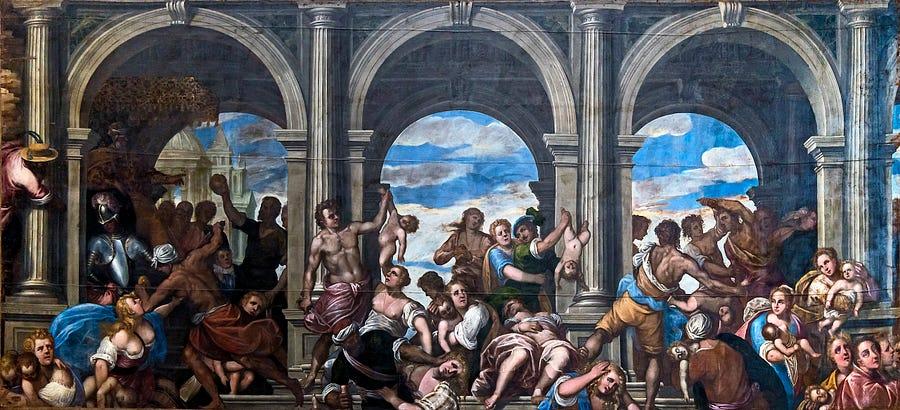
January 6th marks the day in the liturgical calendar when the arrival of the Magi visiting baby Jesus with their gifts is celebrated. But with it comes the often distressing account of what is known as the Massacre of the Innocents. Matthew places this moment of revelation of Jesus as King alongside one of the darkest episodes in his Gospel, and it’s a stark contrast: one King is here to bring peace on earth, as the angels declared, the other king brought death and destruction. For some readers, this raises an immediate historical question. If Herod truly ordered the killing of all the male children under two in Bethlehem, why does no other ancient historian mention it? Josephus, after all, delights in cataloguing Herod’s cruelty. He records the execution of Herod’s wife, his sons, and numerous political rivals. Herod was paranoid and vicious. As for Herod, if he had before any doubt about the slaughter of his sons, there was now no longer any room left in his soul for it; but he had banished away whatsoever might afford him the least suggestion of reasoning better about this matter, so he already made haste to bring his purpose to a conclusion. He also brought out three hundred of the officers that were under an accusation … whom the multitude stoned with whatsoever came to hand, and thereby slew them. — Josephus, Antiquities of the Jews 16.11.7 So, why the silence here about Bethlehem? The answer, I would say, isn’t anything nefarious or made-up by Matthew, but just something simply down to scale. Bethlehem Was a Very Small Place Bethlehem in the early first century was not a city. It was a village — small, agricultural, and politically insignificant. Most historians estimate its population at somewhere between 300 and 1,000 people, with around 500 being a sensible midpoint. Once we factor in ancient demographics, the numbers become surprisingly modest. Modern demographic research into pre-industrial societies consistently shows that nearly half of all children died before adulthood, with the highest concentration of deaths occurring in the first two years of life. These findings align closely with conditions in Roman-period Judea and support conservative estimates for the number of infants living in a small village such as Bethlehem. Source: Mortality in the past: every second child died — Our World in Data In pre-modern societies with high infant mortality, only about 2–3% of the population would be living children under the age of two at any given time. Many children were born; far fewer survived those earliest years. Applying a conservative 2.5% figure to Bethlehem gives us roughly: 7–8 children under two in a village of 300 12–13 children under two in a village of 500 25 children under two even at the extreme upper estimate of 1,000 inhabitants Herod’s order, however, targeted male children only. Statistically, that halves the number. This places the likely number of victims somewhere between three and twelve boys. Matthew’s reference to ‘Bethlehem and the surrounding region’ does slightly widen the scope of Herod’s order, but not by enough to change the demographic picture. Even when nearby settlements are included (e.g. farmsteads, shepherd settlements, etc. not major cities/towns), the total number of children under two likely remained in the dozens rather than the hundreds, maybe anywhere between 14–45 boys maximum if we make an educated estimate. This is entirely consistent with what we know of population size and infant mortality in the ancient world. This is an important number to realise and consider. Not because the deaths are insignificant simply due to being so few, but because ancient historians did not record history the way we do now. A small number of peasant children killed in an obscure village would not have registered as a notable event alongside palace intrigue, royal executions, or political upheaval. For Josephus, it wou...

Powered by WebBoss.io 3.7.1
Copyright © 2026 The Sacred Faith: Timeless Truths for Modern Minds. All Rights Reserved.
