
Blog Search Results


139 results for had
found
within the Blog
6 displayed out of 139 (0.04seconds)Page 5 of 24
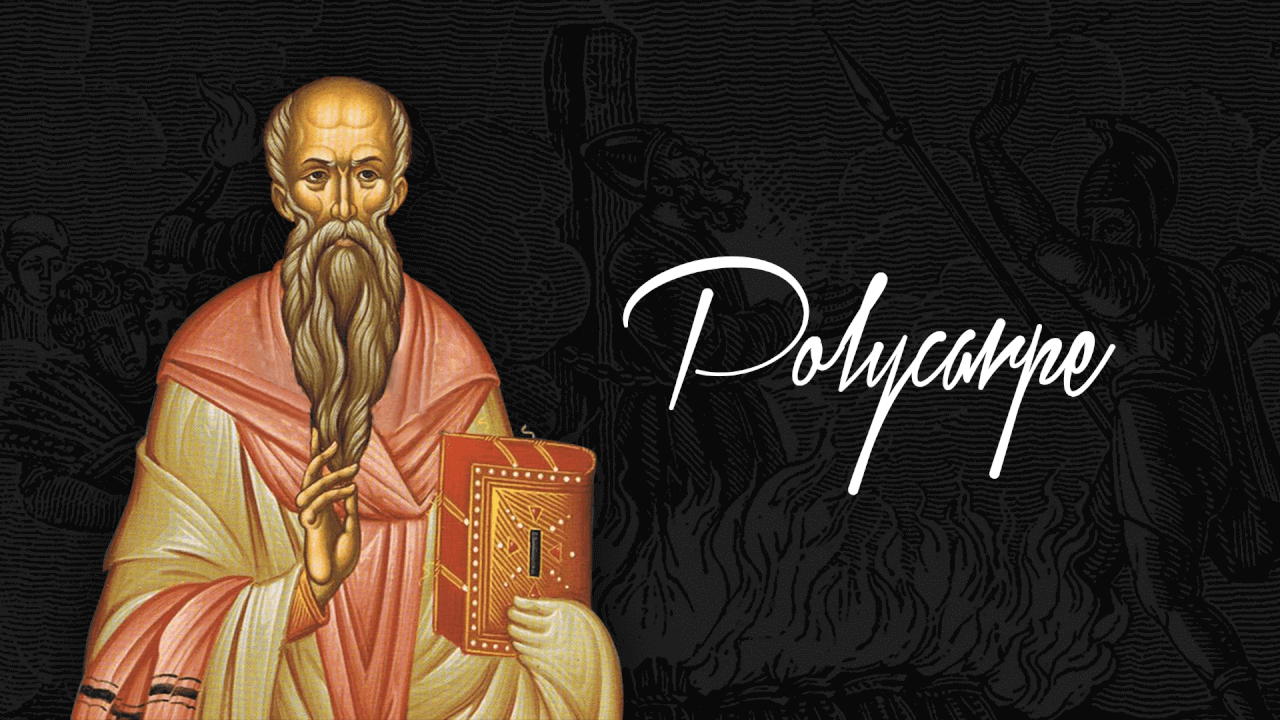
How Polycarp (And Others) Show The Early Use Of The New Testament
Posted by Luke J. Wilson on 21st November 2021 in Early Church | early church,early church fathers,polycarp,new testament,canon,biblical canon
Polycarp is one of the most important people in early church history. He was a disciple of John the Evangelist, and later became the bishop of Smyrna.
Polycarp was born around 69 A.D. in Smyrna, which is now modern-day Turkey. He grew up during a time when Christians were being persecuted for their beliefs, and he himself became a Christian at a young age. Polycarp is regarded as one of the earliest church fathers because he had a significant impact on Christianity as it spread throughout Asia Minor and Europe, and he also played an important role in shaping biblical canon for centuries to come.
We don’t know a great deal about his life, apart from t...
Support Israel? OK, which Israel?
Posted by Luke J. Wilson on 9th August 2014 in Israel | Israel,war,politics,current events,Hamas,terrorism,promised land,Church Fathers,pacifism,nonviolence,New Covenant
...enturies, had some things to say on violence and joining the military in general. They weren't all in total agreement; some were complete pacifists, whereas others seemed to advocate non-violence but permitted self-defense. I'll just put a few quotes to make the point, but you can read more here about what they had to say, and by looking at the links at the end of this article for more info.
We refrain from making war on our enemies, and [we] cannot bear to see a man killed, even if killed justly.
— Justin Martyr
He who holds the sword must cast it away and that if one of the faithful becomes a soldier, he must be rejected by the Church, for he h...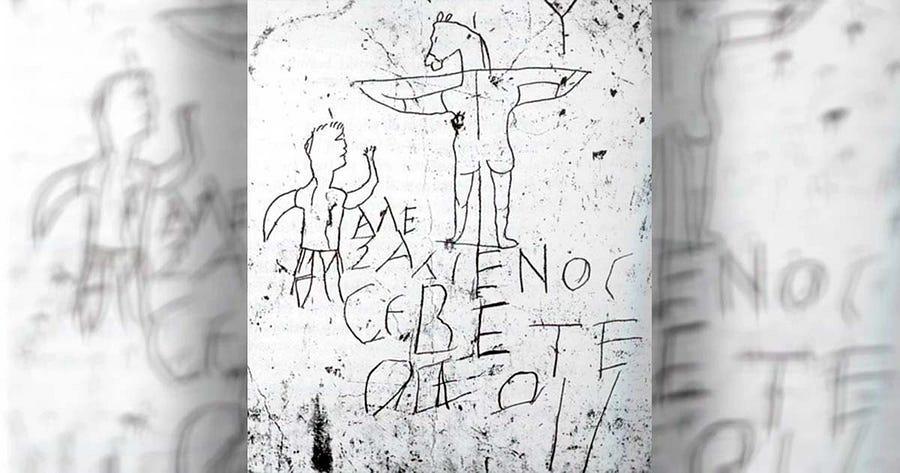
The World's Oldest Anti-Christian Meme
Posted by Luke J. Wilson on 9th March 2026 in Archaeology | Alexamenos graffito,archaeology,history
...I first came across the Alexamenos graffito back in Bible college in the early 2000s. It was one of those “fun facts” that gets dropped into a church history lecture and sticks with you — the ancient Roman equivalent of someone spray-painting an insult on a wall. I filed it away, thought it was fascinating, and largely forgot about it for two decades.
Then, recently, I discovered something about it I had never known. There’s a response to it. Scratched in a different room, in a different hand.
So I started digging into this more to verify the information and discovered more historical curiosities surrounding the graffiti than I ever knew existed wh...
Why do bad things happen to 'good' people?
Posted by Luke J. Wilson on 6th April 2014 in Judgement | judgement,good people,bad things,mercy,grace,Job,divine pushishment
...disciples had a similar question in John 9:1-3 when they came across a man who had been born blind, and asked Jesus whose fault it was - the man's or his parents? I find this particularly interesting as the man was born blind, yet they wonder if it was his fault - how could that be? It definitely highlights some interesting theology of the day if there was a general assumption that sin was always someone's fault - like a punishment, even if you were born like that! Jesus simply responds that it was no ones fault, but it was so that "God’s works might be revealed in him" (v.3). This man's blindness was not a divine punishment, but rather just something that...
Lent Day 22: Athanasius: Life of Anthony: Chaps. 11-20
Posted by Luke J. Wilson on 25th March 2017 in Lent | Lent,great lent,fasting,early church fathers,devotional,daily reading,Athanasius,Bishop of Alexandria,Confessor,Doctor of the Church,Anthony the Great
...Day Twenty-two: St. Athanasius: Life of Anthony: Chaps. 11-20
Who: Bishop of Alexandria; Confessor and Doctor of the Church; born c. 296; died 2 May, 373 AD. He was the main defender of orthodoxy in the 4th-century battle against the Arianism heresy. Certain writers received the title “Doctor” on account of the great advantage their doctrine had on the whole Church, Athanasius especially for his doctrine on the incarnation.
What: The biography of Anthony the Great’s life, which helped to spread the concept of Christian monasticism, particularly in Western Europe.
Why: From the letter’s own prologue: “The life and conversation of our holy Father,...
Lent Day 37: Leo the Great: Letter XXVIII (called the "Tome")
Posted by Luke J. Wilson on 12th April 2017 in Lent | Lent,great lent,fasting,early church fathers,devotional,daily reading,Doctor of the Church,lectures,Tome,Leo the Great,St Leo,hypostatic union,deity of christ,heresy,Pope Leo I
...Eutyches had read all these things closely, “then he would not speak so erroneously as to say that the Word became flesh in such a way that Christ, born of the Virgin's womb, had the form of man, but had not the reality of His mother's body”, which sounds a lot like Docetism, the heresy which was around much more a couple of centuries earlier.
Instead, and in contrast to this, the commonly accepted doctrine on the nature of Jesus is explained by Leo as being, “without detriment therefore to the properties of either nature and substance which then came together in one person, majesty took on humility, strength weakness, eternity mortality...”. In theolo...
Powered by WebBoss.io 3.7.1
Copyright © 2026 The Sacred Faith: Timeless Truths for Modern Minds. All Rights Reserved.
