
Blog Search Results


Did you mean:
matthew 24
?
74 results for Matthew 24
found
within the Blog
6 displayed out of 74 (0.78seconds)Page 8 of 13

Is it the end of the world as we know it?
Posted by Luke J. Wilson on 27th September 2015 in Eschatology | blood moon,last days,end of the world,second coming,apocalypse,prophecy,false prophets,predictions
...s day.
Matthew 24:29 is sometimes included in this type of thing, despite there not being a mention of a red moon, but that "the moon will not give its light" instead. Arguably, Matthew 24 and Revelation 6 are speaking about the same event here, as Jesus also says that "the sun will be darkened" too.
The list becomes a little shorter when you consider that the reference in Acts is actually a quote from the prophecy in Joel. So in actuality, this blood red moon is only really spoken of twice.
What's more interesting, and also a little bit of a death knell for this blood moon theology, is that in Acts 2 when Peter is quoting the prophecy in Joel, he doesn'...
Coffee With Jesus: Luke 22–23
Posted by Luke J. Wilson on 8th February 2023 in Devotional | Kingdom of God,crucifixion,gospels,Last Supper
...Brief Thoughts From Daily Devotions
I’m going to start a new infrequent sub-series called “Coffee with Jesus”, which will be short blogs based on whatever I’m currently reading in the Bible during my morning devotions (as I drink my coffee, hence the name). They won’t necessarily be in any specific order, unless something particularly strikes me each day as I’m reading through a book of the Bible.
Today’s observation comes from Luke 22–23 concerning the Last Supper and the crucifixion of Jesus.
Reading Luke 22, something stood out to me that I hadn’t considered before: at the Passover meal, Jesus says he won’t drink wine again until the Ki...Was the omniscience of God a developed idea?
Posted by Luke J. Wilson on 21st April 2014 in The Nature of God | progressive revelation, Christocentric, Christotelic, Hermeneutics, omniscience, omnipresence, theology
...Or do we retroactively place our current theology of God on God?
Consider the Garden of Eden: '[T]he Lord God called to the man, and said to him, “Where are you?”' (Gen. 3:8-10)
Now today we make it into a rhetorical question, but was this always so? In this story, God is spoken of almost in a physical-bodily sense as walking in the garden, since "they heard the sound of the Lord God walking in the garden" as he moved about, and then tried to hide themselves from his view!
Next think of the tower of Babel - "The Lord came down to see the city and the tower, which mortals had built" (Gen 11:5) - Did he not just know already? Also this story...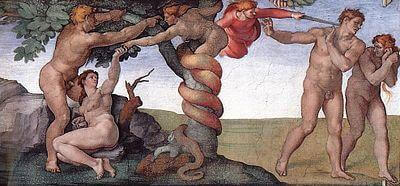
Was there death before the Fall?
Posted by Luke J. Wilson on 15th April 2014 in Death | Sheol,the Fall,Creation,Genesis,Adam and Eve,death,resurrection
...It is often said and believed by many that our souls are immortal - that God gave us a spirit/soul that cannot die when he created us, and that death was not even a concept or reality before Adam and Eve sinned in the Garden of Eden. Despite this idea being a fairly "recent" concept (in terms of history and theology), and it stemming from Greek philosophy, it's also not supported by the Biblical text - especially in Genesis.
Lets look at the creation account in Gen 2:7—
then the Lord God formed man from the dust of the ground, and breathed into his nostrils the breath of life; and the man became a living being.
The word "being" in that verse, or "sou...
Lent Day 39: Leo the Great: Sermon XLIX (On Lent XI)
Posted by Luke J. Wilson on 14th April 2017 in Lent | Lent,great lent,fasting,early church fathers,devotional,daily reading,Doctor of the Church,lectures,Leo the Great,St Leo,Pope Leo I,sermon,almsgiving
...Day Thirty-nine: St. Leo the Great: Sermon XLIX (On Lent XI)
Who: Leo the Great, also known as Pope St. Leo I (the Great), was Pope from 440-61 AD. Place and date of birth unknown; died 10 November, 461. Leo's pontificate, next to that of St. Gregory I, is the most significant and important in Christian antiquity, as he tried to combat the heresies which seriously threatened church unity even in the West, such as Pelagianism.
What: A sermon on the season of Lent as the Easter festival approached.
Why: To encourage the Church to fast during this season in order than they may put away temptations and overcome their vices, to be guided by God in all things.
W...
Man-Made Tradition vs Apostolic Tradition
Posted by Luke J. Wilson on 28th February 2016 in Early Church | early church,early church fathers,tradition,creeds,nicene creed,apostolic creed,man made tradition,apostolic tradition
...Quite often in discussions which are about or involve some aspects of early church history or practices earlier Christians did, someone will inevitably throw out the "show stopper" that is "it's all just man made tradition" therefore not valid and the discussion is over. It’s as though saying it's "man made", without considering anything other than that they can't find an isolated chapter and verse in the bible which states something explicitly, means they've "won" the debate!
Nothing more to see here folks, someone told us it's man made so we can all go home now. Either that, or the mere mention of the word “tradition” and suddenly you’re accused of be...
Powered by WebBoss.io 3.7.1
Copyright © 2026 The Sacred Faith: Timeless Truths for Modern Minds. All Rights Reserved.
