
Blog Search Results


8 results for archaeology
found
within the Blog
6 displayed out of 8 (0.30seconds)Page 1 of 2

Jesus Like You've Never Seen Before - Discoveries from Early Christian Art
Posted by Luke J. Wilson on 13th May 2023 in archaeology | archaeology,icons,Jesus,history,historical
I recently made a video on TikTok about what Jesus looks like in religious art and icons across various cultures, showing that people see Jesus as relatable to them and their people groups, and thus often depict Jesus looking the same as their own race. There was a comment made claiming that the Christ Pantocrator icon is exactly what Jesus looked like, and thus all others are wrong. If you’re wondering about the icon name, Pantocrator (Greek: Παντοκράτωρ) literally means “ruler of all”, but usually gets translated as “Almighty” or “all-powerful”.
The oldest known icon of Christ Pantocrator,6th-century encaustic icon fromSaint Catheri...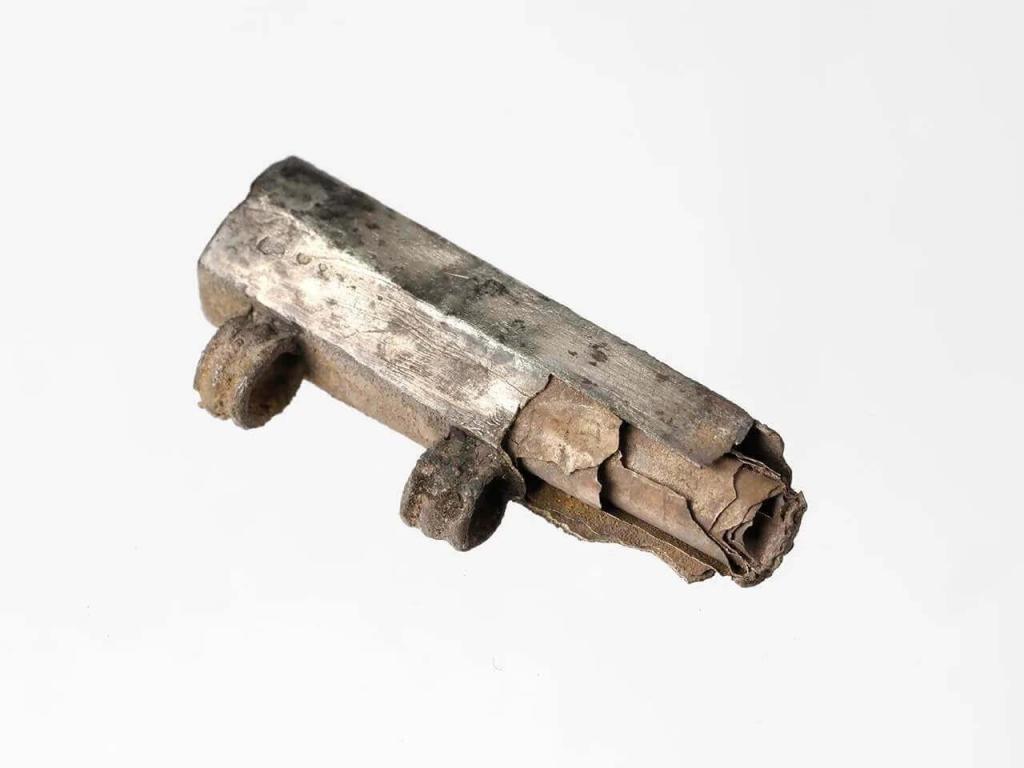
Ancient Amulet Rewrites History Of Christianity In Europe
Posted by Luke J. Wilson on 18th December 2024 in archaeology | archaeology,amulet,discovery,current events,protection amulet
New discovery proclaims Jesus as “Son of God” a century earlier than previously thought.
An exciting archaeological discovery has recently come to light: researchers have unearthed an 1800-year-old silver amulet in Frankfurt, Germany. This amulet provides the earliest known evidence of Christianity north of the Alps and disrupts previously held ideas about the spread of the faith, namely that Christianity didn’t get to the German region around the fourth century.
The amulet, dating from approximately 230 to 270 AD, was found in 2018 beneath the chin of a man’s skeleton during excavations at a Roman burial site near the former town of Nida, now part o...
Ancient “curse” amulet drastically changes perspective on Biblical dating
Posted by Luke J. Wilson on 26th March 2022 in archaeology | current events,archaeology,curse amulet,Jerusalem Post
On Thursday at ancient Shiloh, Dr. Scott Stripling, director of excavations for the Associates for Biblical Research (ABR), presented new findings which may well be one of the most significant discoveries in biblical archaeology in recent times!
More than thirty years ago, Prof. Adam Zertal discovered a small lead amulet, only two centimetres square, from wet-sifting material taken from an excavation on Mount Ebal. This came from a square altar dated from the 13th century BC, which had been built on top of an older and circular altar. Prof. Zertal believed this was the same altar Joshua built when he entered the land of Israel:
Josh. 8:30Then Joshua built on M...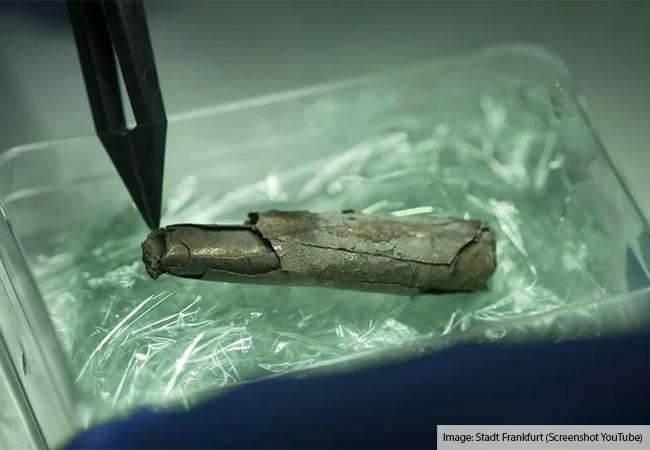
Implications Of The Frankfurt Silver Amulet: Insights Into Early Christian Practice And Belief
Posted by Luke J. Wilson on 6th January 2025 in archaeology | amulet,liturgy,history,current events,early church
...izons for archaeology, the historical sciences, and theology while raising many new questions.
What other artefacts might still be buried in this Roman cemetery? Could further finds reveal more about the lives of these early Christians? As theologians and historians continue to study this discovery, it should inspire and challenge us modern believers to reflect on our own faith and its deep historical roots. Let it inspire a renewed devotion to the Lord Jesus Christ in us, who was boldly proclaimed even in times of persecution.
Further Reading
Ancient Amulet Rewrites History of Christianity in Europe | by Luke J. Wilson | Dec, 2024 | Medium
“Frankfurt...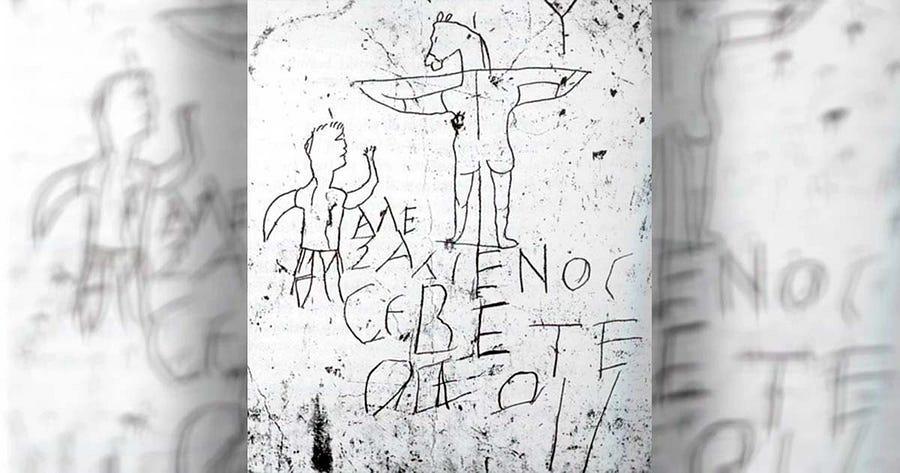
The World's Oldest Anti-Christian Meme
Posted by Luke J. Wilson on 9th March 2026 in archaeology | Alexamenos graffito,archaeology,history
...I first came across the Alexamenos graffito back in Bible college in the early 2000s. It was one of those “fun facts” that gets dropped into a church history lecture and sticks with you — the ancient Roman equivalent of someone spray-painting an insult on a wall. I filed it away, thought it was fascinating, and largely forgot about it for two decades.
Then, recently, I discovered something about it I had never known. There’s a response to it. Scratched in a different room, in a different hand.
So I started digging into this more to verify the information and discovered more historical curiosities surrounding the graffiti than I ever knew existed wh...
Scientist Uncovers Hidden 1,750-Year-Old New Testament Translation with Ultraviolet Imaging
Posted by Luke J. Wilson on 17th April 2023 in archaeology | Syriac bible,Codex Sinaiticus,textual criticism,history,archaeology,Old Syriac
...A scientist has reportedly uncovered an ancient translation containing sections of the Gospel of Matthew, believed to be the sole surviving evidence of the fourth manuscript supporting the Old Syriac version of the Gospels.
The research team, which includes medieval expert Grigory Kessel from the Austrian Academy of Sciences (OeAW), employed ultraviolet imaging to reveal the ancient translation concealed beneath three layers of text.
The research, published last month in the journal New Testament Studies, presents an interpretation of Matthew 11:30 to Matthew 12:26, initially translated as part of the Old Syriac translations around 1,500 years ago.
According...
Powered by WebBoss.io 3.7.1
Copyright © 2026 The Sacred Faith: Timeless Truths for Modern Minds. All Rights Reserved.
