
Blog Search Results


Did you mean:
monarchy of the father
?
92 results for monarchy of the Father
found
within the Blog
6 displayed out of 92 (3.32seconds)Page 15 of 16

Patristics.info has launched!
Posted by Luke J. Wilson on 13th September 2019 in Early Church | early church,early church fathers,patristics
Hey everyone, so I’ve launched a new website called Patristics.info to be a new resource for all things early church related. I’ve added a few texts which I already had formatted from my book manuscript, plus other resources like timelines, maps, recommended books etc. I’ll be adding more soon in the coming days.
I’ve also created a “topical index” page too which is auto-generated from the tags on the pages to aid with searching, plus I created a word highlighter on each page so you can search keywords in a text and have them highlighted if you’re looking for particular things.
If anyone would like to be involved to contribute resources or blog...
Why God Is Necessary For Morality
Posted by Darwin to Jesus on 16th April 2025 in Atheism | Fyodor Dostoevsky,Dostoyevsky,Atheism,morality
Guest post by Darwin to Jesus
Dostoevsky famously said, “If there is no God, then everything is permitted.”
For years, as an atheist, I couldn’t understand what he meant, but now I do…
Here’s a simple analogy that shows why only theism can make sense of morality:
Imagine you just got hired at a company.
You show up, set up your desk, and decide to use two large monitors.
No big deal, right?
But then some random guy walks up to you and says: “Hey, you’re not allowed to do that.”
You ask, “What do you mean?”
they say, “You’re not permitted* to use monitors that big.”
In this situation, the correct response would be: “Says who...
Before the Pumpkins: the Barbecued Deacon
Posted by Luke J. Wilson on 31st October 2025 in Halloween | halloween,martyrdom,martyr,Lawrence
In our last post, we walked with Perpetua and Felicity through the sands of the amphitheatre, their faith outshining Rome’s cruelty. Now for the final part in this series, we turn to another of the Church’s earliest heroes — one whose courage was matched by an unexpected wit. His name was Lawrence, a deacon of Rome, remembered across centuries as the man who kept his humour even while lying on the griddle.
the Setting: Rome, AD 258
Under Emperor Valerian, a fresh persecution of Christians swept through the Empire. Bishops, priests, and deacons were hunted down, their property seized, and their churches closed. the bishop of Rome at that time was Six...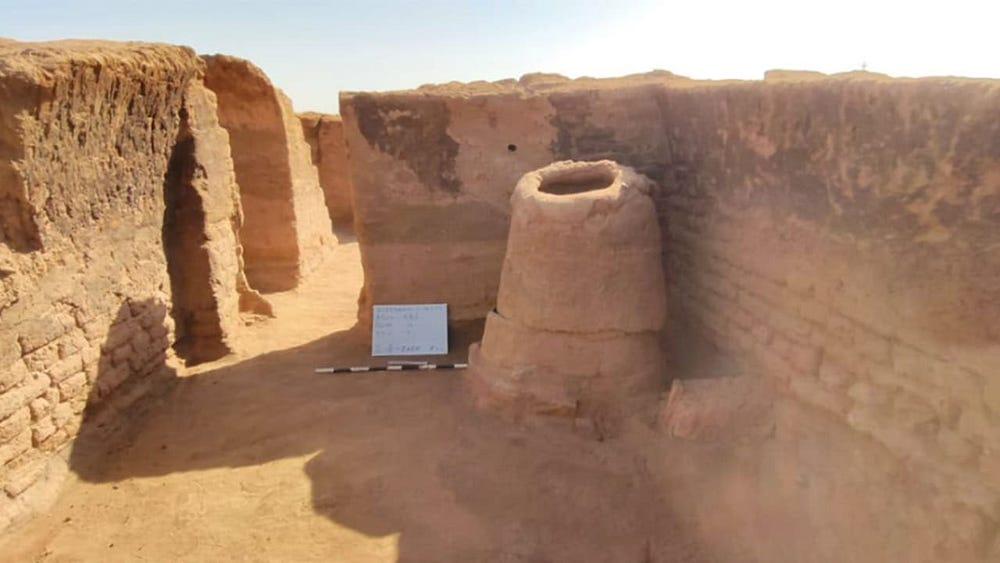
A City In the Sand: What A Fourth-Century Discovery In Egypt’s Western Desert Tells Us About the Early Church
Posted by Luke J. Wilson on 27th July 2026 in Archaeology | archaeology,early church,history
In early July 2026, Egypt’s Ministry of Tourism and Antiquities announced something pretty amazing: an entire Byzantine-era city, buried beneath the sands of the Dakhla Oasis, had been uncovered almost intact! Streets, homes, bread ovens, a fortress, and at its heart, a fourth-century basilica church.
That might not seem very exciting on first glance. But this find deserves a closer look, because it puts flesh on something we usually only encounter in the abstract: what it actually looked like when Christianity took root, house by house, in an ordinary town far from the centres of imperial power.
What Was Found
the excavation, carried out by an Egy...Was the omniscience of God a developed idea?
Posted by Luke J. Wilson on 21st April 2014 in the Nature of God | progressive revelation, Christocentric, Christotelic, Hermeneutics, omniscience, omnipresence, theology
Or do we retroactively place our current theology of God on God?
Consider the Garden of Eden: '[T]he Lord God called to the man, and said to him, “Where are you?”' (Gen. 3:8-10)
Now today we make it into a rhetorical question, but was this always so? In this story, God is spoken of almost in a physical-bodily sense as walking in the garden, since "they heard the sound of the Lord God walking in the garden" as he moved about, and then tried to hide themselves from his view!
Next think of the tower of Babel - "the Lord came down to see the city and the tower, which mortals had built" (Gen 11:5) - Did he not just know already? Also this story...
Humble without the #hashtag
Posted by Luke J. Wilson on 6th November 2015 in Christianity | Christmas,Starbucks,Joshua Feuerstein,red cups,Xmas cups,holiday cups,Jesus,feed the homeless,feed the hungry,hashtag,humble,merrychristmasstarbucks
As much as it a pains me to give this guy any more exposure, sometimes you need to in order to expose something.
First, you need to watch the latest video from Joshua Feuerstein to understand what I'm talking about here:
I do this not to further his “cause” or “movement” but rather to counteract it. Mainly with something more practical, but hopefully also with more common sense too.
It's things like this that give Christianity a bad name. I mean really, is this really what Christians should be worried about? Why not do something more useful like feed the homeless and start a movement that'll actually benefit society AND do something Jesus...
Powered by WebBoss.io 3.7.1
Copyright © 2026 The Sacred Faith: Timeless Truths for Modern Minds. All Rights Reserved.
