
Blog Search Results


171 results for good people
found
within the Blog
6 displayed out of 171 (0.33seconds)Page 6 of 29
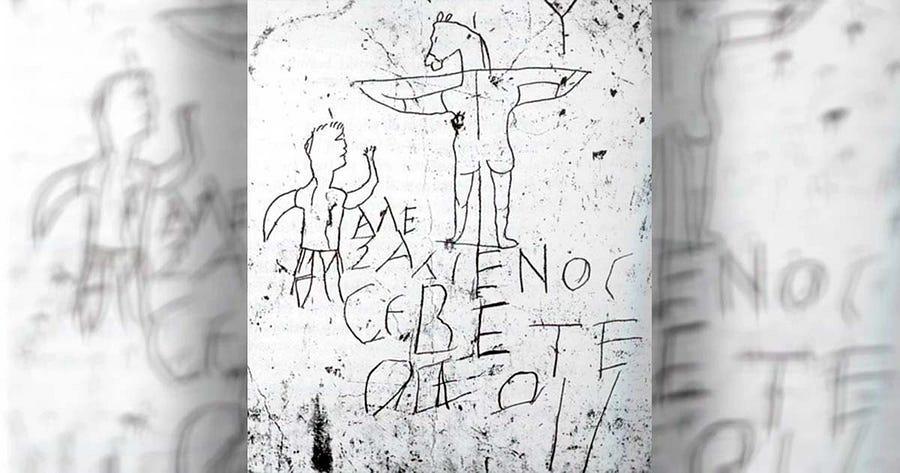
The World's Oldest Anti-Christian Meme
Posted by Luke J. Wilson on 9th March 2026 in Archaeology | Alexamenos graffito,archaeology,history
I first came across the Alexamenos graffito back in Bible college in the early 2000s. It was one of those “fun facts” that gets dropped into a church history lecture and sticks with you — the ancient Roman equivalent of someone spray-painting an insult on a wall. I filed it away, thought it was fascinating, and largely forgot about it for two decades.
Then, recently, I discovered something about it I had never known. There’s a response to it. Scratched in a different room, in a different hand.
So I started digging into this more to verify the information and discovered more historical curiosities surrounding the graffiti than I ever knew existed wh...
Lent: Day 16 - Justin Martyr: First Apology, Chaps. 48-59
Posted by Luke J. Wilson on 18th March 2017 in Lent | Lent,great lent,fasting,early church fathers,devotional,daily reading,Justin Martyr,apologetics
Day Sixteen: St. Justin Martyr: First Apology, Chaps. 48-59
Who: Justin Martyr was a Philosopher who converted to Christianity and became a tireless evangelist and apologist. Justin wrote more Christianity than any other person prior to his time. He is classified herein as Eastern, since he a native of Samaria and his thought patterns were Eastern. However, he spent the last years of his life in Rome, where he was executed as a martyr (c. 165).
What: An apologetic (defence) essay to explain what Christians believe and do.
Why: Justin is demanding the Emperor to investigate accusations and unjust persecution against Christians so that they at least may face...
Man-Made Tradition vs Apostolic Tradition
Posted by Luke J. Wilson on 28th February 2016 in Early Church | early church,early church fathers,tradition,creeds,nicene creed,apostolic creed,man made tradition,apostolic tradition
Quite often in discussions which are about or involve some aspects of early church history or practices earlier Christians did, someone will inevitably throw out the "show stopper" that is "it's all just man made tradition" therefore not valid and the discussion is over. It’s as though saying it's "man made", without considering anything other than that they can't find an isolated chapter and verse in the bible which states something explicitly, means they've "won" the debate!
Nothing more to see here folks, someone told us it's man made so we can all go home now. Either that, or the mere mention of the word “tradition” and suddenly you’re accused of be...
Does The UN Statue Resemble The End Times Beast From Daniel And Revelation?
Posted by Luke J. Wilson on 15th December 2021 in Eschatology |
There’s been a lot of fuss on the internet lately about this new statue that the UN has erected outside their headquarters on the Visitor’s Plaza.
I’ve seen screenshots of the original tweet shared on Facebook and other social media platforms, as well as copious articles flooding my newsfeed, all suggesting the same thing: this is the beast from Daniel 7. This of course carries with it the implication that it is also a fulfilment of that prophecy and therefore we should expect something more to happen soon, like “the antichrist” to rise up and consume the world. Or something along those lines. I don’t follow the Dispensational “end times” view a...
?️ How Do I Become a Christian? A message for Muslims seeking to understand the way of Christ
Posted by Luke J. Wilson on 20th May 2025 in Islam | Islam,islam vs christianity,muslim,Christianity,apologetics
You are not alone. Around the world, many Muslims — people who already believe in one God, pray, and seek to live righteously — are drawn to know more about Jesus (ʿĪsā in Arabic). Some have heard He is more than a prophet. Some have sensed His presence in a dream or vision. And some simply long to know God more deeply, personally, and truly.
So what does it mean to become a Christian? And how can you take that step?
This guide is for you.
1. What Christians Believe About God and Jesus
➤ One God, Eternal and good
Christians believe in one God — the same Creator known to Abraham, Moses, and the prophets. But we also belie...
Lent Day 25: Athanasius: Life of Anthony: Chaps. 41-50
Posted by Luke J. Wilson on 29th March 2017 in Lent | Lent,great lent,fasting,early church fathers,devotional,daily reading,Athanasius,Bishop of Alexandria,Confessor,Doctor of the Church,Anthony the Great,demons,demonology,satan,devil
Day Twenty-five: St. Athanasius: Life of Anthony: Chaps. 41-50
Who: Bishop of Alexandria; Confessor and Doctor of the Church; born c. 296; died 2 May, 373 AD. He was the main defender of orthodoxy in the 4th-century battle against the Arianism heresy. Certain writers received the title “Doctor” on account of the great advantage their doctrine had on the whole Church, Athanasius especially for his doctrine on the incarnation.
What: The biography of Anthony the Great’s life, which helped to spread the concept of Christian monasticism, particularly in Western Europe.
Why: From the letter’s own prologue: “The life and conversation of our holy Father,...
Powered by WebBoss.io 3.7.1
Copyright © 2026 The Sacred Faith: Timeless Truths for Modern Minds. All Rights Reserved.
