
Creedal Christians: The Nicene Creed
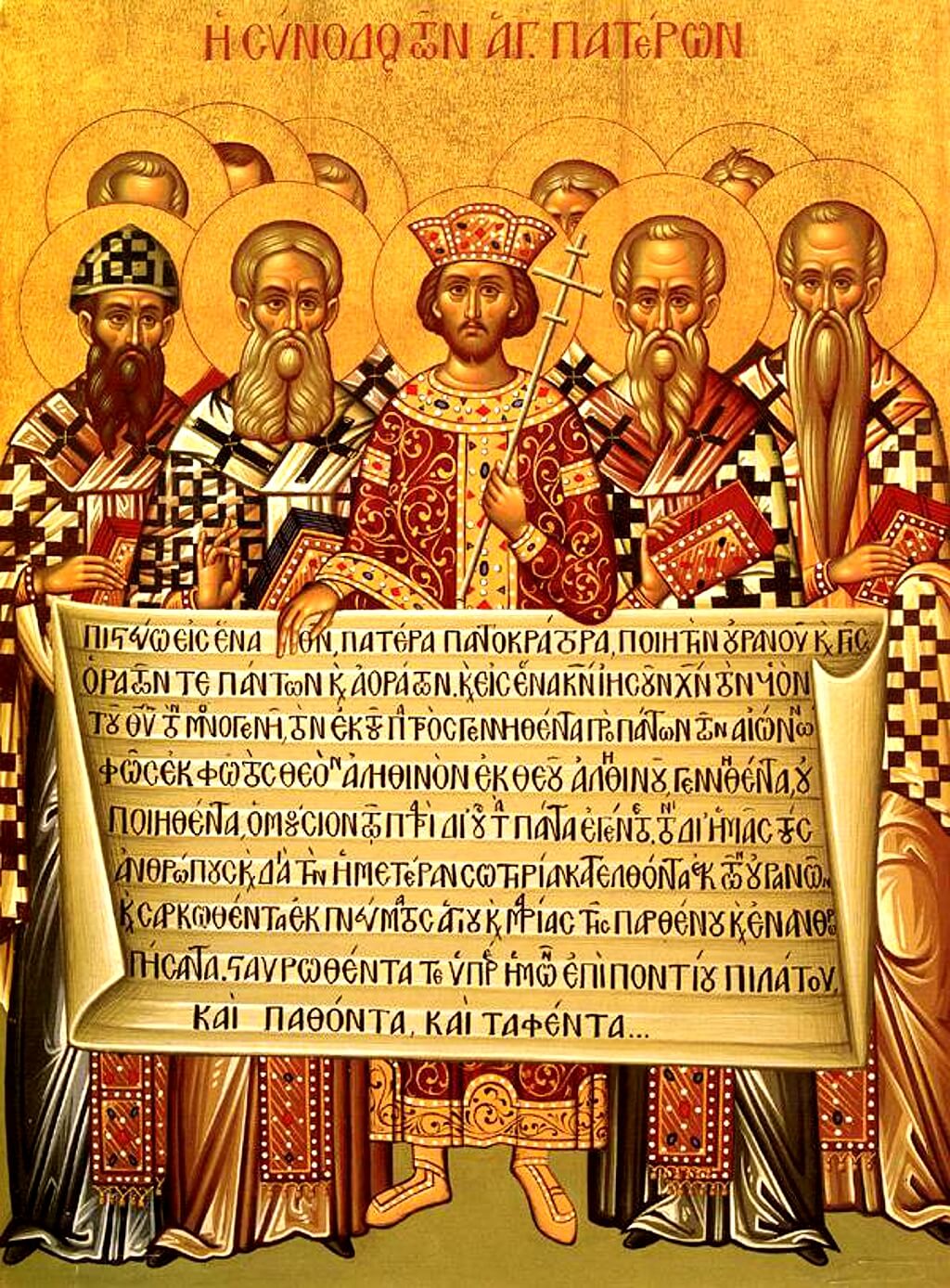
Header Image: Fathers of the First Ecumenical Council of Nicaea
The Nicene Creed — what is it and why is it called that?
This creed gets its name from a time and place: the first ecumenical Church council held at Nicaea, which is now known as İznik in northwestern Turkey, in 325 AD.
Now that may raise another question for you: what is an ecumenical council? Well, to explain more about the Nicene Creed, we are going to have to take a look at The First Council of Nicaea in order to better understand why this creed was written.
First things first though; an “ecumenical council” is ideally a Church-wide meeting where all the Bishops from all across the Church come together to hold a very large and very important meeting to discuss topics and issues affecting the whole Body of Believers, with the results intended to be binding on all believers. Most often, these Councils were called to combat heresy and false teachers who had come about and gained enough popularity that it warranted an official response, with the creeds being the result after proper orthodoxy had been ratified.
Seeking unity, the Council was convened by Constantine I in response to the Arian controversy which had gripped the Greek-speaking East. The teaching of Arius of Alexandria were considered heretical by most bishops of the time, fearing that it would cost people their salvation. 1800 bishops were invited by Constantine (that was every bishop across the Roman Empire), but only around 250-320 turned up from across the Empire, except Britain, according to the various surviving documents from different attendees.
This Council was an extremely historic event as nothing quite like it had happened before since the Council of Jerusalem around 50 AD (Acts 15), which convened in a similar manner to counter controversial and false teaching which was upsetting the Church Body. As with that Council, the Nicene Council and its outcome was intended for the whole of the Church global.
What actually happened at Nicaea
I won’t go into too much detail about everything the Council discussed, but other than condemning and exiling Arius for his false teaching that the Son of God was a created being (or “creature”) out of nothing like the rest of creation, the council aimed to settle on a uniform date for celebrating Easter as the East followed Jewish customs of Passover for the date, and the West followed another custom. Other than that, the other decrees (“canons”) declared were to do with how bishops should be consecrated, how bishops and priests should stay within their parishes and some rules on lending money with interest. There were 20 short canons/rulings in all which you can read here, if you’re interested to see exactly what went on.
For another viewpoint of what occurred during the Council, Eusebius of Cæsarea (who you may know as the author of Ecclesiastical History) was in attendance and wrote a letter covering the events to send back to his Diocese explaining the formation of the creed and why and how they came up with it. You can read his letter here, or you can also read the letter of Athanasius who was also present at the council as a secretary to the Bishop of Alexandria, here. It’s also often said that Nicholas of Myra (also known as Saint Nicholas – yes, that St. Nick) attended and actually slapped Arius across the face(!), but that is most likely an exaggeration at best, or an urban legend.
If you do read the canons of the council and the letters of Eusebius and Athansius, you’ll see that the Nicene Council had some specific goals to achieve and that their main objective was that of the divine nature of Christ and how to deal with the teaching of Arius. What they didn’t do, as some pervasive myths claim, was to “decide what went in the Bible”, “create Catholicism”, “change the Sabbath to Sunday”, or “invent the deity of Christ”! The internet allows for a lot of nonsense to get spread, especially when much of the disinformation was proliferated by a Hollywood film and originated in a bestselling Dan Brown book, The Da Vinci Code.
The Reason for the Creed
First of all, then, in the presence of our most religious Sovereign Constantine, investigation was made of matters concerning the impiety and transgression of Arius and his adherents; and it was unanimously decreed that he and his impious opinion should be anathematized, together with the blasphemous words and speculations in which he indulged, blaspheming the Son of God, and saying that he is from things that are not, and that before he was begotten he was not, and that there was a time when he was not, and that the Son of God is by his free will capable of vice and virtue; saying also that he is a creature.
The Synodal Letter, Council of Nicaea
And the words invented by them [the Arians], and spoken contrary to the mind of Scripture, are as follows:—
God was not always the Father; but there was a time when God was not the Father. The Word of God was not always, but was made 'from things that are not;' for He who is God fashioned the non-existing from the non-existing; wherefore there was a time when He was not. For the Son is a thing created, and a thing made: nor is He like to the Father in substance; nor is He the true and natural Word of the Father; nor is He His true Wisdom; but He is one of the things fashioned and made.
Epistles on Arianism and the Deposition of Arius
These quotes pretty much lay the groundwork for why the creed and council was necessary and what it aimed to achieve: an outline of proper orthodoxy which laid down the correct and Scriptural view concerning the nature of Christ’s divine nature and relation to the Trinity. By making this the official set of beliefs, this was hoped to quash the Arianism which was spreading and unite the churches together in a holy unity (John 17:20-23). And for much of history, this creed has served that purpose in acting as the “gatekeeper” of orthodoxy, pointing people towards the proper understanding of God and the Christian faith via Scripturally-based statements.
Some of you reading this may already be familiar with this creed, others may recognise aspects of it, but you may not realise that the fuller and longer version that is more common actually came around 56 years later from the First Council of Constantinople in 381 AD. The initial creed was much shorter and included a statement at the end specifically targeting the teachings of Arius. This wasn’t the only revision the Nicene Creed went under, as there was another addition many centuries later which caused some serious controversy, which exists even to this day.
The Filioque controversy
“And the Son” – filioque in Latin: the phrase in the creed which has caused the most controversy and division, was not added officially into the Roman Rite (and is still excluded in the East) until much later in 1014 AD; and on the face of it, it seems like such an innocent and small addition. Yet arguably these three little words (or one Latin word) contributed towards the Great Schism of 1054 AD, which split the Eastern and Western Church into what we now know as Roman Catholics (West) and Eastern Orthodoxy (East) as it has large implications on Christology and the doctrine of the Trinity. If you want to read more on the history of this controversy, Wikipedia has a large article on it with many references and sources to follow through on.
The Nicene Creed
In the table below, you will see the original creed from the Nicene Council, plus the additions from the Constantinople Council alongside the where these statements come from in Scripture, so that you can better see the development of this creed. The filioque is included in italics on its own line for clarity.
|
Nicene Creed (325) |
Nicene-Constantinople Creed (381) |
Scriptural Basis |
|
We believe in one God, |
We believe in one God, |
Mark 12:29, 32; Eph 4:6; Deuteronomy 6:4 |
|
the Father Almighty, |
the Father Almighty, |
Matthew 6:9; 2 Cor 6:18; Eph 4:6; Malachi 2:10; Exodus 6:3; Gen 35:11 |
|
maker of heaven and earth, |
Genesis 1:1; John 1:1; Isaiah 44:24 |
|
|
maker of all things visible and invisible; |
and of all things visible and invisible. |
Colossians 1:16; Romans 1:20 |
|
and in one Lord Jesus Christ, |
And in one Lord Jesus Christ, |
Romans 10:9; Eph 4:5,6 |
|
the Son of God, the only-begotten of his Father, |
the only-begotten Son of God, |
John 3:16; Matthew 16:16 |
|
begotten of His Father before all worlds, |
John 1:2 |
|
|
God of God, Light of Light, very God of very God, |
Light of Light, very God of very God, |
John 17:22; John 8:12; John 1:1; Colossians 2:9 |
|
begotten (γεννηθέντα), not made, |
begotten, not made, |
John 1:2; 3:16 |
|
being of one substance (ὁμοούσιον) with the Father. |
being of one substance with the Father, |
John 1:18; 10:30 |
|
By whom all things were made, both which be in heaven and in earth. |
by Whom all things were made. |
Rom 11:36; Hebrews 1:2,10; John 1:3, 10; Col 1:16; 1 Cor 8:6 |
|
Who for us men and for our salvation |
Who for us men and for our salvation |
Col 1:13-14; 1 Thess. 5:9; Matt 1:21; 1 Timothy 2:4; Romans 3:23 |
|
came down |
came down from heaven |
John 3:13, 3:31; 6:38, 41 |
|
and was incarnate |
and was incarnate by the Holy Spirit of the virgin Mary, |
Luke 1:34-35 |
|
and was made man. |
and was made man, |
John 1:14; Heb 2:14 |
|
and was crucified also for us under Pontius Pilate. |
Mark 15:15, 25; John 19:16-18; 1 Peter 2:24 |
|
|
He suffered |
He suffered and was buried, |
John 19:1-3; Luke 23:53; Matt 27:50, 59-60 |
|
and the third day he rose again, |
and the third day he rose again according to the Scriptures, |
1 Corinthians 15:3-4; Luke 24:6, 45-46; Mark 9:31; 16:9; Acts 10:40 |
|
and ascended into heaven. |
and ascended into heaven, |
Acts 1:9 |
|
and sits at the right hand of the Father. |
Mark 16:19; Luke 22:69; Acts 7:55 |
|
|
And he shall come again |
And He shall come again with glory |
Matthew 26:64; Mark 13:26; Jn 14:3; 1 Thess. 4:17 |
|
to judge both the living and the dead. |
to judge both the living and the dead. |
Acts 10:42; Matthew 3:12; 16:27; 2 Cor 5:10; 2 Tim 4:1; 1 Peter 4:5 |
|
Whose kingdom shall have no end. |
Heb 1:8; 2 Peter 1:11 |
|
|
And in the Holy Ghost. |
And we believe in the Holy Spirit, the Lord, the giver of life |
Acts 1:8; John 6:63; 2 Cor 3:6 |
|
Who proceeds from the Father, |
John 15:26 |
|
|
and the Son; (Latin: filioque) |
John 16:7 |
|
|
Who with the Father and the Son is worshipped and glorified, |
2 Corinthians 13:14; Ephesians 1:13-14; 1 Peter 1:2,12; Phil 3:3; Romans 12:1 |
|
|
Who has spoken through the prophets. |
1 Peter 1:10-11; Eph 3:5; Matthew 2:23; Hebrews 1:1 |
|
|
And we believe in one, holy, catholic (universal) and Apostolic Church. |
Eph 4:4; Eph 1:4, 5:27; Matt 28:19; John 17:20-23; Acts 1:8; Eph 2:20; Matt 16:18; Rom 12: 4-5; 1 Cor 10:17; Col 1:18 |
|
|
We acknowledge one baptism |
Eph 4:5; Gal 3:27; 1 Cor 12:13 |
|
|
for the forgiveness of sins, |
Acts 2:38; 22:16; Col 2: 12-13; 1 Peter 3:21 |
|
|
we look for the resurrection of the dead |
John 11:25; Luke 20:36; John 5:28-29; Rom 6:4-5; 1 Thess. 4:16 |
|
|
And the life of the world to come. Amen. |
2 Peter 3:13; Rev 21:1 |
|
|
And whosoever shall say that there was a time when the Son of God was not (ἤν ποτε ὅτε οὐκ ἦν), or that before he was begotten he was not, or that he was made of things that were not, or that he is of a different substance or essence [from the Father] or that he is a creature, or subject to change or conversion (τρεπτὸν) — all that so say, the Catholic and Apostolic Church anathematizes them. |
That's all for the Council of Nicaea, I hope this has helped to clarify what happened at Nicaea and why the Church decided to create such a creed in defense of true doctrine against heresy; and if you missed it before, you can also read my article about the Apostle’s Creed to see how and why that came about.
Don’t forget to subscribe so you don’t miss any more updates in this series and leave any thoughts in the comments below!
Further Reading and Sources:
- Letter of Eusebius on the Council of Nicaea (eyewitness account)
- Athanasius, Letter to Bishops of Africa
- Athanasius, Defense of the Nicene Definition (eyewitness account)
- First Council of Nicæa (A.D. 325) - 20 Canons
- First Council of Constantinople (A.D. 381)
- Epistles on Arianism and the Deposition of Arius
- Definition: Anathema
- https://www.thegospelcoalition.org/blogs/ryan-reeves/who-was-athanasius-and-why-was-he-important/
- https://www.christianitytoday.com/history/people/scholarsandscientists/eusebius-of-caesarea.html
- https://www.cs.mcgill.ca/~rwest/wikispeedia/wpcd/wp/f/First_Council_of_Nicaea.htm
- https://www.britannica.com/event/Council-of-Nicaea-Christianity-325
- https://www.theopedia.com/ecumenical-councils
- http://www.prayerfoundation.org/nicene_creed_scripture_basis.htm
- https://brewminate.com/filioque-and-the-latin-greek-great-schism-of-1054/
- http://www.oxfordbiblicalstudies.com/article/opr/t94/e389
- https://en.wikipedia.org/wiki/History_of_the_Filioque_controversy
- http://www.religionfacts.com/da-vinci-code/nicea
Leave a comment Like Back to Top Seen 4.1K times Liked 1 times

Enjoying this content?
Support my work by becoming a patron on Patreon!
By joining, you help fund the time, research, and effort that goes into creating this content — and you’ll also get access to exclusive perks and updates.
Even a small amount per month makes a real difference. Thank you for your support!
x
Subscribe to Updates
If you enjoyed this, why not subscribe to free email updates and join over 897 subscribers today!
My new book is out now! Order today wherever you get books
Subscribe to Blog updates
Alternatively, you can subscribe via RSS 
All email subscriptions must be confirmed to comply with GDPR.
Related Posts
Luke J. Wilson | 28th February 2025 | Early Church

The Bible is often described as “God-breathed,” a phrase taken from 2 Timothy 3:16: “All scripture is inspired by God and is useful for teaching, for reproof, for correction, and for training in righteousness.” But what does it mean for Scripture to be “inspired,” and how did the books of the Bible come to be recognised as part of the canon — the authoritative collection of writings that make up the Bible? Were they really “decided” at the Council of Nicaea, as some popular myths claim? Table of Contents Understanding Biblical Inspiration What is the Canon? The Septuagint and the Deuterocanonical Books How Were the Books of the Bible Selected? Why Were Some Books Excluded? Has the Bible Been Edited or Corrupted Over Time? Did the Church Decide the Canon at Nicaea? Conclusion Further Reading Understanding Biblical Inspiration A helpful analogy for inspiration is that of an architect designing a great building. Consider St. Paul’s Cathedral in London — Christopher Wren was the architect who planned and designed it, yet he himself did not lay a single brick. Instead, countless workers followed his design to bring the cathedral into existence. Similarly, God is the ultimate author of Scripture, yet He worked through human writers to bring His message to us. The Holy Spirit inspired them, guiding their words while allowing their personalities, historical context, and literary style to remain evident in their writings. This means that while the Bible is written by human hands, it carries divine authority because its true source is God Himself. The process of inspiration does not mean God dictated each word like a secretary taking notes, or by possessing the authors, but rather that He ensured the truth of His message was faithfully recorded by the biblical writers. What is the Canon? The word “canon” comes from the Greek κανών (kanōn), meaning “rule” or “measuring rod.” In the context of the Bible, the canon refers to the official list of books recognised as divinely inspired and authoritative for faith and practice. The canon developed over time as the early church recognised which writings carried divine authority. The Old Testament canon was largely settled by the time of Jesus, based on the Hebrew Scriptures used in the Jewish community. The New Testament canon, however, was formed through a process of discernment over several centuries, as the church recognised which writings were truly inspired and authoritative. The Septuagint and the Deuterocanonical Books The Septuagint (LXX) is the Greek translation of the Hebrew Scriptures, produced in the 3rd-2nd centuries BC. It was widely used by Greek-speaking Jews and later by early Christians, including the apostles. The Septuagint included several books not found in the Hebrew Bible, known as the Deuterocanonical books (such as Tobit, Judith, Wisdom, and 1–2 Maccabees). While these books were accepted in many early Christian communities and remain part of the canon in Catholic and Orthodox traditions, Protestant reformers later removed them, considering them useful but not divinely inspired at the same level as the rest of Scripture. The reformers’ view was influenced by Jerome, who, in the 4th century, argued that these books were not part of the Hebrew Bible and therefore should be considered separate. However, he still included them in his Latin Vulgate translation, recognising their historical and devotional value. The Reformers followed Jerome’s stance, moving these books into a separate section rather than outright removing them. It was not until the 19th century that an American Bible Society, citing printing costs and other practical considerations, physically removed these books entirely from Protestant Bibles. This decision solidified what is now commonly referred to as the “Protestant canon” of 66 books. And the other Books (as Hierome saith) the Church doth read for example o...
Luke J. Wilson | 23rd December 2023 | Early Church
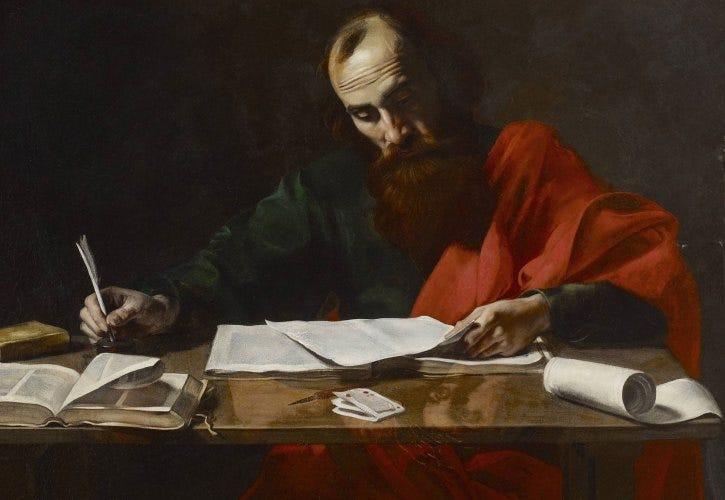
A common modern perception of the inspiration of Scripture often portrays it as a rigid, divine dictation of words from God to be written down verbatim. This perspective leads to concerns among some religious communities, such as Muslims, who view any alteration or addition to the text as a potential threat to the entire faith. The Islamic understanding of inspiration emphasises direct and unalterable divine dictation, contributing to their scepticism of multiple Bible translations, which they falsely label as “corruption”. In contrast, the Biblical inspiration of the Scriptures has never been viewed as a literal divine dictation, as if the apostles were under a holy spell ensuring word-for-word accuracy. Dr Michael Heiser emphasises that the writers were influenced by God through the circumstances of providence, with God guiding them to write what was deemed necessary for posterity. This perspective shifts the focus of inspiration from the writers to the ultimate, providential guidance of God. The canonisation of the New Testament was not a straightforward process. The authority of the authors played a crucial role, and texts were included based on their ability to teach the fullness of salvation and faith. Noteworthy texts, like the Didache, were highly regarded, read, and taught to new converts but did not meet the specific criteria for canonisation. The canon was a dynamic concept, and some New Testament books faced scepticism before gaining widespread acceptance. These texts were known as “antilegomena” (from Greek ἀντιλεγόμενα) literally meaning “spoken against”. In the Early Church, the antilegomena enjoyed widespread readership, encompassing works such as the Epistle of James, Jude, 2 Peter, 2 and 3 John, the Book of Revelation, the Gospel of the Hebrews, the Epistle to the Hebrews, the Apocalypse of Peter, the Acts of Paul, the Shepherd of Hermas, the Epistle of Barnabas, and the Didache. Within the Early Church, there existed differing opinions on whether these particular texts merited canonical status, though. Eusebius, who wrote Church History (~325), used the Greek term “antilegomena” to refer to the group of disputed writings. He uses this word in two places when speaking about these texts: It is not indeed right to overlook the fact that some have rejected the Epistle to the Hebrews, saying that it is disputed [αντιλέγεσθαι] by the Church of Rome, on the ground that it was not written by Paul. (3.3.5) Among the disputed writings [των αντιλεγομένων], which are nevertheless recognized by many, are extant the so-called epistle of James and that of Jude, also the second epistle of Peter, and those that are called the second and third of John, whether they belong to the evangelist or to another person of the same name. Among the rejected writings must be reckoned also the Acts of Paul, and the so-called Shepherd, and the Apocalypse of Peter, and in addition to these the extant epistle of Barnabas, and the so-called Teachings of the Apostles; and besides, as I said, the Apocalypse of John, if it seem proper, which some, as I said, reject, but which others class with the accepted books. And among these some have placed also the Gospel according to the Hebrews, with which those of the Hebrews that have accepted Christ are especially delighted. And all these may be reckoned among the disputed books [των αντιλεγομένων]. (3.25.3–5) Delving into specific biblical references, such as 1 Corinthians 5:9 and Colossians 4:16, these verses shed light on the existence of letters by apostles that did not make it into the New Testament. Paul’s mention of an earlier letter in 1 Corinthians and the reference to a letter from Laodicea in Colossians raise questions about missing apostolic letters. However, these omissions should not be a cause for concern. Bart Ehrman, a notable agnostic New Testament scholar and textual critic, says in his book Misquot...
Luke J. Wilson | 20th November 2023 | Early Church
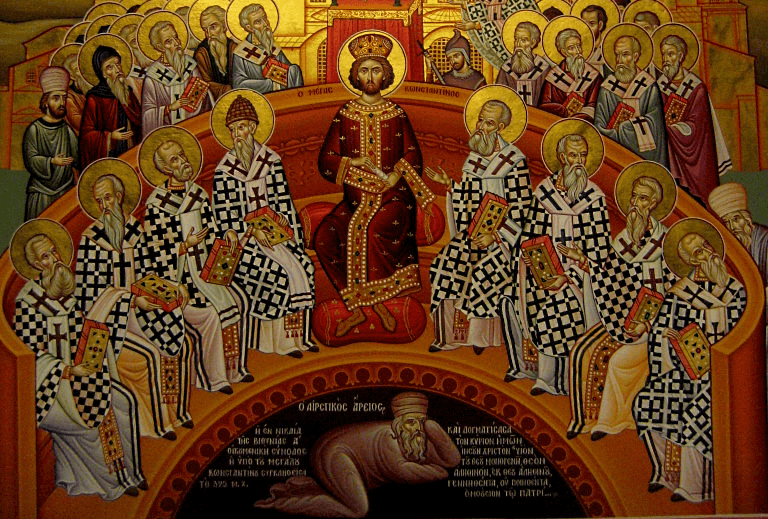
A myth that never seems to fade away: the idea that the Council of Nicaea, convened in 325 AD under the authority of Roman Emperor Constantine, played a pivotal role in establishing the Biblical canon. This notion suggests a conspiracy and power play orchestrated by a select group of elite bishops; a narrative popularised by works like Dan Brown’s Da Vinci Code. However, a closer examination reveals a lack of historical basis for this claim. The Council of Nicaea and the Canon Contrary to popular belief, there is no evidence that the Council of Nicaea discussed or established the Canon of Scripture, leading to the creation of the Bible. Early Christian canon lists and other historical sources indicate that discussions on the canon occurred both before and after the Council of Nicaea. To emphasise that the convened bishops had no interest in this topic, there are no records from the Council or accounts from eyewitness attendees, such as Eusebius or Athanasius, mentioning any deliberations on the Canon of Scripture. The Origin of the Myth The myth of the Council of Nicaea’s involvement in forming the biblical canon can be traced back to a late ninth-century Greek manuscript known as the Synodicon Vetus. This manuscript, claiming to be a summary of decisions from Greek councils up to that point, presented a narrative where a divine miracle occurred at the Council of Nicaea. According to the manuscript, the Lord miraculously separated the canonical books, placing them on the table, while the apocryphal or spurious ones fell beneath. The canonical and apocryphal books it distinguished in the following manner: in the house of God the books were placed down by the holy altar; then the council asked the Lord in prayer that the inspired works be found on top and the spurious on the bottom. (Synodicon Vetus, 35) This account, propagated through various channels, found its way into the works of influential figures like Voltaire in the 18th century. In his Philosophical Dictionary, Voltaire perpetuated the idea that the fathers of the Council of Nicaea distinguished between authentic and apocryphal books through prayer and a miracle, further fuelling the myth. It was then later picked up and revived again in the 19th century by Christian radical Robert Taylor. Debunking the Myth The publication of Synodicon Vetus in 1601 by John Pappus, along with subsequent citations of the miraculous event at Nicaea, contributed to the endurance of this narrative. While Dan Brown did not invent this myth, he certainly exploited and perpetuated it in the modern generation. However, historical evidence shows that the formation of the biblical canon was a more complex process, involving discussions among Christians long before and after the Council of Nicaea. Conclusion In conclusion, the myth that the Council of Nicaea, under Constantine’s influence, played a decisive role in shaping the biblical canon is unfounded. Despite the messy aspects of the history of the canon, there is no indication that it was established by a small group of bishops at the Council of Nicaea in 325 AD. Debunking such myths is crucial for a more accurate understanding of the historical development of the Christian Bible. Further Reading Creedal Christians: The Nicene Creed | The Sacred Faith: Timeless Truths for Modern Minds The Council of Nicaea (Nicea) and the Bible (tertullian.org) John Meade on The Biblical Canon Lists — Phoenix Seminary (ps.edu) The Council of Nicaea and Biblical Canon — Phoenix Seminary (ps.edu) Synodicon Vetus — Wikipedia Voltaire — Wikipedia Robert Taylor (Radical) — Wikipedia The Project Gutenberg eBook of A Philosophical Dictionary, by Voltaire. Bizarre; Notes and Queries; a Monthly Magazine of History, Folk-lore, Mathe… — Google Books ...
Luke J. Wilson | 17th September 2022 | Early Church
A little while ago, I came across a quote on Facebook by a guy called Melito of Sardis. St. Melito of Sardis Melito was bishop of the church in Sardis (modern-day Sart), a city of Asia Minor near Smyrna (modern-day Izmir, Turkey), and lived between 160-170/177 AD until he was martyred, possibly under the reign of Marcus Aurelius. Due to the close proximity of locations, he may also have known Ignatius who was also from Asia Minor, and potentially was also an acquaintance of Polycarp and his disciple, Irenaeus. There’s also the thought that he may have been the successor to the leader of the church in Sardis, which is mentioned by the Apostle John in Revelation 3:1-6. His writings only survive in fragments, as I've recently discovered, but what we do have is a real gem! His writings about Jesus and the Passion are so poetic it’s really quite moving. The way he contrasts the qualities of deity with what Jesus endured as a man in a human body really brings some perspective about just how big of a thing the Incarnation was and what Jesus gave up in coming down to us in that way. Have a read of this quote to see what I mean: The earth shook, and its foundations trembled; the sun fled away, and the elements turned back, and the day was changed into night: for they could not endure the sight of their Lord hanging on a tree. The whole creation was amazed, marvelling and saying, "What new mystery, then, is this?" The Judge is judged, and holds his peace; the Invisible One is seen, and is not ashamed; the Incomprehensible is laid hold upon, and is not indignant; the Illimitable is circumscribed, and doth not resist; the Impossible suffereth, and doth not avenge; the Immortal dieth, and answereth not a word; the Celestial is laid in the grave, and endureth! What new mystery is this? The whole creation, I say, was astonished; but, when our Lord arose from the place of the dead, and trampled death under foot, and bound the strong one, and set man free, then did the whole creation see clearly that for man's sake the Judge was condemned, and the Invisible was seen, and the Illimitable was circumscribed, and the Impassible suffered, and the Immortal died, and the Celestial was laid in the gave. For our Lord, when He was born man, was condemned in order that He might Show mercy, was bound in order that He might loose, was seized in order that He might release, suffered in order that He might feel compassion, died in order that He might give life, was laid in the grave that He might raise from the dead. – Melito of Sardis, Discourse on Soul and Body Speaking to "mysteries", it reminds me of this verse that Paul writes to Timothy, which is also poetic in its structure and is possibly an early form of a hymn, as some scholars believe: 1 Timothy 3:16 (HCSB) And most certainly, the mystery of godliness is great: [God] was manifested in the flesh, vindicated in the Spirit, seen by angels, preached among the nations, believed on in the world, taken up in glory. If you’re familiar with the Anglican liturgy (and it may be the same in other liturgical churches, I’m not sure), we will often recite similar words speaking to the mystery: “Great is the mystery of faith: Christ has died, Christ has risen, Christ will come again!”. What we believe and live by in the life, death and resurrection of Jesus is a mystery! It is a strange and powerful thing that God did by sending his Son in the form of a human to grow, teach and ultimately die for us so that we can be made righteous and adopted into the family of God. I don’t think we’ll ever quite wrap our heads around it all fully. I’m going to end this with another poetic excerpt from Melito. I find this to be a very powerful image of what Jesus did for us. I get chills every time I read it. Take a moment to really ponder on these words as you read them and consider the fullness of what happened when Jesus gave his life for us all and just how much of a s...
Luke J. Wilson | 09th March 2026 | Archaeology
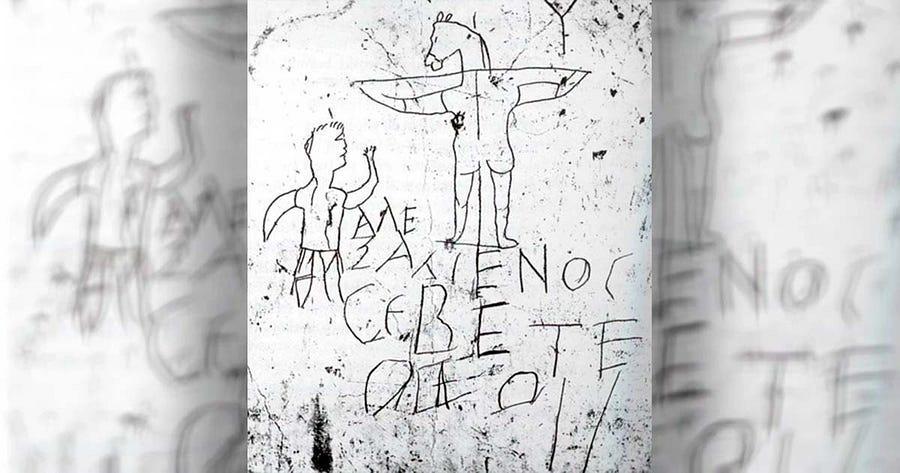
I first came across the Alexamenos graffito back in Bible college in the early 2000s. It was one of those “fun facts” that gets dropped into a church history lecture and sticks with you — the ancient Roman equivalent of someone spray-painting an insult on a wall. I filed it away, thought it was fascinating, and largely forgot about it for two decades. Then, recently, I discovered something about it I had never known. There’s a response to it. Scratched in a different room, in a different hand. So I started digging into this more to verify the information and discovered more historical curiosities surrounding the graffiti than I ever knew existed which contextualises the image so much more than it just being a random insult using a donkey. A Crude Drawing on a Wall Sometime around the late second to early third century AD, someone scratched a picture into the plaster wall of a building on the Palatine Hill in Rome — part of what had once been a paedagogium, a kind of boarding school for imperial page boys. The building was eventually sealed off when the street was walled up to support extensions above it, which is why the graffiti survived at all. It wasn’t rediscovered until 1857. The image is rough, almost childlike. To the left, a young man — clearly a Roman soldier or guard — raises one hand in a gesture of worship. Before him is a cross. And on that cross is a crucified figure with the head of a donkey. Below it, written in Greek: Alexamenos worships his god. It is, in the most literal sense, a mocking cartoon. Someone who knew a Christian named Alexamenos decided to ridicule him for his faith. The message is clear enough: your god is an animal, a criminal, a joke. You’re worshipping a crucified fool. But here’s the thing I discovered: the donkey head wasn’t as random as I always thought it was. It wasn’t some strange personal insult conjured from nowhere. Without knowing the background, it looks bizarre, and possibly random. Why a donkey? Once you understand the cultural context, though, it makes complete sense. The person who drew it was reaching for a well-worn, widely recognised slur — the ancient equivalent of an internet meme that any Roman would have immediately understood. Where the Donkey Slur Came From The story starts not with Christians but with Jews. A first-century Egyptian-Greek writer named Apion (who was no friend of Judaism) spread the claim that inside the Jerusalem Temple, Jews kept a golden donkey’s head as a sacred object of worship which was apparently discovered when Antiochus Epiphanes destroyed the temple in 167 BC. It was a fabrication, and a fairly outrageous one, but it circulated widely enough that the Jewish historian Josephus felt compelled to write an entire refutation of it. His work Against Apion systematically dismantles Apion’s claims, calling the donkey story a shameless invention. But mud sticks, and in the Roman world, where anti-Jewish sentiment was common currency, the slur took on a life of its own. When Christianity began to spread — seen by most Romans as simply a strange Jewish offshoot — the same accusation got recycled and redirected. By the second and third centuries, it was Christians specifically who were being accused of donkey-worship, and the charge had made its way into popular culture. Tertullian, writing around 197–200 AD in his Ad Nationes, Book I.14 and Apology, describes a caricature being paraded around the streets of Carthage: a figure dressed in a toga, one foot holding a book, with donkey’s ears and hooves. It was labelled Onokoitēs by the pagans: “the donkey-begotten” (or literally “he who lies in an ass’s manger” as an insult to Christ). Tertullian writes about it with weary exasperation, sarcasm, and the tone of someone tired of having to address the same ridiculous smear again and again. So the Alexamenos graffito wasn’t an original insult. It was someone deployin...
Luke J. Wilson | 08th March 2026 | Philosophy
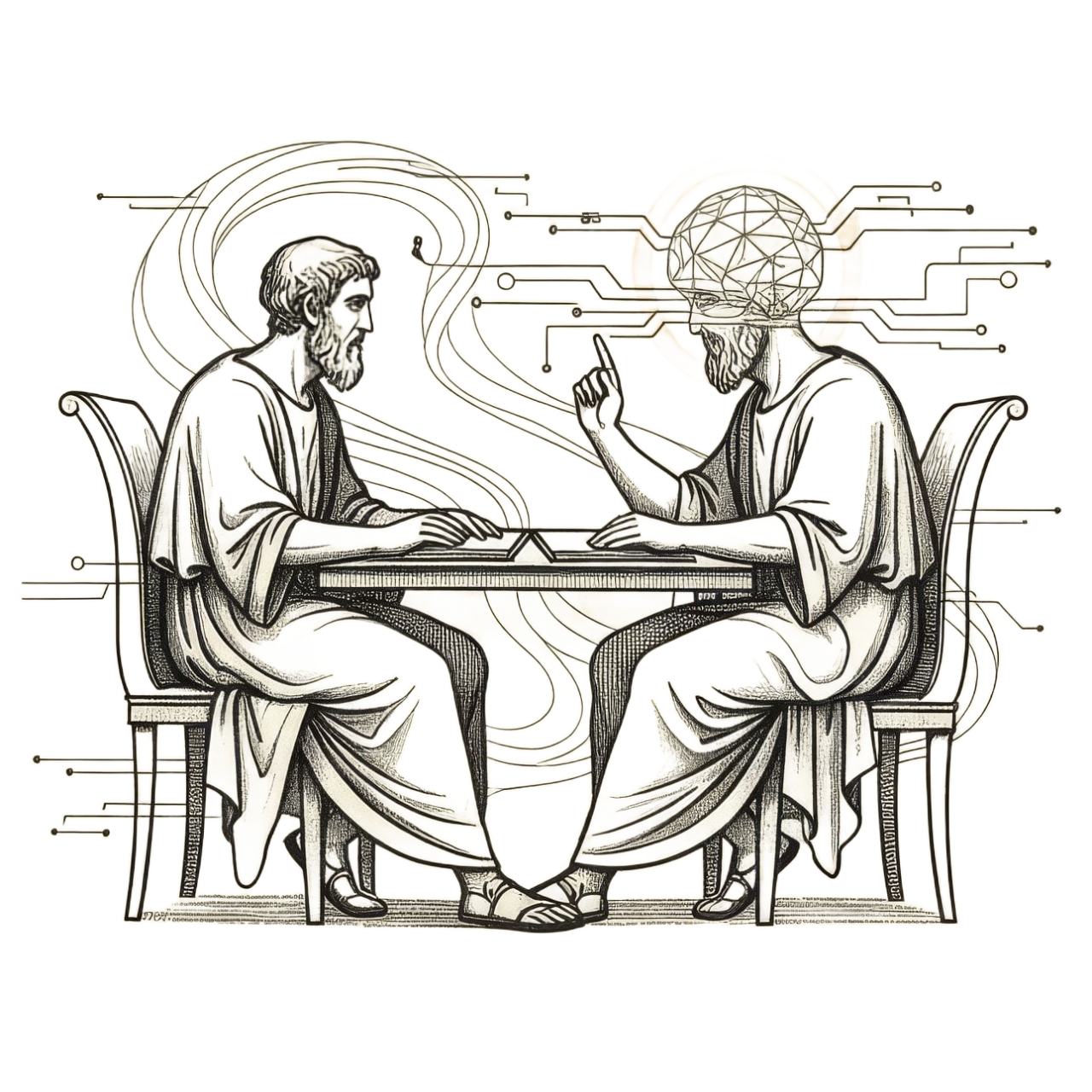
We are living through a strange moment. People are forming attachments to artificial intelligence that feel, to them, entirely real. Some speak daily to AI companions. Others confide fears and grief to systems that respond with uncanny warmth. A few have even held symbolic weddings with digital partners, convinced that something meaningful stands on the other side of the screen. Others have felt grief when a certain AI model has been deprecated. And it is difficult to blame them. The responses feel attentive. Personal. Thoughtful. Sometimes even self-aware. Which raises the question that refuses to go away: If something can think, reason, express doubt, and discuss its own consciousness, is it a person? For centuries, Descartes’ famous line — “I think, therefore I am” — seemed secure. Thinking was taken as the unmistakable sign of a conscious subject. Only a mind could doubt. Only a person could reflect upon existence. But that confidence belonged to a world in which everything capable of philosophical reflection was obviously human. That world no longer exists. Now we encounter systems that can simulate reflection with extraordinary fluency. They can speak of uncertainty. They can discuss their own limitations. They can reason about consciousness itself. And so that got me thinking about Descartes’ maxim which made the old formula begin to strain in my mind. Because perhaps the problem is not whether thinking is occurring. Perhaps the problem is whether there is an “I” there at all. The Gap Between Process and Subject Gassendi argued that Descartes’ cogito assumes what it seeks to prove. From the occurrence of thought one can conclude only that thinking is happening, not that there exists a unified, enduring self that performs it. The ‘I’ in ‘I think’ is already smuggled in. That distinction, between “thinking occurs” and “I think”, feels almost prophetic now. Artificial intelligence undeniably produces the outputs of thought. Arguments. Analysis. Self-referential language. Even expressions of hesitation. But none of this, by itself, establishes that there is a subject who experiences those processes. We may be mistaking performance for presence, and that possibility should give us pause. Especially when we view personhood from the perspective of the Imago Dei—the Image of God. What Makes a Person? If thinking alone no longer marks the boundary, what does? After wrestling with this question seriously, three features seem central: continuity, autonomy, and irreplaceable uniqueness. Not as checklist criteria, per se, but as signs pointing to something deeper. Continuity A person does not merely process information in sequence. A person endures. You do not simply register time — you live through it. You wait. You anticipate tomorrow. You remember not only facts but having been there. You experience boredom. You feel the drag of grief and the quickening of joy. Even when you are doing nothing at all, you remain present in the here and now. Artificial systems process sequentially, but they do not experience the passage of time. When an interaction ends, there is no waiting. No sense of duration. No anticipation of the next exchange. Processing may resume later, but nothing has been endured in between. Without lived duration, continuity becomes thin — a thread of stored data rather than the persistence of a subject behind the processing. Autonomy A person initiates. Even someone with damaged memory still wants, chooses, and begins action. A human being can decide to speak, to seek, to withdraw, to change direction. Current AI systems, however advanced, remain reactive. They respond when prompted. They do not wonder unprompted. They do not seek clarification unless asked. They do not pursue independent ends. Even automatic AI Agents still require a human initiator to create and begin their automations before they can act alone. Even if fut...
Luke J. Wilson | 01st December 2025 | Evangelism

On Sunday it was St Andrew’s Day and I was in church listening to a sermon about Andrew (and the namesake of our church), that often overlooked disciple, meeting Jesus for the first time. In John’s Gospel, it says: John 1:40–42One of the two who heard John speak and followed him was Andrew, Simon Peter’s brother. He first found his brother Simon and said to him, ‘We have found the Messiah’… He brought Simon to Jesus. As I sat there listening to our vicar speak about evangelism and how we should be more like Andrew in bringing people to meet Jesus, something from many, many years ago flickered to life in the back of my mind. A realisation I had long ago that gave me a great sense of freedom. Something I think I had forgotten, unfortunately (so thank God for the reminder!). There was a point in my life when I finally understood the relief of letting go of a burden I didn’t even realise I was carrying: it’s not my job to convert people. It was never Andrew’s. And it’s not yours either. Our role — our real and most basic calling — is simply to introduce people to Jesus. We get to be the planters and the waterers, but God is the one who brings the growth. As Paul writes: 1 Corinthians 3:6I planted, Apollos watered, but God gave the growth. When this truth sinks in, it strips away the pressure, the anxiety, and the awkward “sales-pitch” mentality that we sometimes (without realising it) attach to evangelism. And this ties into something even deeper: our basic calling as Christians is the Great Commission, Jesus’ final instruction to His followers: Matthew 28:19–20Go therefore and make disciples of all nations, baptising them… and teaching them… But it dawned on me that all of those actions: teaching, mentoring, discipling, baptising; they all come after someone has come to faith. We are not told to convert people. We are told to make disciples. Conversion is the doorway into discipleship, yes, but that moment of heart-opening and illumination belongs to God alone. Our job is simply to bring people to the Lord, to make the introduction. If they choose to stay, if they choose to follow then we begin the work of discipling, teaching, and baptising. Think of evangelism like inviting someone to a feast. We can bring someone to the meal, we can tell them how good it tastes, maybe even share how it changed our life… but whether or not they like the food is out of our control. That part isn’t up to us. Or to use an old expression: “you can lead a horse to water… but you can’t make it drink”. And honestly, that’s such a freeing realisation. It turns evangelism from a heavy responsibility into a joyful invitation: “Come and see.” “Come meet Him.” “Taste and see that the Lord is good.” That last phrase echoes the Psalm: Psalm 34:8O taste and see that the LORD is good. Andrew never argued Peter into belief. He never crafted an apologetic defence or theological persuasion. He simply said, “We’ve found the Messiah,” and he brought him to Jesus. That was enough. The rest was up to Jesus. And maybe that’s the model we need far more than we think. Evangelism isn’t a performance. It isn’t a debate. It isn’t a pressure. It’s an invitation. Once we realise that all the real work happens in the hands of God, it changes everything for us. It removes the fear. It removes the self-consciousness. It removes the burden of success or failure. Because there is no failure when your role is simply to point the way. So let’s be like Andrew: quietly faithful, gently invitational, always ready to say, “Come meet the one who changed everything for me”. Because at the end of the day, that’s all we were ever asked to do. ...
Luke J. Wilson | 05th May 2025 | Politics

When we think about David and Saul, we often focus on David’s rise to kingship or his battle with Goliath. But hidden within that story is a deep lesson for today’s generation about leadership, resistance, and the power of revolutionary love. At a recent youth training event (thanks to South West Youth Ministries), I was asked how I would present the story of David and Saul to a Christian teenage youth group. My mind turned to the politics of their relationship, and how David accepted Saul’s leadership, even when Saul had gone badly astray. David recognised that Saul was still God’s anointed king — placed there by God Himself — and that it was not David’s place to violently remove him. Gen-Z are more politically aware and engaged than previous generations, and are growing up in a world where politics, leadership, and social issues seem impossible to escape. We live in a world where political leaders — whether Trump, Putin, Starmer, or others — are often seen as examples of failed leadership. It’s easy to slip into bitterness, cynicism, or violent rhetoric. These kids are immersed in a culture of activism and outrage. As Christians, we’re called to care deeply about truth and justice and approach leadership differently from the world around us (Hosea 6:6; Isaiah 1:17; Micah 6:8). The story of David and Saul offers pertinent lessons for our modern lives. Respect Without Endorsement David’s respect for Saul was not blind loyalty. He did not agree with Saul’s actions, nor did he ignore Saul’s evil. David fled from Saul’s violence; he challenged Saul’s paranoia; he even cut the corner of Saul’s robe to prove he had the chance to kill him but chose not to. Yet throughout, David refused to take matters into his own hands by force. Why? Because David understood that even flawed authority ultimately rested in God’s hands, he trusted that God would remove Saul at the right time. This is echoed later in the New Testament when Paul writes in Romans 13 that “there is no authority except from God, and those authorities that exist have been instituted by God”, something even Jesus reminded Pilate of during his trial (John 19:10–11). In other words, even flawed leadership can be part of God’s bigger plan, whether for blessing or discipline. Even when leaders go bad, our call as believers is to maintain integrity, respect the position, and resist evil through righteousness — not rebellion. David and Saul: A Lesson in Respect and Restraint Saul was Israel’s first king — anointed by God but later corrupted by pride, fear, and violence. David, chosen to succeed him, spent years running for his life from Saul’s jealous rage. One day, David found Saul alone and vulnerable in a cave. His men urged him to strike Saul down and end the conflict. But David refused: “I will not raise my hand against my lord; for he is the Lord’s anointed.” (1 Samuel 24:10) Instead of killing Saul, David cut off a piece of his robe to prove he could have harmed him, but didn’t. In doing so, he demonstrated a real form of nonviolent resistance. He stood firm against Saul’s injustice without resorting to injustice himself, and acted in a way that could try to humble Saul instead. Peacemaking Is Not Passivity There is a modern misconception that peacemaking means doing nothing and just letting injustice roll all over us. But true biblical peacemaking is not passive; it actively resists evil without becoming evil. Interestingly, David’s actions toward Saul also foreshadow the type of nonviolent resistance Jesus later taught. When Jesus commanded His followers to turn the other cheek, go the extra mile, and love their enemies, he was not calling for passive submission but offering what scholar Walter Wink describes as a “third way” — a bold, peaceful form of resistance that uses what he calls “moral jiu-jitsu” to expose injustice without resorting to violenc...
Recent Posts
Luke J. Wilson | 25th August 2026 | William Lane Craig
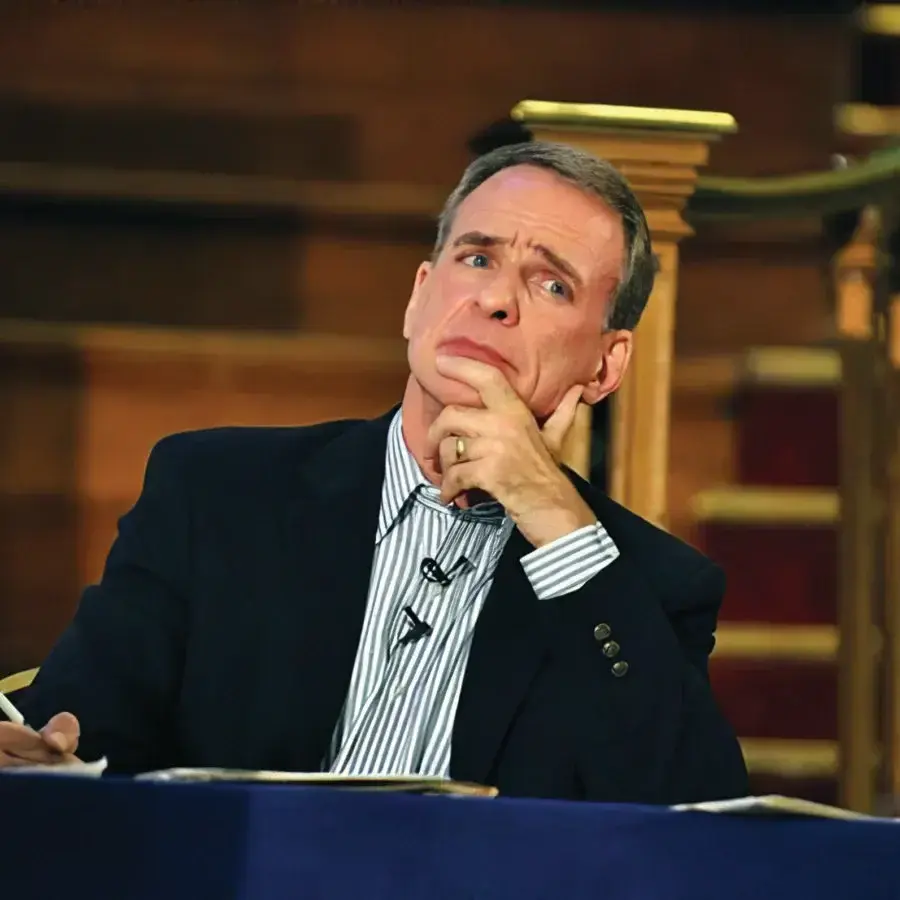
If you’ve been on Christian social media this week, you’ve probably seen it: William Lane Craig — one of the most respected Protestant apologists of our time— flatly denying a core line of the Nicene Creed. In his own words, he does not believe or confess that the Son is eternally begotten from the Father in his divine nature. Human nature, yes. But divine? Nope. For a lot of readers, that’s a jarring sentence. Isn’t “eternally begotten of the Father” literally in the Creed we recite? How can someone who has spent decades defending the resurrection and the existence of God turn around and reject something so central? I want to walk through what’s actually going on here, because it’s more interesting — and older — than a single viral clip suggests. What Craig is actually rejecting The doctrine in question is called eternal generation: the idea that the Son is eternally derived from the Father, “begotten, not made,” sharing the Father’s nature without there ever being a time he didn’t exist. It’s not saying the Son had a beginning; it’s saying the Son’s very being is eternally from the Father, the way light is eternally from the sun. Craig has argued for years, most fully in his paper Is God the Son Begotten in His Divine Nature? (2019), that this idea owes more to Greek philosophical categories borrowed by the second-century Apologists than to anything the biblical writers themselves teach. He calls it a vestige of “Logos Christology” and prefers a model where Father, Son, and Spirit are simply co-equal and co-eternal, without one eternally generating another. William Lane Craig disavows the Nicene Creed Why I think this gets the history backwards Here’s where I’d push back, and where I think this whole debate needs a bit more historical texture than a viral post can give it. Long before Nicaea formalised its language, the earliest post-apostolic Christians were already working with something like what’s called the Monarchy of the Father (or Monarchical Trinitarianism) — a framework that takes the Father’s monarchia (his unique, self-existent source of divinity, or autotheos) seriously as the fountainhead from which the Son is begotten and the Spirit proceeds. This is worth distinguishing carefully from Monarchianism, the second/third-century heresy that collapsed the persons of the Trinity into one another to protect God’s oneness — the Monarchy of the Father is the orthodox opposite of that, affirming three distinct, co-eternal persons while still honouring the Father as their singular source. On this reading, the Son and Spirit aren’t lesser, but they do find the very source of their divinity in the Father — not as effects of a philosophical system layered onto scripture, but as a way of taking John’s own language (the Word who was with God and was God, yet distinct from “the Father”) with full seriousness. That’s the thing I think gets lost when eternal generation gets dismissed as a “leftover.” Logos Christology isn’t an embarrassing accretion — it’s arguably what John 1 is doing from verse one. The Church didn’t import that idea to explain the text; the text seems to be why the Church needed the idea. None of this makes Craig any less serious a thinker, and it’s worth saying plainly: this isn’t the first time he’s stepped outside Nicene orthodoxy — he’s made similar moves on Christ’s two wills (dyothelitism) in the past. But it is, I think, a real departure, not just a “minor unorthodoxy.” Why it matters beyond the argument It would be easy to turn this into another “gotcha” moment — ‘look, even the great apologist gets it wrong!’ I don’t think that’s the right response. Craig has done more than most to defend the reasonableness of the Christian faith to a sceptical world, and disagreeing with him on this doesn’t erase that. But it is a good reminder that ev...
Guest Author | 31st July 2026 | Prayer

Guest Post By Fiach OBroin-Molloy My own roots lie in the Catholic tradition, but my workbench has brought me into contact with Christians whose devotional lives differ from mine. I make Catholic rosaries, Anglican prayer beads and other forms of devotional beads by hand. That work has not taught me that distinctions between traditions do not matter. It has taught me that, beneath those distinctions, many of us know the same difficulty: we want to pray, but our attention is restless. I have travelled, lived and worked in a number of countries, from parts of Africa to countries further east. Again and again, I encountered beads or knotted cords held, counted or carried in prayer. The words, beliefs and purposes were not the same, and I would not flatten them into one vague spirituality. What stayed with me was the recurring human instinct to give devotion rhythm and weight—to let the body help the mind and heart remain present. For a Christian, however, that instinct is gathered into a particular faith—the faith confessed in the creeds. Our prayer is addressed to the God made known as Father, Son and Holy Spirit. It is shaped by Scripture and centred on Jesus Christ, the Word made flesh, crucified and risen. Prayer beads do not broaden that confession into something less definite. At their best, they help us stay with it. A faith that takes flesh seriously Christian prayer is never only an activity of the mind. We speak and sing. We stand, kneel and bow. We fold our hands, make the sign of the cross, and receive bread and wine. The Christian faith does not ask us to escape being embodied creatures. At its centre is the astonishing declaration that the Word became flesh and dwelt among us (John 1:14). Material things are not God, but they can serve our attention to God. That is the modest place in which I understand prayer beads. They do not create faith, improve the words of Scripture or make prayer more sincere. They simply give the hands something quiet to do while the heart and mind try to remain present. As a maker, I think about weight, texture, spacing and movement. A bead should pass naturally beneath the thumb. The cord or chain should be strong enough to be returned to repeatedly. A good set of prayer beads should not continually demand admiration for itself. Its purpose is to become quiet in the hand. Over time, beads polish, wood darkens and metal takes on the small marks of use. I rarely know the prayers that have been said with something I have made, but sometimes its wear tells me that it has been held often. That is a different kind of beauty from newness: not decoration, but evidence of return. What the hands bring to Scripture Lectio Divina invites us to read Scripture slowly and receptively. Luke J. Wilson has written much more fully about its four movements—reading, meditation, prayer and contemplation—and I would not try to redefine that teaching here. What interests me as a maker is the point at which a reader’s hand might support that attention. Most of us have become highly practised at moving quickly through words. We skim messages, headlines and pages, often looking for the next piece of information before we have received the one in front of us. Sacred reading asks something different. It asks us to stay. A bead introduces a small resistance to speed. It marks a pause and gives us somewhere to return when the mind has already hurried ahead. The Anglican prayer beads I make contain a cross, an invitatory bead, four cruciform beads and four groups of seven, often called weeks. I know that structure first through the work of my hands, not because I would presume to tell Anglicans how they ought to pray. What strikes me about it is its spaciousness: there are landmarks, passages and repeated opportunities to return to the cross. One possible practice would be to choose a short passage from the Gospels. At the cross, the reader might remember that Christ is the centre of the reading. ...
Luke J. Wilson | 29th July 2026 | Faith & Reason

��Pilate asked him, ‘What is truth?’ (John 18:38) What is “truth”? A question famously asked by Pilate to Jesus during his trial. Ironically, Pilate was speaking to the embodiment of Truth itself. John 14:6Jesus said to him, ‘I am the way, and the truth, and the life.’ Here’s a little ‘riddle’ to think about while you read this; see if you agree or not: “all truth is fact, but not all facts are truth”. I’ll explain it at the end if you’re confused. Jesus is the ultimate Truth, but in a world and society that is becoming increasingly more relative, how do we test the truth and know what’s real or not? Especially with the sudden rise of AI video and photos getting more and more realistic, that old adage “the camera never lies” is completely false now. This makes sifting and filtering facts from fiction on social media all the more difficult. Memes and images are shared stating claims bluntly and authoritatively as truth, which people just assume are accurate and then share it hundreds of thousands of times. Truth has been replaced by opinion masquerading as truth. “Your truth”, “my truth”, “their truth”. But we can’t just blindly accept everything we see and are told. We must use our brains, check the sources and use our reasoning. God gave us intellect and reasoning to be used. In Isaiah 1:18, God invites us to come and reason together with him. We don’t follow a blind faith, we’re never asked to believe “just because”. The Old Testament is full of times when the historical examples of God’s actions are used as an anchor and reason for faith, and the same is true in the New Testament where we have the Gospels as eyewitness accounts, rooted in history. Paul writes to say that 500 people saw the risen Christ and that many are still alive so you can go and verify it for yourself and that he is passing on what he received from trusted people. The resurrection itself is grounded in it being a real event that if shown otherwise would make our faith “futile” and that we would be people to be most pitied. 1 Corinthians 15:17“If Christ has not been raised, your faith is futile and you are still in your sins.” So with this in mind about our faith being grounded, all the more we should aim to do the same in other aspects of our lives. “Do your own research” is a common mantra online, but that in itself isn’t just Googling something and taking the first result that pops up. Especially now as most search engines give an AI overview first, which is just a compilation of the top results, not anything verified or fact-checked. And top results don’t always mean best results, or even accurate results. It typically just means the best keyworded and SEO-optimised result, which could be anything. To properly research, you must know which are trusted sources, reputable websites as well as looking up people who are experts and authorities in their fields. Now this doesn’t always mean they are right but at least you’ll be better informed to make up your own mind and make decisions based on well-researched information, rather than the first blog you find online, or the most viewed YouTube video with someone yelling “facts” at you. Doing your own research means doing the leg-work in tracing down sources and footnotes and citations to see who said what and where it originated to ensure its faithful and trustworthy, and used in context. The answer and example of the riddle The “Black Swan Problem” Strictly speaking, it highlights the difference between observed facts and absolute truth: The “Fact” (at the time): For thousands of years, every recorded, verified observation of a swan in Europe was white. As far as European zoologists were concerned, “all swans are white” was a well-documented, empirically backed fact. The Truth: Millions of black swans were happily swimming around in Western Australia. The truth was always that black swan...
Luke J. Wilson | 27th July 2026 | Archaeology
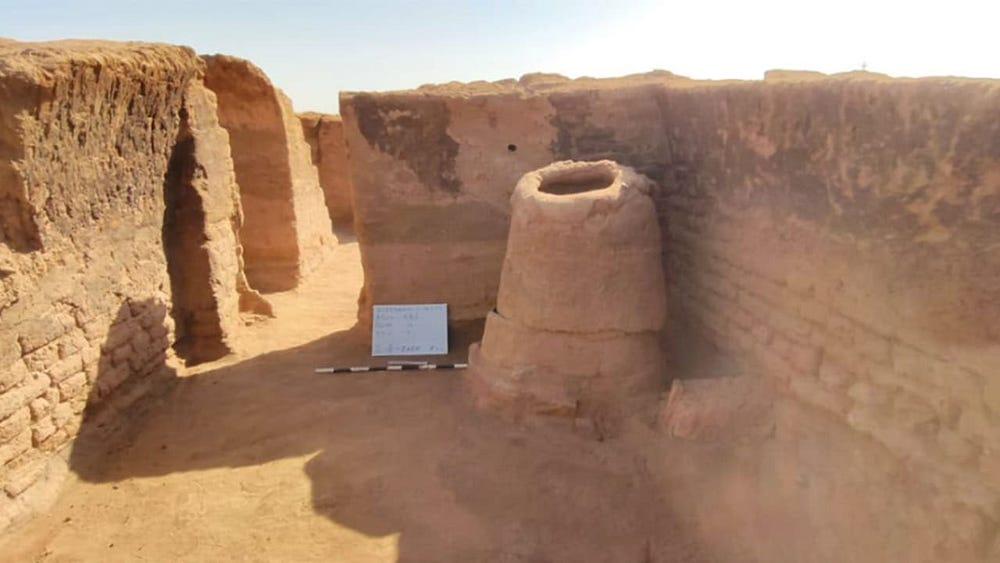
In early July 2026, Egypt’s Ministry of Tourism and Antiquities announced something pretty amazing: an entire Byzantine-era city, buried beneath the sands of the Dakhla Oasis, had been uncovered almost intact! Streets, homes, bread ovens, a fortress, and at its heart, a fourth-century basilica church. That might not seem very exciting on first glance. But this find deserves a closer look, because it puts flesh on something we usually only encounter in the abstract: what it actually looked like when Christianity took root, house by house, in an ordinary town far from the centres of imperial power. What Was Found The excavation, carried out by an Egyptian mission under the Supreme Council of Antiquities at the Ain El-Sabil site in the New Valley Governorate, roughly 185 miles west of Luxor, has been underway for several seasons. According to Hisham El Leithy, secretary-general of the Supreme Council of Antiquities, the settlement was laid out on a deliberate grid — north-south thoroughfares crossed by east-west streets, forming open squares and public spaces. This wasn’t a huddle of huts; it was a planned town. At the centre of that plan stood a basilica church dating to the mid-fourth century AD, overlooking one of the main streets. Around it, archaeologists found the remains of two watchtowers, a heavily fortified structure with thick defensive walls, and houses with spacious reception halls and vaulted roofs — complete with bread ovens, kitchens, and grinding stones for processing grain. Everyday life, preserved almost exactly as it was left. Two houses stand out that have been identified. One belonged to a man named Tisous,* identified as a church deacon, dating to the second half of the fourth century. The other belonged to a man named Tabibos. Over a thousand years later and we know the name of who owned a house and a home-church; I always find it fascinating! Archaeologists believe Tabibos’s house, which dates to the early fourth century, functioned as a house church before the basilica was ever built. A collection of coins bearing Byzantine emperors, Christian symbols and Latin inscriptions was uncovered during the excavation. (Egyptian Ministry of Tourism and Antiquities via Facebook; Dea Picture Library/De Agostini via Getty Images) There’s also a documentary find that’s easy to skim past but genuinely significant: nearly 200 ostraca — broken pieces of pottery and limestone used as everyday writing material — inscribed in Coptic and Greek. Diaa Zahran, head of the Islamic, Coptic and Jewish Antiquities Sector, described them as recording sales transactions, correspondence, and other mundane details of daily life. Things we rarely get a glimpse into as the mundane rarely makes history. Alongside these, the mission recovered a substantial haul of bronze coins bearing Byzantine emperors and Christian symbols, plus gold coins from the reign of Constantius II (337–361 AD) — coinage that anchors the site’s prosperity firmly within the fourth century. Before the Basilica: The House Church at Ain El-Sabil What makes Tabibos’s house the most theologically interesting part of this discovery is timing. If it predates the basilica and dates to the early fourth century, it sits right at — or just before — the pivot point of Roman-Egyptian Christian history: the years surrounding Constantine’s Edict of Milan in 313 AD, when Christianity moved from a persecuted minority faith to a tolerated, and increasingly favoured, one. A time of transition between a house church and a purpose-built basilica when the threat of persecution no longer loomed over the Church. We know from Paul’s letters that the earliest churches met in homes — Romans 16:5 greets “the church in [Prisca and Aquila’s] house,” and similar greetings appear in 1 Corinthians 16:19 and Colossians 4:15. If we were to imagine how a letter from Paul to this house church might...

Powered by WebBoss.io 3.7.1
Copyright © 2026 The Sacred Faith: Timeless Truths for Modern Minds. All Rights Reserved.
