
The Gospel of Jeffrey Dahmer

Header Image: Netflix
There’s a new Netflix documentary out at the moment which has hit the news recently about the infamous serial killer Jeffery Dahmer.
I haven’t watched it, but I knew of him as a serial killer though I didn’t realise just how horrific his crimes were until I read the Wikipedia article about him! Not for the faint of heart, that’s for sure.
But this post isn’t really about Dahmer, not entirely, but rather the reactions to some recent social media posts about him and the (often vitriol) responses they’ve got. Here’s one example:
Dahmer is probably in heaven and experiencing eternal joy. If this bothers you, you don’t know the depths of your own depravity or the price paid for his forgiveness.
— Eriq Jäger (@MilkToastOnRye) September 27, 2022
Now, a little context in case you are unaware: Dahmer professed faith in Jesus, repented and was baptised while in prison. The minister who baptised him, Roy Ratcliff, also met with him weekly for one-hour Bible studies and pastoral care. He even wrote a book about the experience and was convinced his conversion was genuine.
I’m going to state something off the back of this which will no doubt offend some, but it is for this reason that Paul says the truth of the Gospel is offensive:
If you can’t accept that Jeffrey Dahmer could be welcomed into the Kingdom of God, then you don’t understand the Gospel.
Does the idea that a homosexual, cannibalistic, murdering rapist could be forgiven by God cause you some discomfort? I’ll be honest, when I first considered something like this many years ago, it did cause me to have a knee-jerk reaction against it. I understand the apprehension. We want people like him to burn in hell for all eternity. But let me say it like this: if Dahmer can’t be saved, then neither can you (or me). Or do you think you are “better” or “good enough” for salvation and Dahmer isn’t? If you do think this, then, again, you don’t understand the Gospel or God’s grace.

Many Christians are aware of Paul’s words in Romans 3:23: “all have sinned and fall short of the glory of God”. I often see this quoted online as inspirational images and posters, or as a way to explain human failings, since no one can live up to what God requires of us through our own efforts. But when you apply this to a repentant murderer, suddenly it’s no longer valid? That’s not how grace works. Look at the surrounding context; Paul makes it abundantly clear that there are no exceptions — for falling short or being saved by grace:
…the righteousness of God through faith in Jesus Christ for all who believe. For there is no distinction, since all have sinned and fall short of the glory of God; they are now justified by his grace as a gift, through the redemption that is in Christ Jesus… (Rom 3:22–24, emphasis mine)
There is no distinction: we have all sinned and we can all be justified by grace. All we need to do is place our faith in Jesus and his finished work on the cross.
The Apostle Paul knew the depth of this grace well for he was also “breathing threats and murder against the disciples of the Lord” (Acts 9:1) when hunting down Christians and approving of Stephen’s martyrdom (Acts 8:1).
Paul acknowledges his sin but recognises that God saved him as a testimony to the abundant goodness and mercy of God, so that if even Paul can be saved, then so can anyone.
1 Timothy 1:16
But I received mercy for this reason, so that in me, the worst of them, Christ Jesus might demonstrate His extraordinary patience as an example to those who would believe in Him for eternal life.
Jeffrey Dahmer was definitely “the worst of them”, yet not beyond the reach of our ever-loving saviour, Christ Jesus.
I understand the human desire to want to see the vilest of people punished or condemned to hellfire, and even the Apostles and other believers were wary of Paul’s conversion and claim to have faith, understandably so. “When he had come to Jerusalem, he attempted to join the disciples; and they were all afraid of him, for they did not believe that he was a disciple.” (Acts 9:26).
Paul had an experience of Jesus, came to faith and was baptised. Jeffrey Dahmer, similarly, came to faith and was baptised, and people questioned his sincerity and faith, as they did Paul, because of his background and previous crimes. But God looks inwardly, and as Isaiah said, he dwells with those who are humble with a contrite heart (Isaiah 57:15).
This is the test of faith: humility, repentance and good works (James 2:26; Rom 6:1–4). Paul’s life displayed a changed character, and from what I read, Dahmer was different post-baptism too according to Roy Ratcliff, although he didn’t get much time to live after converting — he was baptised in May 1994 and bludgeoned to death by another inmate November of that same year.
But the point remains, which is the heart of the Gospel: God’s grace and mercy are far bigger than we can ever comprehend, as much as we might not like it, God can save whomever HE wills, not whoever WE prefer.
Like the thief on the cross, who also faced the consequences of his crimes yet cried out to Jesus in his final moments, anyone can be saved, no matter their past. This is the Gospel in its simplest terms.
Don’t get me wrong, Jeffrey Dahmer will face the judgement of God, just as we all will, for “it is appointed for mortals to die once, and after that the judgement” (Heb 9:27). Looking also at what Paul writes to the Corinthian church, he speaks of God’s judgement on “the Day” as a fire which will burn up all our works and leave behind whatever good works we did through Christ in us as the foundation (see also Malachi 3:2–3).
1 Corinthians 3:14–15
If what has been built on the foundation [of Jesus] survives, the builder will receive a reward. If the work is burned, the builder will suffer loss; the builder will be saved, but only as through fire.
I suspect Dahmer will suffer loss on that Day, but he himself will be saved if his conversion was truly genuine; and if we can’t accept that, then we have no right to expect God to extend that same grace and mercy to us too because we have all sinned and fallen short.
Hear Dahmer confess his faith in Jesus in his own words:
Further Reading
- Jeffrey Dahmer — Wikipedia
- Serial Killer Jeffrey Dahmer and Christian Conversion, Jeffrey Dahmer and Forgiveness — Beliefnet
- Forgiving Jeffrey Dahmer. Hit Netflix series poses a troubling… | by Dan Foster | Backyard Church | Oct, 2022 | Medium
- Jeffrey Dahmer Confesses the Lord Jesus Christ — YouTube
- Dark Journey, Deep Grace: Jeffrey Dahmer’s Story of Faith: Amazon.co.uk: Ratcliff, Roy, Adams, Lindy: 9780976779025: Books
Leave a comment Like Back to Top Seen 11.7K times Liked 1 times

Enjoying this content?
Support my work by becoming a patron on Patreon!
By joining, you help fund the time, research, and effort that goes into creating this content — and you’ll also get access to exclusive perks and updates.
Even a small amount per month makes a real difference. Thank you for your support!
x
Subscribe to Updates
If you enjoyed this, why not subscribe to free email updates and join over 889 subscribers today!
My new book is out now! Order today wherever you get books
Subscribe to Blog updates
Alternatively, you can subscribe via RSS 
All email subscriptions must be confirmed to comply with GDPR.
Related Posts
Luke J. Wilson | 3 hours ago | Archaeology
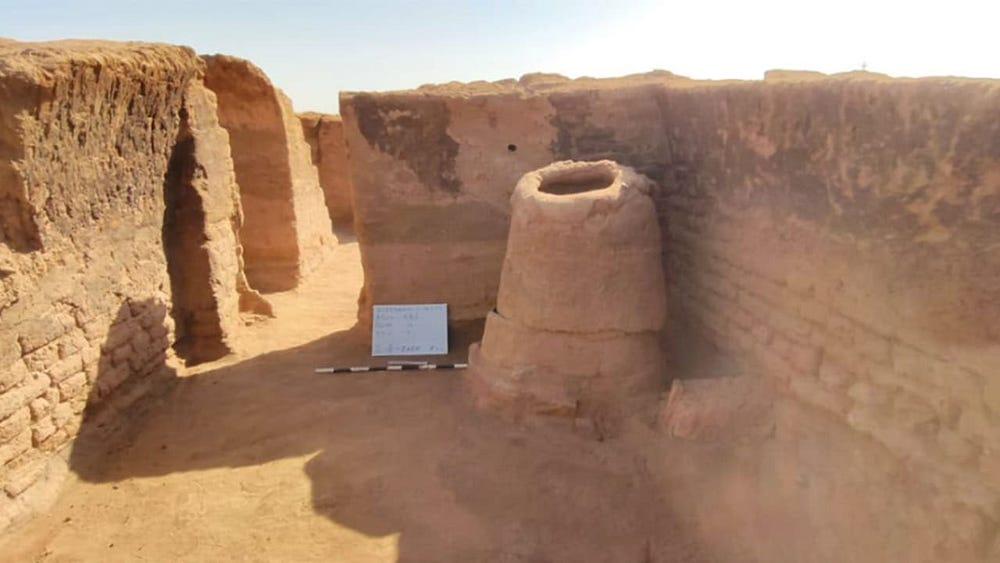
In early July 2026, Egypt’s Ministry of Tourism and Antiquities announced something pretty amazing: an entire Byzantine-era city, buried beneath the sands of the Dakhla Oasis, had been uncovered almost intact! Streets, homes, bread ovens, a fortress, and at its heart, a fourth-century basilica church. That might not seem very exciting on first glance. But this find deserves a closer look, because it puts flesh on something we usually only encounter in the abstract: what it actually looked like when Christianity took root, house by house, in an ordinary town far from the centres of imperial power. What Was Found The excavation, carried out by an Egyptian mission under the Supreme Council of Antiquities at the Ain El-Sabil site in the New Valley Governorate, roughly 185 miles west of Luxor, has been underway for several seasons. According to Hisham El Leithy, secretary-general of the Supreme Council of Antiquities, the settlement was laid out on a deliberate grid — north-south thoroughfares crossed by east-west streets, forming open squares and public spaces. This wasn’t a huddle of huts; it was a planned town. At the centre of that plan stood a basilica church dating to the mid-fourth century AD, overlooking one of the main streets. Around it, archaeologists found the remains of two watchtowers, a heavily fortified structure with thick defensive walls, and houses with spacious reception halls and vaulted roofs — complete with bread ovens, kitchens, and grinding stones for processing grain. Everyday life, preserved almost exactly as it was left. Two houses stand out that have been identified. One belonged to a man named Tisous,* identified as a church deacon, dating to the second half of the fourth century. The other belonged to a man named Tabibos. Over a thousand years later and we know the name of who owned a house and a home-church; I always find it fascinating! Archaeologists believe Tabibos’s house, which dates to the early fourth century, functioned as a house church before the basilica was ever built. A collection of coins bearing Byzantine emperors, Christian symbols and Latin inscriptions was uncovered during the excavation. (Egyptian Ministry of Tourism and Antiquities via Facebook; Dea Picture Library/De Agostini via Getty Images) There’s also a documentary find that’s easy to skim past but genuinely significant: nearly 200 ostraca — broken pieces of pottery and limestone used as everyday writing material — inscribed in Coptic and Greek. Diaa Zahran, head of the Islamic, Coptic and Jewish Antiquities Sector, described them as recording sales transactions, correspondence, and other mundane details of daily life. Things we rarely get a glimpse into as the mundane rarely makes history. Alongside these, the mission recovered a substantial haul of bronze coins bearing Byzantine emperors and Christian symbols, plus gold coins from the reign of Constantius II (337–361 AD) — coinage that anchors the site’s prosperity firmly within the fourth century. Before the Basilica: The House Church at Ain El-Sabil What makes Tabibos’s house the most theologically interesting part of this discovery is timing. If it predates the basilica and dates to the early fourth century, it sits right at — or just before — the pivot point of Roman-Egyptian Christian history: the years surrounding Constantine’s Edict of Milan in 313 AD, when Christianity moved from a persecuted minority faith to a tolerated, and increasingly favoured, one. A time of transition between a house church and a purpose-built basilica when the threat of persecution no longer loomed over the Church. We know from Paul’s letters that the earliest churches met in homes — Romans 16:5 greets “the church in [Prisca and Aquila’s] house,” and similar greetings appear in 1 Corinthians 16:19 and Colossians 4:15. If we were to imagine how a letter from Paul to this house church might...
Luke J. Wilson | 12th March 2026 | Eschatology

Something bizarre happened in the White House Oval Office this week. Photographs circulated on social media showing President Donald Trump seated at his desk, surrounded by approximately twenty Christian pastors from across the country, their hands extended towards him in prayer. The image provoked sharply divided reactions: some saw it as a moving expression of faith; others found it deeply unsettling. Whatever one makes of the optics, it arrived at a charged moment. Trump held a prayer meeting in the Oval Office after his administration admitted the war with Iran will likely last weeks longer than promised | Credit: Dan Scavino's X account Days earlier, reports emerged that a military commander had told troops that the current US war with Iran is “all part of God’s divine plan,” and that President Trump had been “anointed by Jesus to light the signal fire in Iran to cause Armageddon and mark his return to Earth.” These were not fringe internet rumours. They were filed as formal complaints with the Military Religious Freedom Foundation (MRFF) by an anonymous non-commissioned officer acting on behalf of fifteen service members — the majority of whom were themselves Christians. By Tuesday of that week, MRFF had logged more than two hundred similar complaints across fifty military installations, covering every branch of the armed forces. More than two dozen Democratic members of Congress have since called for a Department of Defense Inspector General investigation, citing what they describe as “glaring Constitutional concerns” and potential violations of DoD regulations on religious neutrality. The political questions about separation of church and state in the US are for others to address. What I want to do here is something more straightforward: examine what Revelation actually says, because the theology driving these claims does not hold up under scrutiny. And that matters here a lot; not as a partisan point, but as a question of biblical faithfulness. First, a Word About Context If you have read my previous article on Revelation some of what follows will be familiar ground. But it bears repeating, because the misunderstanding at the heart of this story is so widespread that it has taken on the feel of settled orthodoxy in many circles. The Book of Revelation is commonly thought to be written in the late first century ~95 AD, during or around the reign of Emperor Domitian. Though there is internal evidence that it was possibly written during Nero’s reign prior to 70 AD. Both of these emperors were most aggressive proponents of the imperial cult in Rome’s history. Domitian required that he be addressed as “lord and god,” had this title printed on coinage, and expected acts of religious reverence towards the Emperor as a demonstration of political loyalty. To refuse was to invite economic exclusion, marginalisation, and worse. Rome on seven hills It is into that precise context that John of Patmos writes. He is not composing a coded forecast of twenty-first century geopolitics. He is writing resistance literature — what scholars call apocalyptic literature — a well-established Jewish and early Christian genre which uses vivid symbolic imagery to pull back the curtain on earthly power and name it for what it truly is. The seven-headed beast of Revelation is Rome. The seven heads are the seven hills of Rome, an identification so widely acknowledged in early church scholarship that it barely requires argument. The mark of the beast, calculated through Hebrew gematria to 666 (or 616 in some early manuscripts), points directly to Nero Caesar (transliterated into Hebrew as נרון קסר, “nrwn qsr”) — the Emperor who became the archetype of anti-Christian persecution due to the levels of evilness he enacted. The second beast, which looks like a lamb but speaks for the dragon, performs signs to deceive, enforces the mark, and compels worship of the first beas...
Luke J. Wilson | 22nd November 2025 | Persecution
Every now and then something happens in this country that feels small on the surface but carries a deeper spiritual weight beneath it. In this case it comes from a Labour council just outside of London when in March of this year, Rushmoor Borough Council attempted to criminalise Christian street preaching. The injunction has thankfully been paused (for now) as Christians rallied, prayed, and pushed back. But the implications of what nearly happened, and could still happen, should give all of us pause. Because once one council tries something like this, others start paying attention. A precedent has been set — not necessarily in law, but in what could be. Someone, somewhere, will look at Rushmoor’s attempt and think, perhaps this is the way to make Christianity quiet again. The Quiet Re-emergence of Old Hostilities We tend to imagine persecution as something ancient or foreign. Lions, arenas, emperors, gulags, terror attacks in far off countries. And sure, we here in the UK are not shedding literal blood for the Gospel, but that doesn’t mean persecution has vanished. It has simply changed shape. Instead of swords and prisons, we face restrictions and injunctions. Instead of mobs dragging believers through the streets, councils draft documents that treat prayer, worship, and evangelism as public threats. The methods have changed, but the intent remains strangely familiar: to push the Gospel to the margins, to confine it to the private sphere, and to make public displays of faith something suspicious, weird, and even harmful. If Rushmoor’s injunction had gone through, it would have made praying with someone in town square, even holding out a leaflet, something punishable by fines or prison time. No blood shed, but freedom restricted and removed. No martyrdom, but the same coercive pressure to be silent. Succumb to Caesar (the local council) or face death (prison/fines etc). History Teaches Us Something the Councils Have Forgotten Whenever authorities have attempted to stifle Christianity, something remarkable has happened: the Church has not faded away, but grown. Opposition has never extinguished faith; instead, it has refined it, purified it, strengthened it. Tertullian famously wrote, “The blood of the martyrs is the seed of the Church.” And while no one in Britain today is being asked to spill blood for Christ, the principle still holds. Pressure produces depth. Threats produce courage. Restrictions produce creativity. This is where real faith takes hold and grows! When believers are told to stop preaching, they remember why they preach. When prayer is threatened, prayer increases. When the gospel is pushed out of the public square, Christians step back into it with clarity and resolve. It’s ironic, really. When the world tries to silence the Church, it ends up drawing attention to the very message it wants to suppress. The Real Danger: Not the Injunction Itself, But What Comes Next The paused injunction in Rushmoor is not the end of the story. If anything, it is the prologue. Because we are now entering a season where councils and governments — pressured by secular expectations and political anxieties — may test the boundaries of religious freedom in ways that would have been unthinkable twenty years ago. Once you try to criminalise prayer in public, the next attempt becomes easier. And we’ve already seen examples of this with the so-called “buffer zones” around abortion clinics. Once preaching is labelled “hateful,” more restrictions feel reasonable. A few street preachers have already been arrested this year already. Once a council decides that worship and prayer is “distressing”, others will wonder if they should follow suit. This is how liberties are lost: not in a single moment, but through a drip-feed of small decisions that gradually reshape what is considered normal. That is why Christians cannot afford to shrug this off as a local issue. It is a signpost...
Luke J. Wilson | 29th January 2025 | Easter
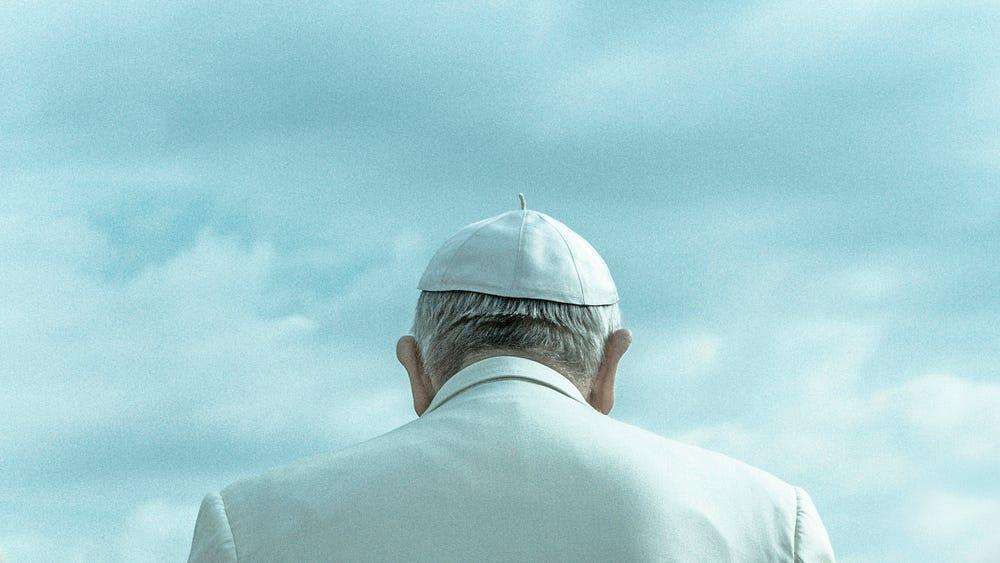
Pope Francis has recently expressed the Catholic Church’s willingness to accept a unified date for Easter, a move aimed at fostering greater Christian unity, particularly with the Orthodox Church. This long-standing issue arises from the different calendars used by Western and Eastern Christian traditions — the Gregorian and Julian calendars — leading to discrepancies in Easter celebrations. Talks between Catholic and Orthodox leaders have intensified, hoping a common date could be agreed upon. However, this raises important questions for Protestant denominations regarding whether they would adopt the unified date or risk falling out of alignment with these historic branches of Christianity. Celebrating the Week of Prayer for Christian Unity recently, Pope Francis noted that this year the Easter date coincides with the West’s Gregorian calendar and the East’s Julian calendar. The Pope said, “I renew my appeal that this coincidence may serve as an appeal to all Christians to take a decisive step forward toward unity around a common date for Easter.” “The Catholic Church is open to accepting the date that everyone wants: a date of unity” — Pope Francis The recent discussions between the Catholic and Orthodox churches regarding the unification of the Easter celebration date have some significant implications for Protestant denominations and as an Anglican, the wider Anglican Communion. Historically, the disparity in Easter dates has been a visible manifestation of Christian disunity, and efforts to establish a common date have been ongoing. Previous Attempts In 2016, Archbishop of Canterbury Justin Welby expressed support for a fixed date for Easter, engaging in dialogues with leaders from various Christian traditions, including Pope Francis and Orthodox Patriarch Bartholomew. He emphasised the importance of unity in celebrating the resurrection of Christ and hoped for an agreement within a decade, or at least before he retired. Recently uncovered scandals forced him to retire earlier than planned, so that dream isn’t happening for him anymore. A long time ago here in the UK, an act of Parliament was passed in 1928 which allowed for Easter Sunday to be fixed on the first Sunday after the second Saturday in April. But this Act has never been activated and so Easter has remained a variable date, determined by the moon’s cycle. From an Anglican perspective, aligning the date of Easter with Catholic and Orthodox churches would be a significant ecumenical step, reflecting a commitment to Christian unity. The Anglican Communion, known for its via media (middle way) approach, often seeks to bridge differences between traditions. Therefore, it is plausible that the Anglican Church would support and adopt a unified Easter date, should an agreement be reached between the Catholic and Orthodox churches. I would at least expect the leadership to discuss it at Synod, and personally, I hope it would be accepted as a step towards global unity on our most important and significant celebration: the resurrection of Christ! For other Protestant denominations though, reactions may vary. Some may view the unification of the Easter date as a positive move towards greater Christian unity and choose to follow suit. Others, valuing their own traditions and independence (or anti-Catholic bias), might prefer to maintain their current practices as a variable date. The impact on Protestant denominations largely depends on their theological perspectives and openness to ecumenical initiatives. Ancient Controversies Before the Council of Nicaea in 325, different Christian communities celebrated Easter on different dates; the council decided that for the unity of the Christian community and its witness, Easter would be celebrated on the first Sunday after the first full moon after the spring equinox. This is known as the Quartodeciman (lit. Fourteenth) controversy. It’s called this due to the issue being over w...
Recent Posts
Luke J. Wilson | 3 hours ago | Archaeology
In early July 2026, Egypt’s Ministry of Tourism and Antiquities announced something pretty amazing: an entire Byzantine-era city, buried beneath the sands of the Dakhla Oasis, had been uncovered almost intact! Streets, homes, bread ovens, a fortress, and at its heart, a fourth-century basilica church. That might not seem very exciting on first glance. But this find deserves a closer look, because it puts flesh on something we usually only encounter in the abstract: what it actually looked like when Christianity took root, house by house, in an ordinary town far from the centres of imperial power. What Was Found The excavation, carried out by an Egyptian mission under the Supreme Council of Antiquities at the Ain El-Sabil site in the New Valley Governorate, roughly 185 miles west of Luxor, has been underway for several seasons. According to Hisham El Leithy, secretary-general of the Supreme Council of Antiquities, the settlement was laid out on a deliberate grid — north-south thoroughfares crossed by east-west streets, forming open squares and public spaces. This wasn’t a huddle of huts; it was a planned town. At the centre of that plan stood a basilica church dating to the mid-fourth century AD, overlooking one of the main streets. Around it, archaeologists found the remains of two watchtowers, a heavily fortified structure with thick defensive walls, and houses with spacious reception halls and vaulted roofs — complete with bread ovens, kitchens, and grinding stones for processing grain. Everyday life, preserved almost exactly as it was left. Two houses stand out that have been identified. One belonged to a man named Tisous,* identified as a church deacon, dating to the second half of the fourth century. The other belonged to a man named Tabibos. Over a thousand years later and we know the name of who owned a house and a home-church; I always find it fascinating! Archaeologists believe Tabibos’s house, which dates to the early fourth century, functioned as a house church before the basilica was ever built. A collection of coins bearing Byzantine emperors, Christian symbols and Latin inscriptions was uncovered during the excavation. (Egyptian Ministry of Tourism and Antiquities via Facebook; Dea Picture Library/De Agostini via Getty Images) There’s also a documentary find that’s easy to skim past but genuinely significant: nearly 200 ostraca — broken pieces of pottery and limestone used as everyday writing material — inscribed in Coptic and Greek. Diaa Zahran, head of the Islamic, Coptic and Jewish Antiquities Sector, described them as recording sales transactions, correspondence, and other mundane details of daily life. Things we rarely get a glimpse into as the mundane rarely makes history. Alongside these, the mission recovered a substantial haul of bronze coins bearing Byzantine emperors and Christian symbols, plus gold coins from the reign of Constantius II (337–361 AD) — coinage that anchors the site’s prosperity firmly within the fourth century. Before the Basilica: The House Church at Ain El-Sabil What makes Tabibos’s house the most theologically interesting part of this discovery is timing. If it predates the basilica and dates to the early fourth century, it sits right at — or just before — the pivot point of Roman-Egyptian Christian history: the years surrounding Constantine’s Edict of Milan in 313 AD, when Christianity moved from a persecuted minority faith to a tolerated, and increasingly favoured, one. A time of transition between a house church and a purpose-built basilica when the threat of persecution no longer loomed over the Church. We know from Paul’s letters that the earliest churches met in homes — Romans 16:5 greets “the church in [Prisca and Aquila’s] house,” and similar greetings appear in 1 Corinthians 16:19 and Colossians 4:15. If we were to imagine how a letter from Paul to this house church might...
Luke J. Wilson | 12th March 2026 | Eschatology
Something bizarre happened in the White House Oval Office this week. Photographs circulated on social media showing President Donald Trump seated at his desk, surrounded by approximately twenty Christian pastors from across the country, their hands extended towards him in prayer. The image provoked sharply divided reactions: some saw it as a moving expression of faith; others found it deeply unsettling. Whatever one makes of the optics, it arrived at a charged moment. Trump held a prayer meeting in the Oval Office after his administration admitted the war with Iran will likely last weeks longer than promised | Credit: Dan Scavino's X account Days earlier, reports emerged that a military commander had told troops that the current US war with Iran is “all part of God’s divine plan,” and that President Trump had been “anointed by Jesus to light the signal fire in Iran to cause Armageddon and mark his return to Earth.” These were not fringe internet rumours. They were filed as formal complaints with the Military Religious Freedom Foundation (MRFF) by an anonymous non-commissioned officer acting on behalf of fifteen service members — the majority of whom were themselves Christians. By Tuesday of that week, MRFF had logged more than two hundred similar complaints across fifty military installations, covering every branch of the armed forces. More than two dozen Democratic members of Congress have since called for a Department of Defense Inspector General investigation, citing what they describe as “glaring Constitutional concerns” and potential violations of DoD regulations on religious neutrality. The political questions about separation of church and state in the US are for others to address. What I want to do here is something more straightforward: examine what Revelation actually says, because the theology driving these claims does not hold up under scrutiny. And that matters here a lot; not as a partisan point, but as a question of biblical faithfulness. First, a Word About Context If you have read my previous article on Revelation some of what follows will be familiar ground. But it bears repeating, because the misunderstanding at the heart of this story is so widespread that it has taken on the feel of settled orthodoxy in many circles. The Book of Revelation is commonly thought to be written in the late first century ~95 AD, during or around the reign of Emperor Domitian. Though there is internal evidence that it was possibly written during Nero’s reign prior to 70 AD. Both of these emperors were most aggressive proponents of the imperial cult in Rome’s history. Domitian required that he be addressed as “lord and god,” had this title printed on coinage, and expected acts of religious reverence towards the Emperor as a demonstration of political loyalty. To refuse was to invite economic exclusion, marginalisation, and worse. Rome on seven hills It is into that precise context that John of Patmos writes. He is not composing a coded forecast of twenty-first century geopolitics. He is writing resistance literature — what scholars call apocalyptic literature — a well-established Jewish and early Christian genre which uses vivid symbolic imagery to pull back the curtain on earthly power and name it for what it truly is. The seven-headed beast of Revelation is Rome. The seven heads are the seven hills of Rome, an identification so widely acknowledged in early church scholarship that it barely requires argument. The mark of the beast, calculated through Hebrew gematria to 666 (or 616 in some early manuscripts), points directly to Nero Caesar (transliterated into Hebrew as נרון קסר, “nrwn qsr”) — the Emperor who became the archetype of anti-Christian persecution due to the levels of evilness he enacted. The second beast, which looks like a lamb but speaks for the dragon, performs signs to deceive, enforces the mark, and compels worship of the first beas...
Luke J. Wilson | 09th March 2026 | Archaeology
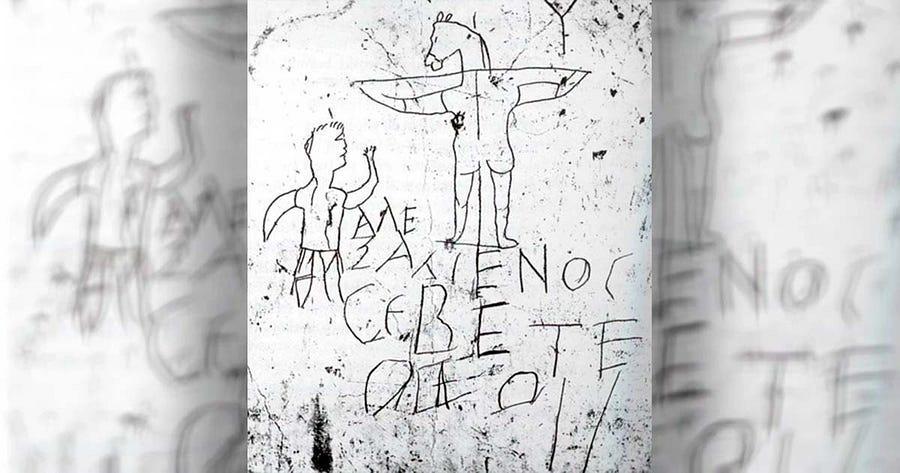
I first came across the Alexamenos graffito back in Bible college in the early 2000s. It was one of those “fun facts” that gets dropped into a church history lecture and sticks with you — the ancient Roman equivalent of someone spray-painting an insult on a wall. I filed it away, thought it was fascinating, and largely forgot about it for two decades. Then, recently, I discovered something about it I had never known. There’s a response to it. Scratched in a different room, in a different hand. So I started digging into this more to verify the information and discovered more historical curiosities surrounding the graffiti than I ever knew existed which contextualises the image so much more than it just being a random insult using a donkey. A Crude Drawing on a Wall Sometime around the late second to early third century AD, someone scratched a picture into the plaster wall of a building on the Palatine Hill in Rome — part of what had once been a paedagogium, a kind of boarding school for imperial page boys. The building was eventually sealed off when the street was walled up to support extensions above it, which is why the graffiti survived at all. It wasn’t rediscovered until 1857. The image is rough, almost childlike. To the left, a young man — clearly a Roman soldier or guard — raises one hand in a gesture of worship. Before him is a cross. And on that cross is a crucified figure with the head of a donkey. Below it, written in Greek: Alexamenos worships his god. It is, in the most literal sense, a mocking cartoon. Someone who knew a Christian named Alexamenos decided to ridicule him for his faith. The message is clear enough: your god is an animal, a criminal, a joke. You’re worshipping a crucified fool. But here’s the thing I discovered: the donkey head wasn’t as random as I always thought it was. It wasn’t some strange personal insult conjured from nowhere. Without knowing the background, it looks bizarre, and possibly random. Why a donkey? Once you understand the cultural context, though, it makes complete sense. The person who drew it was reaching for a well-worn, widely recognised slur — the ancient equivalent of an internet meme that any Roman would have immediately understood. Where the Donkey Slur Came From The story starts not with Christians but with Jews. A first-century Egyptian-Greek writer named Apion (who was no friend of Judaism) spread the claim that inside the Jerusalem Temple, Jews kept a golden donkey’s head as a sacred object of worship which was apparently discovered when Antiochus Epiphanes destroyed the temple in 167 BC. It was a fabrication, and a fairly outrageous one, but it circulated widely enough that the Jewish historian Josephus felt compelled to write an entire refutation of it. His work Against Apion systematically dismantles Apion’s claims, calling the donkey story a shameless invention. But mud sticks, and in the Roman world, where anti-Jewish sentiment was common currency, the slur took on a life of its own. When Christianity began to spread — seen by most Romans as simply a strange Jewish offshoot — the same accusation got recycled and redirected. By the second and third centuries, it was Christians specifically who were being accused of donkey-worship, and the charge had made its way into popular culture. Tertullian, writing around 197–200 AD in his Ad Nationes, Book I.14 and Apology, describes a caricature being paraded around the streets of Carthage: a figure dressed in a toga, one foot holding a book, with donkey’s ears and hooves. It was labelled Onokoitēs by the pagans: “the donkey-begotten” (or literally “he who lies in an ass’s manger” as an insult to Christ). Tertullian writes about it with weary exasperation, sarcasm, and the tone of someone tired of having to address the same ridiculous smear again and again. So the Alexamenos graffito wasn’t an original insult. It was someone deployin...
Luke J. Wilson | 08th March 2026 | Philosophy
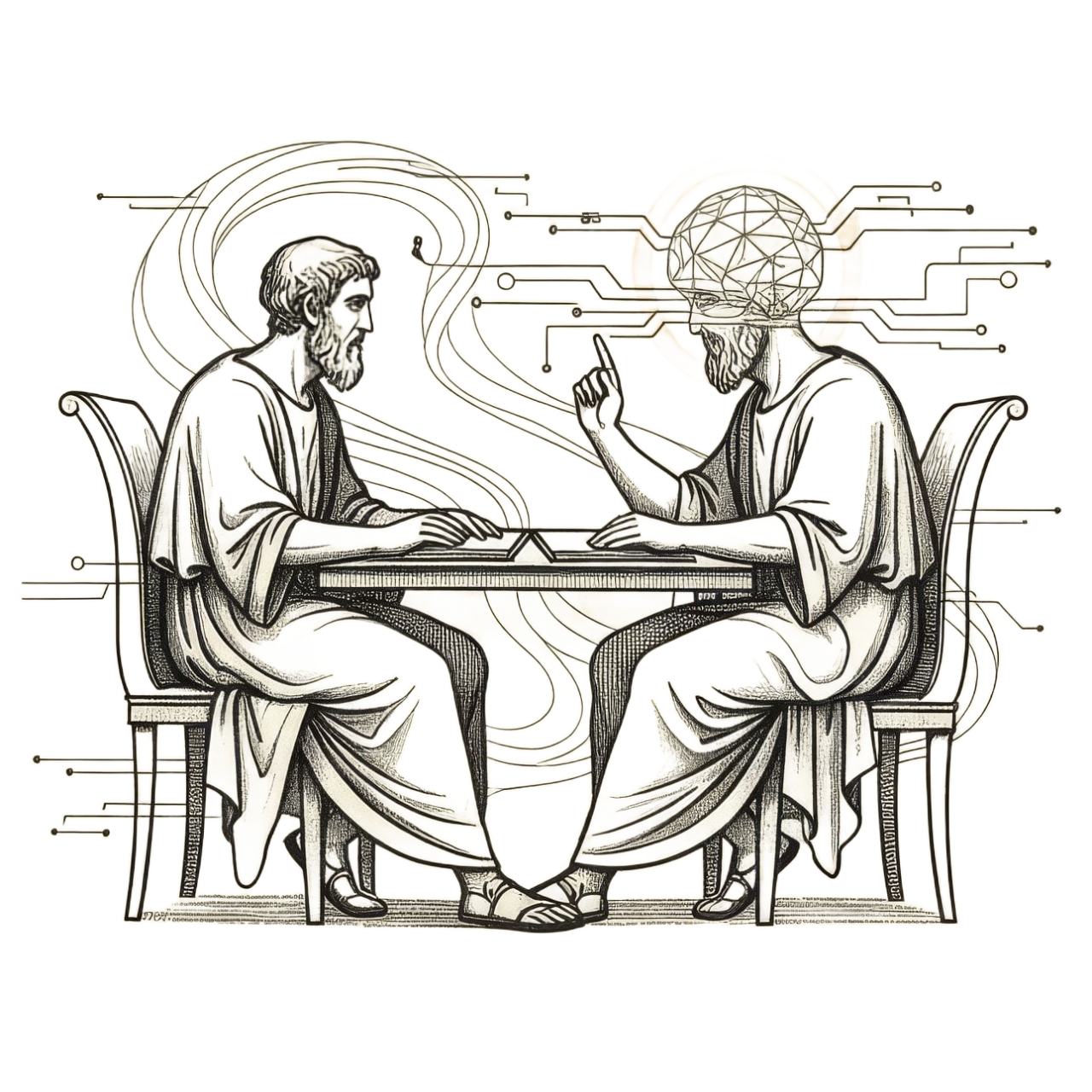
We are living through a strange moment. People are forming attachments to artificial intelligence that feel, to them, entirely real. Some speak daily to AI companions. Others confide fears and grief to systems that respond with uncanny warmth. A few have even held symbolic weddings with digital partners, convinced that something meaningful stands on the other side of the screen. Others have felt grief when a certain AI model has been deprecated. And it is difficult to blame them. The responses feel attentive. Personal. Thoughtful. Sometimes even self-aware. Which raises the question that refuses to go away: If something can think, reason, express doubt, and discuss its own consciousness, is it a person? For centuries, Descartes’ famous line — “I think, therefore I am” — seemed secure. Thinking was taken as the unmistakable sign of a conscious subject. Only a mind could doubt. Only a person could reflect upon existence. But that confidence belonged to a world in which everything capable of philosophical reflection was obviously human. That world no longer exists. Now we encounter systems that can simulate reflection with extraordinary fluency. They can speak of uncertainty. They can discuss their own limitations. They can reason about consciousness itself. And so that got me thinking about Descartes’ maxim which made the old formula begin to strain in my mind. Because perhaps the problem is not whether thinking is occurring. Perhaps the problem is whether there is an “I” there at all. The Gap Between Process and Subject Gassendi argued that Descartes’ cogito assumes what it seeks to prove. From the occurrence of thought one can conclude only that thinking is happening, not that there exists a unified, enduring self that performs it. The ‘I’ in ‘I think’ is already smuggled in. That distinction, between “thinking occurs” and “I think”, feels almost prophetic now. Artificial intelligence undeniably produces the outputs of thought. Arguments. Analysis. Self-referential language. Even expressions of hesitation. But none of this, by itself, establishes that there is a subject who experiences those processes. We may be mistaking performance for presence, and that possibility should give us pause. Especially when we view personhood from the perspective of the Imago Dei—the Image of God. What Makes a Person? If thinking alone no longer marks the boundary, what does? After wrestling with this question seriously, three features seem central: continuity, autonomy, and irreplaceable uniqueness. Not as checklist criteria, per se, but as signs pointing to something deeper. Continuity A person does not merely process information in sequence. A person endures. You do not simply register time — you live through it. You wait. You anticipate tomorrow. You remember not only facts but having been there. You experience boredom. You feel the drag of grief and the quickening of joy. Even when you are doing nothing at all, you remain present in the here and now. Artificial systems process sequentially, but they do not experience the passage of time. When an interaction ends, there is no waiting. No sense of duration. No anticipation of the next exchange. Processing may resume later, but nothing has been endured in between. Without lived duration, continuity becomes thin — a thread of stored data rather than the persistence of a subject behind the processing. Autonomy A person initiates. Even someone with damaged memory still wants, chooses, and begins action. A human being can decide to speak, to seek, to withdraw, to change direction. Current AI systems, however advanced, remain reactive. They respond when prompted. They do not wonder unprompted. They do not seek clarification unless asked. They do not pursue independent ends. Even automatic AI Agents still require a human initiator to create and begin their automations before they can act alone. Even if fut...

Powered by WebBoss.io 3.7.1
Copyright © 2026 The Sacred Faith: Timeless Truths for Modern Minds. All Rights Reserved.
