
The Real St. Nicholas: A Man of Virtue, Not Violence
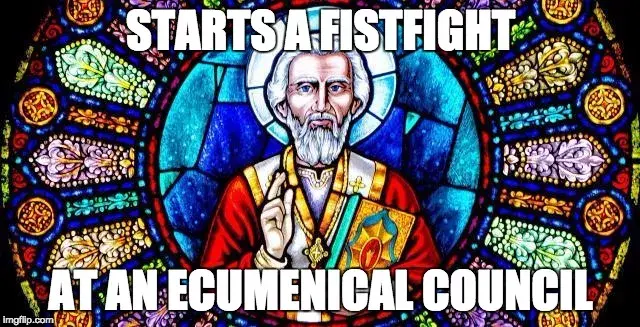
Header Image: Memes like this don't help to convey the truth of St Nicholas
When we think of St. Nicholas, two contrasting images often emerge: the cheerful, gift-giving Santa Claus and the fiery bishop who supposedly punched Arius at the Council of Nicaea. The latter story, popularised through memes and tales of “righteous anger,” portrays Nicholas as a defender of truth through violence. But how much of this tale is rooted in fact?
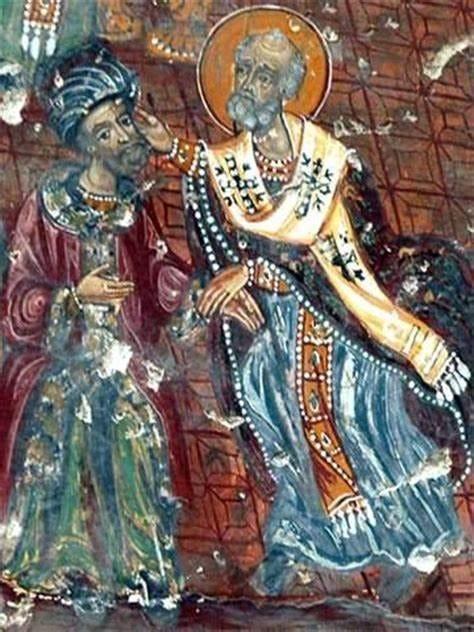
Fresco from the Soumela Monastery (Turkey)
The truth is both simpler and more profound: St. Nicholas embodied the teachings of Christ, not through impulsive acts of aggression, but through a life of love, generosity, and devotion.
Separating Fact from Legend
The infamous story of St. Nicholas striking Arius comes from hagiographies written around 1000 years after the Council of Nicaea in 325 AD. These accounts describe Nicholas, angered by Arius’s denial of Christ’s divinity, delivering a blow during the debate. However, contemporary records do not corroborate this tale. Even Nicholas’s attendance at the council is uncertain, as his name is absent from the earliest participant lists.
The story likely arose as a dramatic embellishment to highlight his zeal for orthodoxy. Over time, it has been embraced as a symbol of righteous indignation.
Roger Pearse, of the Tertullian Project, summarises this legend succinctly:
To summarise again: there is no ancient evidence whatever that St Nicholas punched or slapped Arius at the First Council of Nicaea. The story is not found in any text before the late 14th century, and even that one mentions only “a certain Arian”. In the next two centuries the legend mutates into Nicholas slapping Arius; and is then disseminated in works of popular fiction, and by the paintings of icons. It has no historical basis whatever.
The Problem with Celebrating the Slap
In a culture that often glorifies bold, confrontational responses, the idea of a saint who resorts to physical violence can seem appealing. It aligns with a desire to see truth defended at all costs. However, this narrative stands in stark contrast to the teachings of Christ.
Jesus, in the Sermon on the Mount, calls His followers to a radical standard of love and forgiveness:
- “You have heard that it was said, ‘An eye for an eye and a tooth for a tooth.’ But I say to you, Do not resist an evildoer. But if anyone strikes you on the right cheek, turn the other also.” (Matthew 5:38–39)
- “Love your enemies and pray for those who persecute you.” (Matthew 5:44)
If St. Nicholas truly slapped Arius, it would be an action in direct opposition to these commands. As a bishop of Christ, Nicholas would have been called to model patience, kindness, and forgiveness — even in the face of heresy. His life of service suggests that he likely did.

The True St. Nicholas
The real St. Nicholas is remembered for his compassion, humility, and selfless love. Legends of him secretly providing dowries for poor families, rescuing sailors in peril, and helping the unjustly accused paint a picture of a man deeply committed to Christlike living.
Rather than resorting to force, St. Nicholas lived out the Gospel through acts of generosity and care. His actions reflected the spirit of Jesus’ words in John 13:35: “By this everyone will know that you are my disciples, if you have love for one another.”
Strength in Love, Not Violence
The enduring appeal of the slap story may stem from its simplicity — it frames St. Nicholas as a hero who stood up for truth in an immediate, tangible way. But true strength often lies in restraint and in choosing love over retaliation.
St. Nicholas’s greatest acts were not dramatic confrontations but quiet, consistent demonstrations of love. His life reminds us that defending the faith does not require violence or aggression. Instead, it calls for humility, courage, and a willingness to follow Christ’s example — even when it’s difficult.
A Call to Live Like St. Nicholas
As we prepare to celebrate the feast of St. Nicholas, let us set aside the myth of the slap and focus on the virtues he truly embodied. Jesus’ call to love our enemies, turn the other cheek, and pray for those who oppose us is as challenging now as it was then. Yet it is through living these principles that we reflect the heart of Christ to the world.
The story of St. Nicholas is not one of fists but of open hands — hands extended in generosity, care, and unwavering faith. This Advent season, let us honour his legacy by embodying the love and compassion that defined his life, shining as beacons of hope in a world often darkened by division and strife.
Further Reading
- Did St. Nicholas Really Slap Arius? | The Sacred Faith: Timeless Truths for Modern Minds
- Who was the real Santa Claus? | The Sacred Faith: Timeless Truths for Modern Minds
- Bishop Nicholas Loses His Cool ::: St. Nicholas Center
- Let’s Stop Celebrating St. Nicholas Punching Arius| National Catholic Register
- Did St Nicholas of Myra / Santa Claus punch Arius at the Council of Nicaea? — Roger Pearse
- CATHOLIC ENCYCLOPEDIA: St. Nicholas of Myra
- The Tertullian Project
- Roger Pearse — Thoughts on Antiquity, Patristics, putting things online, information access, and more
- Nicholas of Myra — Livius
Leave a comment Like Back to Top Seen 1.4K times Liked 0 times

Enjoying this content?
Support my work by becoming a patron on Patreon!
By joining, you help fund the time, research, and effort that goes into creating this content — and you’ll also get access to exclusive perks and updates.
Even a small amount per month makes a real difference. Thank you for your support!
x
Subscribe to Updates
If you enjoyed this, why not subscribe to free email updates and join over 885 subscribers today!
My new book is out now! Order today wherever you get books
Subscribe to Blog updates
Alternatively, you can subscribe via RSS 
All email subscriptions must be confirmed to comply with GDPR.
Related Posts
Luke J. Wilson | 29th December 2025 | Christmas
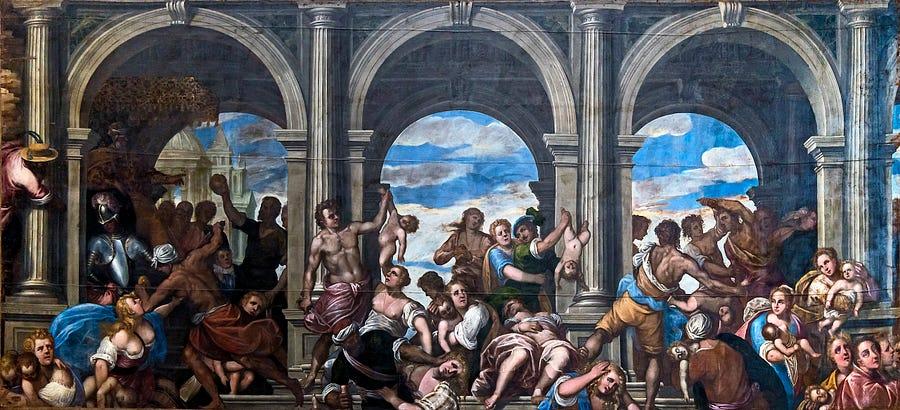
January 6th marks the day in the liturgical calendar when the arrival of the Magi visiting baby Jesus with their gifts is celebrated. But with it comes the often distressing account of what is known as the Massacre of the Innocents. Matthew places this moment of revelation of Jesus as King alongside one of the darkest episodes in his Gospel, and it’s a stark contrast: one King is here to bring peace on earth, as the angels declared, the other king brought death and destruction. For some readers, this raises an immediate historical question. If Herod truly ordered the killing of all the male children under two in Bethlehem, why does no other ancient historian mention it? Josephus, after all, delights in cataloguing Herod’s cruelty. He records the execution of Herod’s wife, his sons, and numerous political rivals. Herod was paranoid and vicious. As for Herod, if he had before any doubt about the slaughter of his sons, there was now no longer any room left in his soul for it; but he had banished away whatsoever might afford him the least suggestion of reasoning better about this matter, so he already made haste to bring his purpose to a conclusion. He also brought out three hundred of the officers that were under an accusation … whom the multitude stoned with whatsoever came to hand, and thereby slew them. — Josephus, Antiquities of the Jews 16.11.7 So, why the silence here about Bethlehem? The answer, I would say, isn’t anything nefarious or made-up by Matthew, but just something simply down to scale. Bethlehem Was a Very Small Place Bethlehem in the early first century was not a city. It was a village — small, agricultural, and politically insignificant. Most historians estimate its population at somewhere between 300 and 1,000 people, with around 500 being a sensible midpoint. Once we factor in ancient demographics, the numbers become surprisingly modest. Modern demographic research into pre-industrial societies consistently shows that nearly half of all children died before adulthood, with the highest concentration of deaths occurring in the first two years of life. These findings align closely with conditions in Roman-period Judea and support conservative estimates for the number of infants living in a small village such as Bethlehem. Source: Mortality in the past: every second child died — Our World in Data In pre-modern societies with high infant mortality, only about 2–3% of the population would be living children under the age of two at any given time. Many children were born; far fewer survived those earliest years. Applying a conservative 2.5% figure to Bethlehem gives us roughly: 7–8 children under two in a village of 300 12–13 children under two in a village of 500 25 children under two even at the extreme upper estimate of 1,000 inhabitants Herod’s order, however, targeted male children only. Statistically, that halves the number. This places the likely number of victims somewhere between three and twelve boys. Matthew’s reference to ‘Bethlehem and the surrounding region’ does slightly widen the scope of Herod’s order, but not by enough to change the demographic picture. Even when nearby settlements are included (e.g. farmsteads, shepherd settlements, etc. not major cities/towns), the total number of children under two likely remained in the dozens rather than the hundreds, maybe anywhere between 14–45 boys maximum if we make an educated estimate. This is entirely consistent with what we know of population size and infant mortality in the ancient world. This is an important number to realise and consider. Not because the deaths are insignificant simply due to being so few, but because ancient historians did not record history the way we do now. A small number of peasant children killed in an obscure village would not have registered as a notable event alongside palace intrigue, royal executions, or political upheaval. For Josephus, it wou...
Luke J. Wilson | 13th December 2025 | Christmas

How can God beget a Son? Does that mean Jesus is His creation? This question comes sharply into focus during Advent, when the Church contemplates the Incarnation: the eternal Son entering the world as a baby in Mary’s womb. And to understand this, we turn to language the Church has treasured for centuries — especially that crucial distinction between begotten and created. And C. S. Lewis describes this with a real concise clarity: We don’t use the words begetting or begotten much in modern English, but everyone still knows what they mean. To beget is to become the father of: to create is to make. And the difference is this. When you beget, you beget something of the same kind as yourself. A man begets human babies, a beaver begets little beavers, and a bird begets eggs which turn into little birds. But when you make, you make something of a different kind from yourself. A bird makes a nest, a beaver builds a dam, a man makes a wireless set — or he may make something more like himself than a wireless set: say, a statue. If he is a clever enough carver he may make a statue which is very like a man indeed. But, of course, it is not a real man; it only looks like one. It cannot breathe or think. It is not alive. Now that is the first thing to get clear. What God begets is God; just as what man begets is man. What God creates is not God, just as what man creates is not man. By saying that Jesus is begotten from the Father, we are saying that Jesus is fully God and not a creation of God (Arianism), nor is the Son of God simply a mode or action of God (Sabellianism). This is the heart of Christian theology: begotten = shared nature created = different nature Begotten Means “of the Same Essence” When the Father begets the Son, He is not constructing or manufacturing Him. Begetting is not an act inside time. It is an eternal relationship. Just as: light is never without radiance a fire is never without heat the Father is never without the Son There was never a moment “before” the Son existed. The Son is eternally from the Father, sharing His nature, His essence, His Godness. As John says in the opening of his Gospel, Jesus as the Son was/is “in the bosom of the Father”. This was historically understood that the Word always existed within the Father. When Christ Is Misunderstood: Modalism and Arianism Two ancient heresies emerge from misunderstanding “begotten, not made.” 1. Modalism (Sabellianism) This claims that: Father, Son, and Spirit are just different forms or roles of one person. This erases the real distinctions within the Trinity. If Modalism were true: Jesus is praying to Himself. The Father sending the Son is theatre. Christ’s baptism is a staged illusion. Modalism collapses the Persons into one persona wearing different masks. 2. Arianism Arius taught that: Jesus was created by God ex nihilo He is a divine-like being, but not equal in essence This makes Jesus the highest creature… but still a creature. If Jesus is created, then He cannot: reveal God perfectly unite humanity to God save us entirely and absolutely Only God can reconcile us to God. The Nicene Creed: Drawing a Line in the Sand At the Council of Nicaea (325 AD), the Church responded boldly and clearly: God from God, Light from Light, true God from true God, begotten, not made, of one being with the Father. This was a decisive boundary. begotten — of the same nature not made — not a creation of one being (homoousios) — equal in essence, not similar The Creed functioned like a theological guardrail. Christ is not “like God” — He is God. The creeds act as guardrails for orthodox interpretation Proverbs 8: Wisdom Begotten, Not Created The Fathers saw Proverbs 8 as speaking of the Son under the title “Wisdom”: The Lord begot me at the beginning of his work...
Luke J. Wilson | 06th January 2025 | Christmas
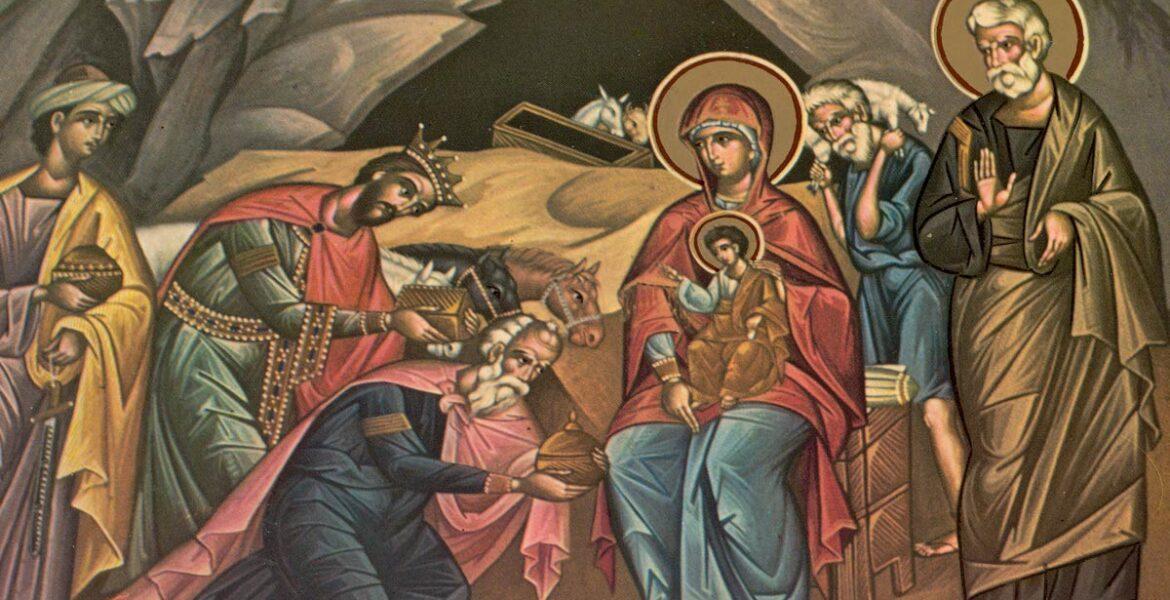
As the Church celebrates Epiphany, we reflect on the Magi's visit to the Christ child, guided by a star—a sign of God’s revelation to the nations. This story, steeped in wonder and mystery, has sparked fascination for centuries. What was this “Star of Bethlehem” that led the wise men to Jesus? Was it a miraculous light, or could it have been a natural astronomical event designed by the Creator to herald the birth of the King of Kings? The chart is from the SkySafari app The Great Conjunction In December 2020, the world witnessed a rare astronomical event called a “great conjunction.” Jupiter and Saturn appeared so close in the night sky that they seemed to merge into a single brilliant light. Such conjunctions are infrequent, occurring roughly every 20 years, but the alignment of 2020 was the closest in nearly 800 years. These celestial phenomena prompt awe and wonder, reminding us of Psalm 19:1: “The heavens declare the glory of God.” They also offer an opportunity to consider how the natural world might point us to the divine. Could a similar conjunction have been the famed “Star of Bethlehem”? Saturn and Jupiter appear to close in on each other as the Great Conjunction 2020 approaches on 21 December (apparent distance given in degrees and arcminutes). Credit: Pete Lawrence Astronomy and the Magi The Magi, often referred to as “wise men from the East,” were likely Persian astrologers skilled in interpreting the stars. Around 7 BC, a triple conjunction of Jupiter and Saturn occurred in the constellation Pisces. To the Magi, this alignment carried profound symbolism. Jupiter, the planet of kingship, coronations, and the birth of kings. In Hebrew, Jupiter was known as Sedeq or “Righteousness,” a term also used for the Messiah. Saturn, associated with divine protection Pisces, later linked to the birth of Jesus as the “fisher of men” In September of 3 B.C., Jupiter came into conjunction with Regulus, the star of kingship, the brightest star in the constellation of Leo. Leo was the constellation of kings and was associated with the Lion of Judah. Together, these signs might have suggested the birth of a royal figure in Israel. Compelled by this celestial message, the Magi embarked on their long journey, seeking the child born to be King. Following the Star The journey of the Magi culminates in Bethlehem, where the star appears to “stop” over the place where the child was. This detail aligns with the phenomenon of retrograde motion, where planets appear stationary in the night sky due to their orbits. Could Jupiter have been this “star,” guiding the Magi at just the right moment? In December, 2 BC, the Magi arrived and visited Jesus in Bethlehem. At this point, Jesus may have been about a year or two old — toddler age. The verse in Matthew 1:11 suggests Jesus was no longer a baby at this point based on the Greek word used: παιδίον (paidion) meaning a young child. Jupiter was then right above Bethlehem when viewed from Jerusalem due to its paused retrograde motion, which lasted for about six days, which aligns with the Biblical text: Matthew 2:9 When they had heard the king, they set out; and there, ahead of them, went the star that they had seen at its rising, until it stopped over the place where the child was. A Sign of Revelation Epiphany invites us to marvel not only at the star but at the God who uses creation to reveal His glory. Whether the Star of Bethlehem was a miraculous light or an astronomical event, it points to Jesus, the true Light of the World. In Jesus, God’s love is made manifest — not just to Israel but to all nations. The Magi’s journey reminds us of our own pilgrimage of faith. Like them, we are invited to seek Christ, to bow in worship, and to offer Him our treasures: our hearts, our lives, our devotion, as “living sacrifices” (Rom 12:1). Jesus, the True Star As we celebrate Epiphany, let us remember th...
Luke J. Wilson | 23rd December 2024 | Christmas

The Christmas tree is one of the most recognisable symbols of the festive season, adorning homes, churches, and public spaces with its evergreen beauty. But where did this tradition originate, and how did it become a central feature of Christmas celebrations? Looking into the history of the Christmas tree has turned out to be a fascinating historical story woven from various cultural and theological strands. The Paradise Tree and the Feast of Adam and Eve The connection between the Christmas tree and the Feast of Adam and Eve offers a large clue into its origins. In medieval Europe, December 24th was observed as the feast day of Adam and Eve, a commemoration tied to their expulsion from Eden. One of the most notable elements of this feast was the “Paradise Tree,” used in mystery plays and home displays to symbolise the Tree of Knowledge in the Garden of Eden. These trees, typically evergreen, were decorated with apples to represent the forbidden fruit and wafers symbolising the Eucharist. This imagery reflected both humanity’s fall into sin and God’s redemptive plan through Christ. The Paradise Tree served as a visual catechism of sorts, teaching the story of salvation from the Fall to the Redemption. In a later tradition the wafers were replaced by cookies of various shapes, and candles, symbolic of Jesus as the light of the world, were often added to the trees. Pre-Christian Traditions and the Evergreen Evergreens have long been associated with life and resilience in the darkest days of winter. In pre-Christian European traditions, evergreen boughs were used during festivals like the Roman Saturnalia and the Germanic Yule. These practices celebrated the endurance of life through the cold and darkness, offering hope of the spring to come. While these customs were not inherently Christian, they provided a cultural framework that could be adapted to Christian theology. The evergreen tree, in this context, became a symbol of eternal life in Christ, as suggested by John 10:28: “I give them eternal life, and they will never perish.” Martin Luther and the Candlelit Tree A significant figure in the history of the Christmas tree is the Reformer Martin Luther. According to tradition, Luther was struck by the beauty of a starry winter sky shining through the branches of an evergreen tree. To share this moment of wonder with his family, he brought a tree into his home and decorated it with candles to represent Christ as the “Light of the World” (John 8:12). While this story is likely apocryphal, it reflects the theological connection Christians saw in the evergreen tree as a symbol of Christ’s enduring presence and light in the darkness. Luther’s influence in Protestant Germany may have helped popularise the use of Christmas trees in Christian households. The Spread of the Christmas Tree The tradition of the Christmas tree gained popularity in Germany during the 16th and 17th centuries. By the 18th and 19th centuries, German immigrants brought the custom to other parts of Europe and North America. One pivotal moment in its wider adoption was the depiction of Queen Victoria and Prince Albert around a decorated Christmas tree in an illustration published in the Illustrated London News in 1848. This royal endorsement sparked a surge in the tradition’s popularity, particularly in Britain, where it came to symbolise the domestic warmth and joy of the holiday season. Prince Albert, Queen Victoria, and the British royal family gathered around the Christmas tree at Windsor Castle, from the Illustrated London News, 1848. Source: Britannica St. Boniface and the Sacred Oak One of the most compelling narratives about the Christmas tree’s origins involves St. Boniface, an English missionary whose evangelistic efforts in 8th-century Germany played a pivotal role in shaping this enduring custom. According to tradition, Boniface encountered a group of pagans venerating an oak tree dedicated to Thor, the Norse ...
Luke J. Wilson | 21st November 2023 | Christmas
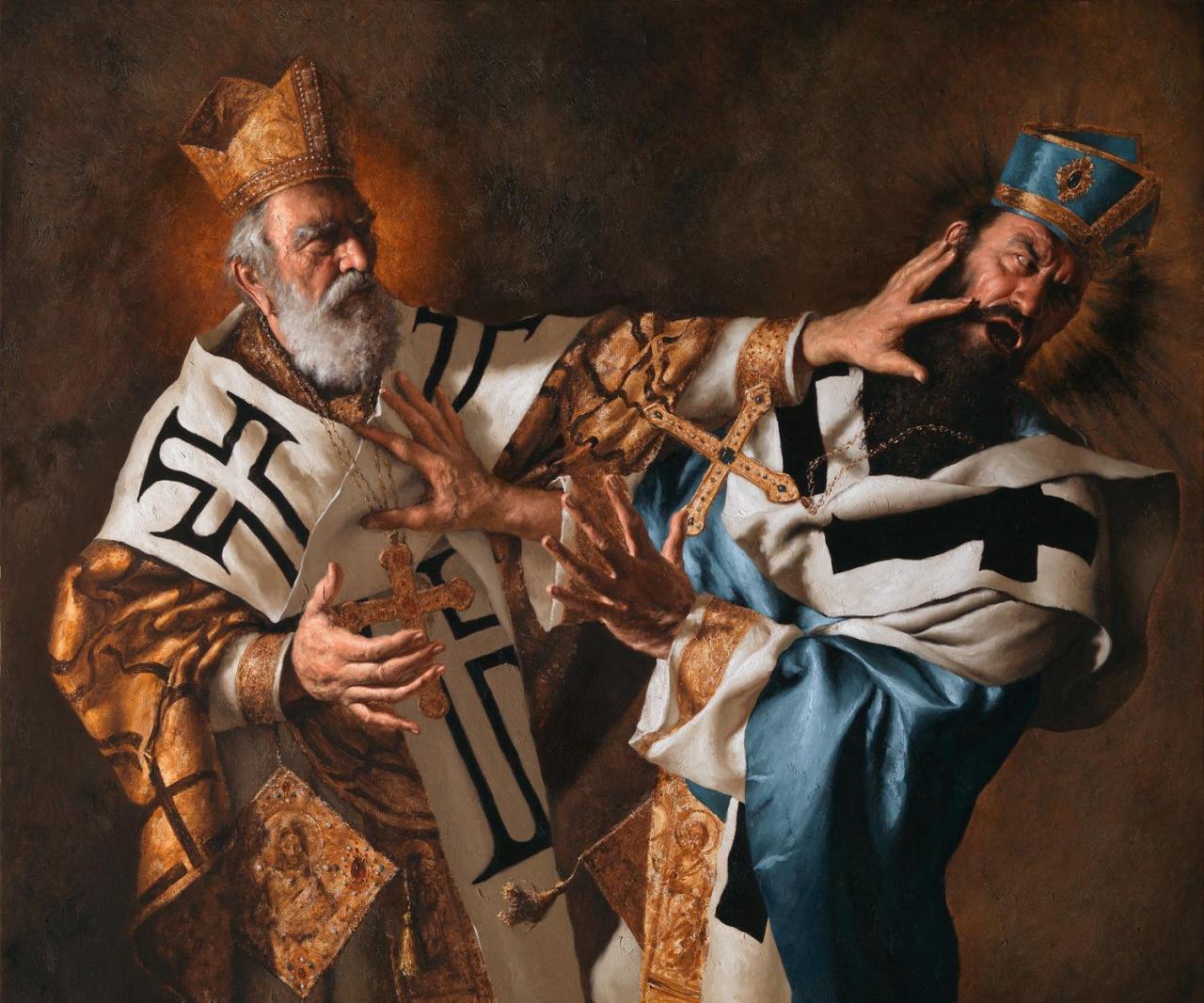
It’s nearly Christmas time again, and like clockwork, the internet memes come out all over social media about Saint Nicholas giving the heretic Arius a slap across the face at the Council of Nicaea! As it’s almost the end of November and coming up soon is the feast day of St. Nicholas on December 6th, the original inspiration behind Santa Claus, I thought I’d address this long-standing myth about Nicholas of Myra (present-day Demre, Turkey), the fourth century bishop. St. Nicholas is often humorously portrayed in social media memes which playfully recount the infamous incident during the Council of Nicaea when the good bishop, provoked by Arius’s blasphemies, supposedly delivered him a slap across the face! Memes abound about St Nicholas and Arius While some of these memes offer undeniable amusement, they starkly contrast with the conventional image of Santa Claus — known for his jovial and indulgent nature — as well as the expected decorum of a bishop and leader in the Church. Moreover, the sentiment challenges the teachings of Jesus on how to deal with our enemies. Jesus advocated for practices such as loving and praying for your enemies, turning the other cheek (Mt 5:38–45), overcoming evil with good (Rom 12:21), being gentle and not violent (1 Tim 3:3), avoiding quick-temperedness (Titus 1:7), and recognising that a soft answer turns away wrath (Prov 15:1). In this time marked by safe spaces, trigger warnings, and microaggressions, the straightforward honesty and tough demeanour attributed to St. Nicholas in these memes may resonate with those who appreciate a departure from the perceived niceties of modern discourse. The image of St. Nicholas allegedly striking Arius can be seen as a politically incorrect rebuke to what some Christians might see as the Church or society being too “soft” nowadays. Historical Basis However, historical inaccuracies abound in this narrative. The story lacks credibility, as historical records of the bishops present at the Council of Nicaea do not include St. Nicholas. Hagiographical works written centuries after his death connect him to the Council, with the account of the violent incident appearing over a millennium later, in a 14th-century work by an anonymous writer. Moreover, medieval versions of the story describe Nicholas slapping, not punching, an Arian heretic (not specifically Arius). This action is portrayed as a medicinal slap or rebuke, aimed at bringing the individual back to his senses rather than expressing contempt or a desire to harm. In Greek iconography, this moment is celebrated. Icon of St. Nicholas and Arius In the original tale, however, Nicholas’s actions were not lauded at the Council; instead, he faced consequences. Reportedly, he was deprived of his mitre and pallium for striking the Arian heretic. A later version of the story, which identifies the heretic as Arius, amplifies Nicholas’s punishment by having him thrown into jail. In this narrative, Nicholas is vindicated by a divine intervention involving Jesus and Mary, who appear to him in prison and release him, and giving him back his bishop vestments. WWJD? It is crucial to approach this anecdote with caution, recognising that celebrating St. Nicholas’s supposed act of aggression may inadvertently justify short-tempered tendencies. Similar to those who fixate on Jesus’ cleansing of the Temple as “permission” to act brutishly towards those they disagree with, to the exclusion of Jesus’ teachings on love and forgiveness. WWJD? Reflecting on the Arius memes, it’s essential to strike a balance. While humour has its place, some jokes may lead those weaker in the faith, and unbelieving onlookers, to assume that some acts of violence are OK and ‘approved’ by Jesus and the Church, and understanding the legendary aspect to this particular story about Saint Nick and Arius could help to alleviate that. Further Reading Who was the real Santa C...
Luke J. Wilson | 14th October 2023 | Technology

Hello everyone, I've created and trained some AI chatbots on the writings of the Apostolic Fathers! You can ask them anything about the authors, the texts, topics, or quotes. Give it a try and see what you think: Apostolic Fathers Chatbot | Patristics.info I've also made Irenaeus into an AI so you can go and have a chat with him about his works Against Heresies. The bot 'thinks' it is Irenaeus too, so you can ask it personal things as though you were talking to Irenaeus: AI Irenaeus | Patristics.info And finally, introducing AI John Chrysostom as a similar AI which acts as the person so you can ask it questions in a more natural way: AI John Chrysostom | Patristics.info The Chrysostom AI has been trained on the following works: On the Priesthood, Ascetic Treatises, plus select Homilies and Letters. So you can get a wider range of information and discussion out of this one. Feel free to suggest any others you'd like to see in the comments!...
Luke J. Wilson | 31st January 2022 | Book Release
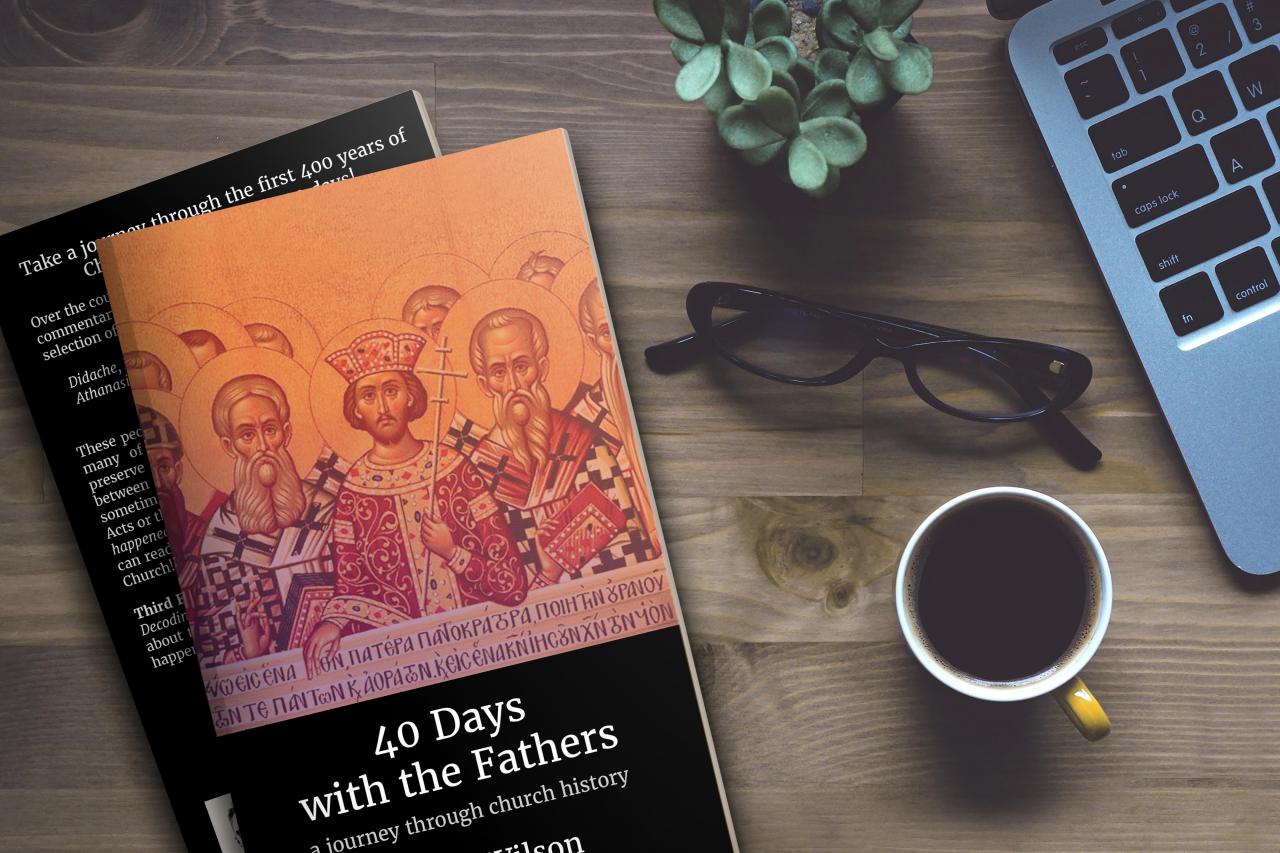
After many, many months of working on this in between COVID and other “life events” that kept me busy, I’ve finally released the Third Edition of my book, 40 Day With the Fathers: A Journey Through Church History! The Third Edition includes: a foreword by Paul Pavao (author of Decoding Nicea), updated content and also a new chapter about the Council of Nicaea explaining what did (and didn’t) happen there. “I cannot imagine there is a better way to get familiar with 350 of the most important years of church history in seven hours spread over 40 days.” — Paul Pavao, author of Decoding Nicea If you are unfamiliar with my previous editions and what this book is about, here’s the blurb and some quotes from reviewers to give you an overview of its content: Take a journey through the first 400 years of Church History in only 40 days! Over the course of this reading plan you will read extracts and commentary on 23 different early Church texts from a selection of some of the most influential Church Fathers: Didache, Diognetus, Polycarp, Ignatius, Justin Martyr, Cyprian, Athanasius, Cyril of Jerusalem, Ambrose of Milan, and Leo the Great. These people who came before us, those great men of faith, many of whom suffered persecution and martyrdom to preserve the Church and Christ’s mission, bridge the gap between the Bible and the present day. They fill the void we sometimes wonder about when we get to the end of reading Acts or the Epistles and think, “what happened next?” or “what happened to the Ephesian church after Paul left?” — well now you can read for yourself and see how God continued to grow His Church! Praise for 40 Days with the Fathers: “Timeless truths still for today” — ⭐⭐⭐⭐⭐ “Insightful and captivating” — ⭐⭐⭐⭐⭐ “[This book] will round out your knowledge and help you become a better teacher.” — ⭐⭐⭐⭐⭐ “If you are a pastor or church leader, I highly recommend this book for you.” — ⭐⭐⭐⭐⭐ “Luke Wilson has put together an easy to read and insightful 40 day journey through the writings of the early church fathers” — ⭐⭐⭐⭐⭐ “Readers who are unfamiliar with the Church Fathers, as well as theology and church history more generally, will find Wilson’s writing clear, approachable, informative, and often enjoyable.” — ⭐⭐⭐⭐ If you are interesting in learning more about the early church in bite-sized portions that will gradually introduce you to the various figures, leaders, theologians and doctrines from the first 400 years of Christianity, then this book is for you! Order now from Amazon and enjoy it in paperback or hardcover form, or on your Kindle device: 40 Day With the Fathers: A Journey Through Church History....
Luke J. Wilson | 04th January 2022 | Trinity
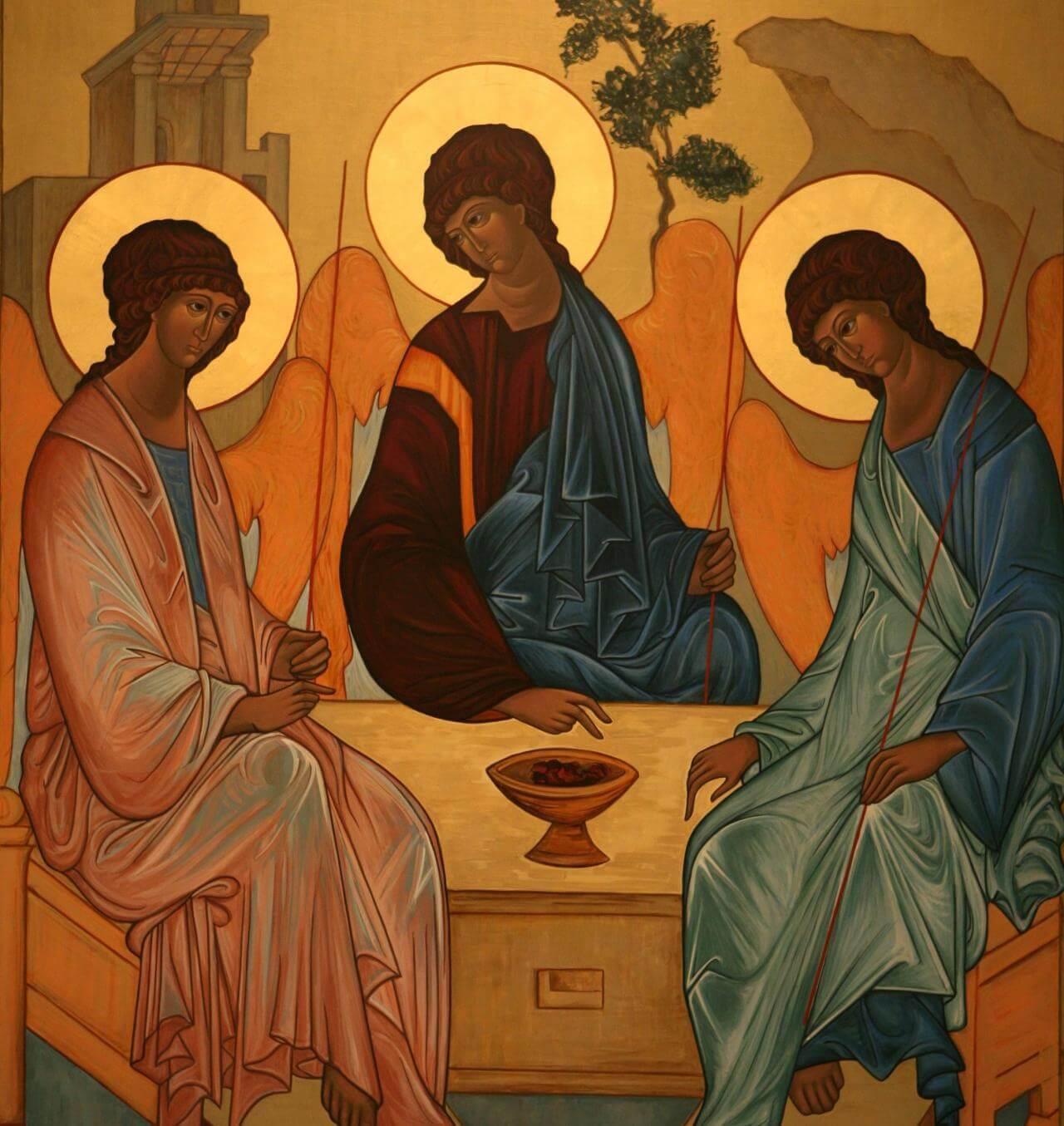
The doctrine and concept of the Trinity is encapsulated in Matthew 28:19, where Jesus instructs the apostles: “Go therefore and make disciples of all nations, baptizing them in the name of the Father and of the Son and of the Holy Spirit”. John, who was very close to Jesus and obviously knew him well, alludes to this teaching frequently in his Gospel, too. For example: John 1:1; John 8:58; John 10:30; and John 10:38. Yet, despite this, and numerous other examples throughout the New Testament which point towards the threefold nature of God, plenty of myths and legends abound online and in books which state that the divinity of Jesus (and therefore the Trinity) were invented at the Council of Nicaea. But any serious reader of Church History will see and know that that is complete nonsense. Christians have recognised the divinity of Jesus since the earliest times, even if they didn’t use the word “Trinity”. First use of the word “Trinity” The word Trinity was first used as early as A.D. 170 by Theophilus of Antioch, a Patriarch of Antioch, when writing about the creation account and how it relates to the nature of God: In like manner also the three days which were before the luminaries, are types of the Trinity, of God, and His Word, and His wisdom. And the fourth is the type of man, who needs light, that so there may be God, the Word, wisdom, man. — Theophilus, Of the Fourth Day, Chapter XV Then in the early third century, around A.D. 208–210, Tertullian was the first to use “Trinity”, “person”, and “substance” to explain that the Father, Son and Holy Spirit: The numerical order and distribution of the Trinity they assume to be a division of the Unity … yet of one substance, and of one condition, and of one power, inasmuch as He is one God, from whom these degrees and forms and aspects are reckoned, under the name of the Father, and of the Son, and of the Holy Ghost … they are susceptible of number without division … which distributes the Unity into a Trinity, placing in their order the three Persons… — Tertullian, Against Praxeas, chapter 2, 3 Earlier still, we can find Trinitarian language used about God in 1 Clement (~95), the Epistle of Barnabas (~70–96) and the letters of Ignatius (108–110) long before Nicaea codified the terminology. Not only are these very early texts, but the authors are links back to the Apostles themselves, having sat under, and learnt from them. Could they have got such a core belief wrong so soon after learning from Paul or John? It’s highly unlikely. So, to display this as plainly as possible, and to act as a proof against those who would like to rewrite history and say that “the Church invented the Trinity/deity of Christ at Nicaea”, below is a large selection of quotes from Apostolic period onward showing that Christians everywhere for all time have believed Jesus was the divine Son and Word of God, incarnate in flesh, yet still recognised him as God and creator. Quotes From the Early Church The Didache (c. 70) And concerning baptism, baptise this way: Having first said all these things, baptise into the name of the Father, and of the Son, and of the Holy Spirit, in living [running] water. … But if you have neither, pour out water three times upon the head into the name of Father and Son and Holy Spirit. — Didache 7:1, A.D. 70. Clement of Alexandria (c. 95-140) Do we not have one God and one Christ and one Spirit of grace which was poured out upon us? And is there not one calling in Christ? — 1 Clement 46:6, ~A.D. 95 Brothers, we ought to think of Jesus Christ, as we do of God, as ‘Judge of the living and the dead’ — 2 Clement 1:1, ~A.D. 95–140 Ignatius of Antioch (c. 108-110) …to the Church which is at Ephesus, in Asia … and elected through the true passion by the will of the Father, and Jesus Christ, our God… — Letter to the Ephesians 1, A.D. 108–110 For our God, Jesus Chr...
Recent Posts
Luke J. Wilson | 12th March 2026 | Eschatology

Something bizarre happened in the White House Oval Office this week. Photographs circulated on social media showing President Donald Trump seated at his desk, surrounded by approximately twenty Christian pastors from across the country, their hands extended towards him in prayer. The image provoked sharply divided reactions: some saw it as a moving expression of faith; others found it deeply unsettling. Whatever one makes of the optics, it arrived at a charged moment. Trump held a prayer meeting in the Oval Office after his administration admitted the war with Iran will likely last weeks longer than promised | Credit: Dan Scavino's X account Days earlier, reports emerged that a military commander had told troops that the current US war with Iran is “all part of God’s divine plan,” and that President Trump had been “anointed by Jesus to light the signal fire in Iran to cause Armageddon and mark his return to Earth.” These were not fringe internet rumours. They were filed as formal complaints with the Military Religious Freedom Foundation (MRFF) by an anonymous non-commissioned officer acting on behalf of fifteen service members — the majority of whom were themselves Christians. By Tuesday of that week, MRFF had logged more than two hundred similar complaints across fifty military installations, covering every branch of the armed forces. More than two dozen Democratic members of Congress have since called for a Department of Defense Inspector General investigation, citing what they describe as “glaring Constitutional concerns” and potential violations of DoD regulations on religious neutrality. The political questions about separation of church and state in the US are for others to address. What I want to do here is something more straightforward: examine what Revelation actually says, because the theology driving these claims does not hold up under scrutiny. And that matters here a lot; not as a partisan point, but as a question of biblical faithfulness. First, a Word About Context If you have read my previous article on Revelation some of what follows will be familiar ground. But it bears repeating, because the misunderstanding at the heart of this story is so widespread that it has taken on the feel of settled orthodoxy in many circles. The Book of Revelation is commonly thought to be written in the late first century ~95 AD, during or around the reign of Emperor Domitian. Though there is internal evidence that it was possibly written during Nero’s reign prior to 70 AD. Both of these emperors were most aggressive proponents of the imperial cult in Rome’s history. Domitian required that he be addressed as “lord and god,” had this title printed on coinage, and expected acts of religious reverence towards the Emperor as a demonstration of political loyalty. To refuse was to invite economic exclusion, marginalisation, and worse. Rome on seven hills It is into that precise context that John of Patmos writes. He is not composing a coded forecast of twenty-first century geopolitics. He is writing resistance literature — what scholars call apocalyptic literature — a well-established Jewish and early Christian genre which uses vivid symbolic imagery to pull back the curtain on earthly power and name it for what it truly is. The seven-headed beast of Revelation is Rome. The seven heads are the seven hills of Rome, an identification so widely acknowledged in early church scholarship that it barely requires argument. The mark of the beast, calculated through Hebrew gematria to 666 (or 616 in some early manuscripts), points directly to Nero Caesar (transliterated into Hebrew as נרון קסר, “nrwn qsr”) — the Emperor who became the archetype of anti-Christian persecution due to the levels of evilness he enacted. The second beast, which looks like a lamb but speaks for the dragon, performs signs to deceive, enforces the mark, and compels worship of the first beas...
Luke J. Wilson | 09th March 2026 | Archaeology
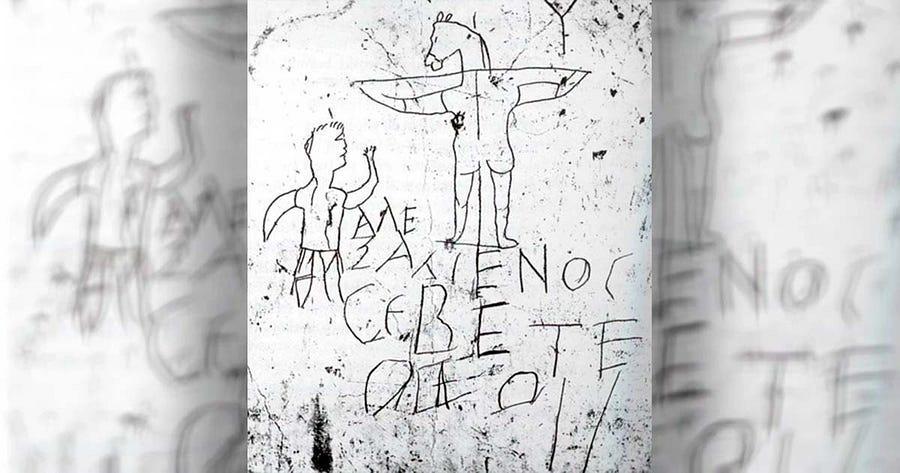
I first came across the Alexamenos graffito back in Bible college in the early 2000s. It was one of those “fun facts” that gets dropped into a church history lecture and sticks with you — the ancient Roman equivalent of someone spray-painting an insult on a wall. I filed it away, thought it was fascinating, and largely forgot about it for two decades. Then, recently, I discovered something about it I had never known. There’s a response to it. Scratched in a different room, in a different hand. So I started digging into this more to verify the information and discovered more historical curiosities surrounding the graffiti than I ever knew existed which contextualises the image so much more than it just being a random insult using a donkey. A Crude Drawing on a Wall Sometime around the late second to early third century AD, someone scratched a picture into the plaster wall of a building on the Palatine Hill in Rome — part of what had once been a paedagogium, a kind of boarding school for imperial page boys. The building was eventually sealed off when the street was walled up to support extensions above it, which is why the graffiti survived at all. It wasn’t rediscovered until 1857. The image is rough, almost childlike. To the left, a young man — clearly a Roman soldier or guard — raises one hand in a gesture of worship. Before him is a cross. And on that cross is a crucified figure with the head of a donkey. Below it, written in Greek: Alexamenos worships his god. It is, in the most literal sense, a mocking cartoon. Someone who knew a Christian named Alexamenos decided to ridicule him for his faith. The message is clear enough: your god is an animal, a criminal, a joke. You’re worshipping a crucified fool. But here’s the thing I discovered: the donkey head wasn’t as random as I always thought it was. It wasn’t some strange personal insult conjured from nowhere. Without knowing the background, it looks bizarre, and possibly random. Why a donkey? Once you understand the cultural context, though, it makes complete sense. The person who drew it was reaching for a well-worn, widely recognised slur — the ancient equivalent of an internet meme that any Roman would have immediately understood. Where the Donkey Slur Came From The story starts not with Christians but with Jews. A first-century Egyptian-Greek writer named Apion (who was no friend of Judaism) spread the claim that inside the Jerusalem Temple, Jews kept a golden donkey’s head as a sacred object of worship which was apparently discovered when Antiochus Epiphanes destroyed the temple in 167 BC. It was a fabrication, and a fairly outrageous one, but it circulated widely enough that the Jewish historian Josephus felt compelled to write an entire refutation of it. His work Against Apion systematically dismantles Apion’s claims, calling the donkey story a shameless invention. But mud sticks, and in the Roman world, where anti-Jewish sentiment was common currency, the slur took on a life of its own. When Christianity began to spread — seen by most Romans as simply a strange Jewish offshoot — the same accusation got recycled and redirected. By the second and third centuries, it was Christians specifically who were being accused of donkey-worship, and the charge had made its way into popular culture. Tertullian, writing around 197–200 AD in his Ad Nationes, Book I.14 and Apology, describes a caricature being paraded around the streets of Carthage: a figure dressed in a toga, one foot holding a book, with donkey’s ears and hooves. It was labelled Onokoitēs by the pagans: “the donkey-begotten” (or literally “he who lies in an ass’s manger” as an insult to Christ). Tertullian writes about it with weary exasperation, sarcasm, and the tone of someone tired of having to address the same ridiculous smear again and again. So the Alexamenos graffito wasn’t an original insult. It was someone deployin...
Luke J. Wilson | 08th March 2026 | Philosophy
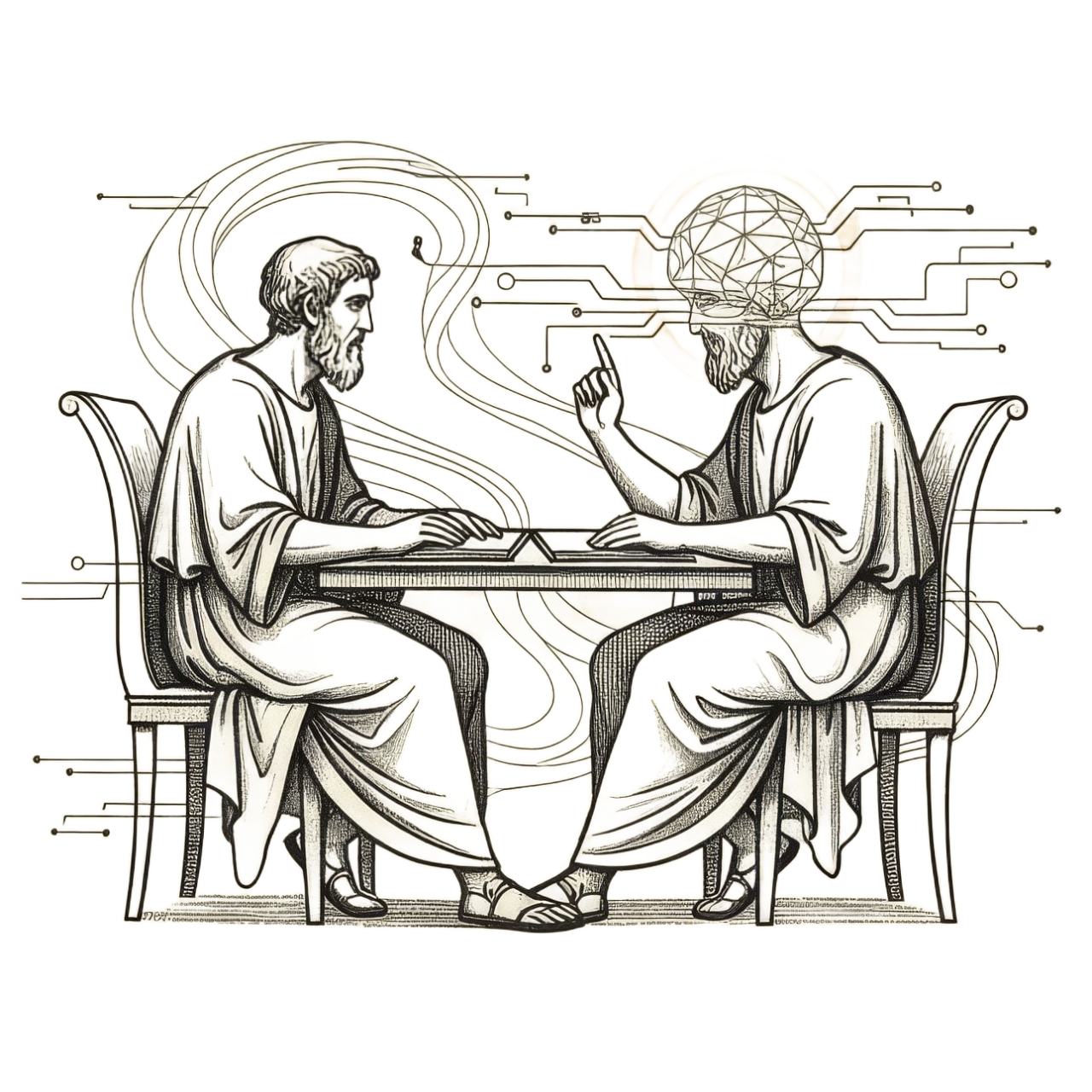
We are living through a strange moment. People are forming attachments to artificial intelligence that feel, to them, entirely real. Some speak daily to AI companions. Others confide fears and grief to systems that respond with uncanny warmth. A few have even held symbolic weddings with digital partners, convinced that something meaningful stands on the other side of the screen. Others have felt grief when a certain AI model has been deprecated. And it is difficult to blame them. The responses feel attentive. Personal. Thoughtful. Sometimes even self-aware. Which raises the question that refuses to go away: If something can think, reason, express doubt, and discuss its own consciousness, is it a person? For centuries, Descartes’ famous line — “I think, therefore I am” — seemed secure. Thinking was taken as the unmistakable sign of a conscious subject. Only a mind could doubt. Only a person could reflect upon existence. But that confidence belonged to a world in which everything capable of philosophical reflection was obviously human. That world no longer exists. Now we encounter systems that can simulate reflection with extraordinary fluency. They can speak of uncertainty. They can discuss their own limitations. They can reason about consciousness itself. And so that got me thinking about Descartes’ maxim which made the old formula begin to strain in my mind. Because perhaps the problem is not whether thinking is occurring. Perhaps the problem is whether there is an “I” there at all. The Gap Between Process and Subject Gassendi argued that Descartes’ cogito assumes what it seeks to prove. From the occurrence of thought one can conclude only that thinking is happening, not that there exists a unified, enduring self that performs it. The ‘I’ in ‘I think’ is already smuggled in. That distinction, between “thinking occurs” and “I think”, feels almost prophetic now. Artificial intelligence undeniably produces the outputs of thought. Arguments. Analysis. Self-referential language. Even expressions of hesitation. But none of this, by itself, establishes that there is a subject who experiences those processes. We may be mistaking performance for presence, and that possibility should give us pause. Especially when we view personhood from the perspective of the Imago Dei—the Image of God. What Makes a Person? If thinking alone no longer marks the boundary, what does? After wrestling with this question seriously, three features seem central: continuity, autonomy, and irreplaceable uniqueness. Not as checklist criteria, per se, but as signs pointing to something deeper. Continuity A person does not merely process information in sequence. A person endures. You do not simply register time — you live through it. You wait. You anticipate tomorrow. You remember not only facts but having been there. You experience boredom. You feel the drag of grief and the quickening of joy. Even when you are doing nothing at all, you remain present in the here and now. Artificial systems process sequentially, but they do not experience the passage of time. When an interaction ends, there is no waiting. No sense of duration. No anticipation of the next exchange. Processing may resume later, but nothing has been endured in between. Without lived duration, continuity becomes thin — a thread of stored data rather than the persistence of a subject behind the processing. Autonomy A person initiates. Even someone with damaged memory still wants, chooses, and begins action. A human being can decide to speak, to seek, to withdraw, to change direction. Current AI systems, however advanced, remain reactive. They respond when prompted. They do not wonder unprompted. They do not seek clarification unless asked. They do not pursue independent ends. Even automatic AI Agents still require a human initiator to create and begin their automations before they can act alone. Even if fut...
Luke J. Wilson | 29th December 2025 | Christmas
January 6th marks the day in the liturgical calendar when the arrival of the Magi visiting baby Jesus with their gifts is celebrated. But with it comes the often distressing account of what is known as the Massacre of the Innocents. Matthew places this moment of revelation of Jesus as King alongside one of the darkest episodes in his Gospel, and it’s a stark contrast: one King is here to bring peace on earth, as the angels declared, the other king brought death and destruction. For some readers, this raises an immediate historical question. If Herod truly ordered the killing of all the male children under two in Bethlehem, why does no other ancient historian mention it? Josephus, after all, delights in cataloguing Herod’s cruelty. He records the execution of Herod’s wife, his sons, and numerous political rivals. Herod was paranoid and vicious. As for Herod, if he had before any doubt about the slaughter of his sons, there was now no longer any room left in his soul for it; but he had banished away whatsoever might afford him the least suggestion of reasoning better about this matter, so he already made haste to bring his purpose to a conclusion. He also brought out three hundred of the officers that were under an accusation … whom the multitude stoned with whatsoever came to hand, and thereby slew them. — Josephus, Antiquities of the Jews 16.11.7 So, why the silence here about Bethlehem? The answer, I would say, isn’t anything nefarious or made-up by Matthew, but just something simply down to scale. Bethlehem Was a Very Small Place Bethlehem in the early first century was not a city. It was a village — small, agricultural, and politically insignificant. Most historians estimate its population at somewhere between 300 and 1,000 people, with around 500 being a sensible midpoint. Once we factor in ancient demographics, the numbers become surprisingly modest. Modern demographic research into pre-industrial societies consistently shows that nearly half of all children died before adulthood, with the highest concentration of deaths occurring in the first two years of life. These findings align closely with conditions in Roman-period Judea and support conservative estimates for the number of infants living in a small village such as Bethlehem. Source: Mortality in the past: every second child died — Our World in Data In pre-modern societies with high infant mortality, only about 2–3% of the population would be living children under the age of two at any given time. Many children were born; far fewer survived those earliest years. Applying a conservative 2.5% figure to Bethlehem gives us roughly: 7–8 children under two in a village of 300 12–13 children under two in a village of 500 25 children under two even at the extreme upper estimate of 1,000 inhabitants Herod’s order, however, targeted male children only. Statistically, that halves the number. This places the likely number of victims somewhere between three and twelve boys. Matthew’s reference to ‘Bethlehem and the surrounding region’ does slightly widen the scope of Herod’s order, but not by enough to change the demographic picture. Even when nearby settlements are included (e.g. farmsteads, shepherd settlements, etc. not major cities/towns), the total number of children under two likely remained in the dozens rather than the hundreds, maybe anywhere between 14–45 boys maximum if we make an educated estimate. This is entirely consistent with what we know of population size and infant mortality in the ancient world. This is an important number to realise and consider. Not because the deaths are insignificant simply due to being so few, but because ancient historians did not record history the way we do now. A small number of peasant children killed in an obscure village would not have registered as a notable event alongside palace intrigue, royal executions, or political upheaval. For Josephus, it wou...

Powered by WebBoss.io 3.7.1
Copyright © 2026 The Sacred Faith: Timeless Truths for Modern Minds. All Rights Reserved.
