
Blog Category: Halloween (6 posts)
Before the Pumpkins: The Barbecued Deacon
Luke J. Wilson | 31st October 2025 |
Apologetics

In our last post, we walked with Perpetua and Felicity through the sands of the amphitheatre, their faith outshining Rome’s cruelty. Now for the final part in this series, we turn to another of the Church’s earliest heroes — one whose courage was matched by an unexpected wit. His name was Lawrence, a deacon of Rome, remembered across centuries as the man who kept his humour even while lying on the griddle.
The Setting: Rome, AD 258
Under Emperor Valerian, a fresh persecution of Christians swept through the Empire. Bishops, priests, and deacons were hunted down, their property seized, and their churches closed. The bishop of Rome at that time was Sixtus II — a gentle and wise shepherd who, like the apostles before him, was soon to drink from the same cup as his Lord. Among his closest companions was Deacon Lawrence, entrusted with overseeing the Church’s treasury and distributing alms to the poor.
The Acts of St Lawrence tell us that when Sixtus was arrested and led to execution, Lawrence ran after him, crying out that he would not be left behind.
Where are you going, father, without your son? Where are you going, priest, without your deacon? You never used to offer sacrifice without me as your minister!
To which Sixtus replied:
My son, I’m not leaving you. Greater trials are waiting for you. In three days you’ll follow me.
Sixtus was beheaded soon after. Lawrence, meanwhile, was arrested and brought before the Roman prefect who, hearing that Lawrence had been the keeper of the Church’s wealth, demanded that he hand it over to the empire.
The True Treasure of the Church
The exchange that followed has been remembered ever since, partly for its irony, partly for its courage.
“Bring forth,” said the prefect, “the treasures of the Church — the gold, the silver, and the precious vessels — that the emperor may possess them.”
Lawrence asked for three days to gather them, which the prefect granted, no doubt imagining c...
Before The Pumpkins: The Day Two Women Defied Rome
Luke J. Wilson | 29th October 2025 |
Apologetics

In the last post, we looked at Polycarp — a faithful bishop who faced the flames rather than deny his Lord. His courage in the face of certain death became a rallying light for generations of believers after him. But his story is only one among many in the long line of the cloud of witnesses who ran the race before us (Hebrews 12:1). Today, we step forward a few decades to another account of extraordinary faith — that of two women, Perpetua and Felicity.
Perpetua left an account of her own martyrdom (technically a Passion) which is considered historically reliable. What makes it extraordinary is that Perpetua herself wrote a portion of it in Latin before her death, making it one of the earliest known writings by a Christian woman! It was then continued by another who witnessed the events once she entered the arena.
The Setting: Carthage, AD 203
Our story takes us to North Africa during the reign of Emperor Septimius Severus. Christianity was still seen as a threat to the Roman order, and anyone refusing to sacrifice to the emperor’s image could be imprisoned or executed. Among the arrested were a small group of catechumens (new believers preparing for baptism) including a young noblewoman named Vibia Perpetua and her servant, Felicity.
Perpetua was only twenty-two years old and the mother of an infant son. Her father, a pagan, begged her to renounce the faith and save her life, but she would not. In her prison diary — one of the earliest surviving Christian texts written by a woman — she records their suffering and her unshakable resolve and faith. After she was arrested with her companions, she wrote of a moment when her father came and tried to persuade her to sacrifice to the Emperor and deny her faith:
When my father, out of love for me, tried to turn me from my faith, I said to him: ‘Father, do you see this vessel here — a water pot or whatever it may be? Can it be called by any other name than what it is?’ He answered, ...
Before The Pumpkins: Faith In The Flames
Luke J. Wilson | 25th October 2025 |
Apologetics

Picture the scene: the year is somewhere around 155–160, Polycarp has just been arrested and brought to the city. The crowd roared in the stadium. The smell of sweat and fear mingled with the dust of Smyrna’s arena. And in the centre of it all stood an old man — calm, unflinching, his face marked with years of faith. The Roman proconsul urged him again: “Swear by the fortune of Caesar. Curse Christ, and I will release you.”
Polycarp looked him in the eye and replied with a defiant response that has echoed down the ages,
Eighty and six years I have served Him, and He has done me no wrong. How can I blaspheme my King who saved me?
Those words have become immortal in and of themselves, reverberating from pulpits, prison cells, and whispered prayers in dark times. They belong to Polycarp, bishop of Smyrna, and one of the clearest windows we have into the courage of the early Church.
The place of Polycarp’s martyrdom was not Rome, as many assume, but the bustling city of Smyrna, in what is now western Turkey. Smyrna was one of the great cities of Asia Minor — wealthy, loyal to Rome, and proud of its grand stadium where games and public spectacles were held. It was in that very stadium, believed by archaeologists to have seated up to 20,000 people, before the watching crowds and the Roman proconsul of the province, that the aged bishop was brought to stand trial. The same stadium that once echoed with cheers for athletes and gladiators would now resound with the final testimony of a Christian who refused to curse his King.
The Roman stadium of Smyrna, located on the slopes of Mount Pagos, fully excavated in 2014. (Source)
A Disciple of the Apostles
Polycarp was no obscure figure on the fringes of history. Born around AD 69, he lived at the very hinge between the apostolic age and the developing life of the Church. Tradition tells us that he was a disciple of the Apostle John, friend and fellow bishop with Ignatius of Antioch, and a mento...
Before The Pumpkins: The Road To The Lions
Luke J. Wilson | 20th October 2025 |
Apologetics
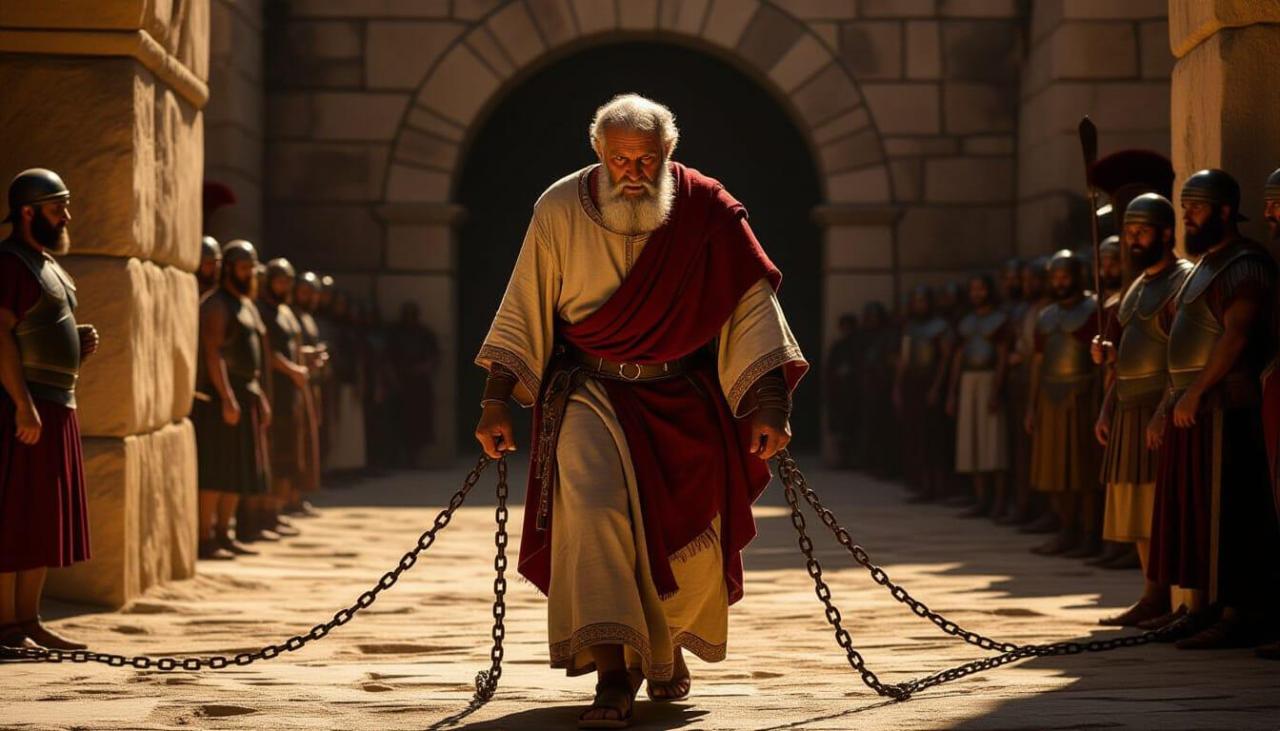
The sound of chains echoed through the streets as Ignatius of Antioch was led from Syria to Rome. The old bishop’s body was frail, but his heart burned with the strength of Christ. Each clinking step brought him closer to the arena — and to the wild beasts that would tear him apart — yet his letters brimmed with joy and passion, and a sense of urgency inspiring others to unity, obedience, and unwavering faith. For Ignatius, death was not defeat; it was the completion of discipleship, crossing the finish line of faith… the moment when imitation of Christ became complete.
Ignatius of Antioch is one of my favourite Early Church Fathers mainly for how much reading his letters had an impact on me. His letter to the church in Rome, especially, as you could really sense his passion and dedication to his faith and conviction to see through his impending martyrdom head on, fearless in the face of death! And as one of the earliest martyrs outside of the New Testament, his story is the perfect place to begin this series.
A Disciple of the Apostles
Ignatius lived in the generation just after the apostles, serving as bishop of Antioch in Syria. Tradition says that Ignatius was the small child whom Jesus held in his arms in Matt. 18:2, though this cannot be verified as Ignatius himself never states it. A more trustworthy tradition 4tells us that he was a disciple of the Apostle John, and this lineage can be felt in his writings. His letters echo the same themes and emphasis on Christ as John does in his Gospel around the incarnation, never failing to highlight the physical nature of Jesus as well as his divine which can be seen with such statements like “Jesus Christ our God” (Epistle to the Ephesians).
During the reign of Emperor Trajan (around AD 107), Christians were increasingly viewed as enemies of the Roman order. Refusing to worship the emperor was seen as defiance, and Ignatius, as one of the most visible leaders of the Church, became a prime targe...
Before The Pumpkins: Reclaiming All Hallows’ Eve
Luke J. Wilson | 12th October 2025 |
Apologetics

It’s that time of year again when pumpkins appear in windows, skeletons hang from doorways, and debates resurface about whether Christians should have anything to do with Halloween. Some will say it’s entirely “pagan” in origin, others that it’s harmless fun — and many of us fall somewhere in the middle, just trying to work out what’s right (or try to ignore it!).
But what if we’ve forgotten that Halloween began not with ghosts and ghouls, but with grace and glory? Hallowe’en — “All Hallows’ Eve” — was never about celebrating darkness; it was about remembering the light. It marked the night before All Saints’ Day, a day to honour those who gave their lives for Christ — the martyrs and the faithful who stood firm when the world turned against them.
The very first commemorations of this kind go back far earlier than medieval Europe. Around 135 AD, Christians were already gathering at the tombs of martyrs like Polycarp of Smyrna, treating their remains as “more precious than the most exquisite jewels”. By the third century, Cyprian of Carthage was writing that the Church should record the dates when martyrs were killed so that their witness could be remembered each year. The faithful didn’t gather to mourn their loss, they gathered to celebrate their victory over death by attaining the reward of eternal life.
Over time, as persecutions multiplied, there were simply too many to commemorate individually. So the Church dedicated a universal feast: first in May, then later moved to November 1st — All Saints’ Day — to honour every witness who had finished the race and kept the faith. That’s the true origin of Halloween’s eve: not a night of fear, but a vigil of remembrance.
And so, as the world lights candles inside pumpkins, we light ours in memory of those who shone brightest in the darkness. Saints and martyrs remind us that the Christian story is one of life conquering death — of love refu...
Is Halloween a Pagan Holiday?
Luke J. Wilson | 30th October 2017 |
Apologetics

It's that time of year when you begin to see various articles and debates online about Hallowe'en, and whether it's entirely pagan in origin and the Church "stole it"; or if it's something that Christians should even have any part in.
Table of Contents
Origins of the holiday
Aren’t there pagan roots?
What about “Trick or Treat”, costumes and pumpkins?
In conclusion
To some people, the answer is a straightforward “no”, while others say it falls into the realm of Christian freedom and personal discernment. But what about if you're unsure or somewhere in the middle of those two positions, how should you decide what is the right thing to do?
We can all see that the modern celebration of Halloween is focused quite heavily on darkness and evil beings. Here in the UK, it's not quite so prevalent; it seems more like an excuse for adults to dress up and have a party as much as the kids do (although with more alcohol involved). American society has really taken the holiday to its extremes with some of the decorations I've seen online and on TV and in films, to the point that suicide and murder victims left in public view have been mistaken for scary props!
Origins of the holiday
Has Hallowe'en always been like this though? Let's take a look at its origins to see where this holiday comes from to help us decide whether we should partake or not.
Did you know that Hallowe'en actually started out as a Christian holiday (Holy Day)? “Hallowe’en”, or more precisely, All Hallows Eve (from the Old English hallowed meaning “holy”), is an ancient holiday in the Christian calendar to mark the day before All Saints Day on November 1st.
All Saints Day is a day to celebrate and remember the martyrs and all those who have died and gave their lives for the Faith. Originally, this yearly festival began in the 7th century when Pope Boniface IV consecrated the Pantheon, a Roman temple to the gods. This then became a church called St. Mary of the Martyrs, and...

Powered by WebBoss.io 3.7.1
Copyright © 2026 The Sacred Faith: Timeless Truths for Modern Minds. All Rights Reserved.
