Luke J. Wilson | 29th July 2026 | Faith & Reason

��Pilate asked him, ‘What is truth?’ (John 18:38)
What is “truth”? A question famously asked by Pilate to Jesus during his trial. Ironically, Pilate was speaking to the embodiment of Truth itself.
John 14:6Jesus said to him, ‘I am the way, and the truth, and the life.’
Here’s a little ‘riddle’ to think about while you read this; see if you agree or not: “all truth is fact, but not all facts are truth”. I’ll explain it at the end if you’re confused.
Jesus is the ultimate Truth, but in a world and society that is becoming increasingly more relative, how do we test the truth and know what’s real or not? Especially with the sudden rise of AI video and photos getting more and more realistic, that old adage “the camera never lies” is completely false now.
This makes sifting and filtering facts from fiction on social media all the more difficult. Memes and images are shared stating claims bluntly and authoritatively as truth, which people just assume are accurate and then share it hundreds of thousands of times. Truth has been replaced by opinion masquerading as truth. “Your truth”, “my truth”, “their truth”.
But we can’t just blindly accept everything we see and are told. We must use our brains, check the sources and use our reasoning. God gave us intellect and reasoning to be used. In Isaiah 1:18, God invites us to come and reason together with him. We don’t follow a blind faith, we’re never asked to believe “just because”. The Old Testament is full of times when the historical examples of God’s actions are used as an anchor and reason for faith, and the same is true in the New Testament where we have the Gospels as eyewitness accounts, rooted in history. Paul writes to say that 500 people saw the risen Christ and that many are still alive so you can go and verify it for yourself and that he is passing on what he received from trusted people. The resurrection itself is grounded in it being a real event that if shown otherwise would make our faith “futile” and that we would be people to be most pitied.
1 Corinthians 15:17“If Christ has not been raised, your faith is futile and you are still in your sins.”
So with this in mind about our faith being grounded, all the more we should aim to do the same in other aspects of our lives. “Do your own research” is a common mantra online, but that in itself isn’t just Googling something and taking the first result that pops up. Especially now as most search engines give an AI overview first, which is just a compilation of the top results, not anything verified or fact-checked. And top results don’t always mean best results, or even accurate results. It typically just means the best keyworded and SEO-optimised result, which could be anything.
To properly research, you must know which are trusted sources, reputable websites as well as looking up people who are experts and authorities in their fields. Now this doesn’t always mean they are right but at least you’ll be better informed to make up your own mind and make decisions based on well-researched information, rather than the first blog you find online, or the most viewed YouTube video with someone yelling “facts” at you. Doing your own research means doing the leg-work in tracing down sources and footnotes and citations to see who said what and where it originated to ensure its faithful and trustworthy, and used in context.
The answer and example of the riddle
The “Black Swan Problem”
Strictly speaking, it highlights the difference between observed facts and absolute truth:
The “Fact” (at the time): For thousands of years, every recorded, verified observation of a swan in Europe was white. As far as European zoologists were concerned, “all swans are white” was a well-documented, empirically backed fact.
The Truth: Millions of black swans were happily swimming around in Western Australia. The truth was always that black swan...
Luke J. Wilson | 29th December 2025 | Christmas
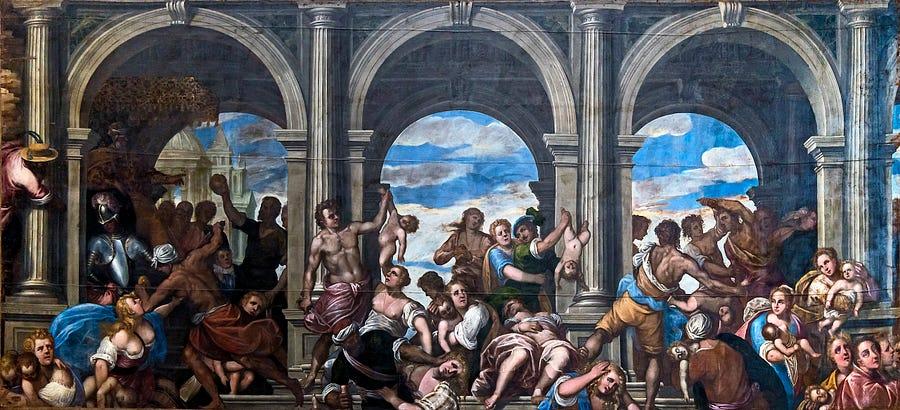
January 6th marks the day in the liturgical calendar when the arrival of the Magi visiting baby Jesus with their gifts is celebrated. But with it comes the often distressing account of what is known as the Massacre of the Innocents. Matthew places this moment of revelation of Jesus as King alongside one of the darkest episodes in his Gospel, and it’s a stark contrast: one King is here to bring peace on earth, as the angels declared, the other king brought death and destruction.
For some readers, this raises an immediate historical question. If Herod truly ordered the killing of all the male children under two in Bethlehem, why does no other ancient historian mention it? Josephus, after all, delights in cataloguing Herod’s cruelty. He records the execution of Herod’s wife, his sons, and numerous political rivals. Herod was paranoid and vicious.
As for Herod, if he had before any doubt about the slaughter of his sons, there was now no longer any room left in his soul for it; but he had banished away whatsoever might afford him the least suggestion of reasoning better about this matter, so he already made haste to bring his purpose to a conclusion. He also brought out three hundred of the officers that were under an accusation … whom the multitude stoned with whatsoever came to hand, and thereby slew them. — Josephus, Antiquities of the Jews 16.11.7
So, why the silence here about Bethlehem?
The answer, I would say, isn’t anything nefarious or made-up by Matthew, but just something simply down to scale.
Bethlehem Was a Very Small Place
Bethlehem in the early first century was not a city. It was a village — small, agricultural, and politically insignificant. Most historians estimate its population at somewhere between 300 and 1,000 people, with around 500 being a sensible midpoint.
Once we factor in ancient demographics, the numbers become surprisingly modest.
Modern demographic research into pre-industrial societies consistently shows that nearly half of all children died before adulthood, with the highest concentration of deaths occurring in the first two years of life. These findings align closely with conditions in Roman-period Judea and support conservative estimates for the number of infants living in a small village such as Bethlehem.
Source: Mortality in the past: every second child died — Our World in Data
In pre-modern societies with high infant mortality, only about 2–3% of the population would be living children under the age of two at any given time. Many children were born; far fewer survived those earliest years. Applying a conservative 2.5% figure to Bethlehem gives us roughly:
7–8 children under two in a village of 300
12–13 children under two in a village of 500
25 children under two even at the extreme upper estimate of 1,000 inhabitants
Herod’s order, however, targeted male children only. Statistically, that halves the number.
This places the likely number of victims somewhere between three and twelve boys.
Matthew’s reference to ‘Bethlehem and the surrounding region’ does slightly widen the scope of Herod’s order, but not by enough to change the demographic picture. Even when nearby settlements are included (e.g. farmsteads, shepherd settlements, etc. not major cities/towns), the total number of children under two likely remained in the dozens rather than the hundreds, maybe anywhere between 14–45 boys maximum if we make an educated estimate. This is entirely consistent with what we know of population size and infant mortality in the ancient world.
This is an important number to realise and consider.
Not because the deaths are insignificant simply due to being so few, but because ancient historians did not record history the way we do now. A small number of peasant children killed in an obscure village would not have registered as a notable event alongside palace intrigue, royal executions, or political upheaval. For Josephus, it wou...
Luke J. Wilson | 13th December 2025 | Christmas

How can God beget a Son? Does that mean Jesus is His creation?
This question comes sharply into focus during Advent, when the Church contemplates the Incarnation: the eternal Son entering the world as a baby in Mary’s womb. And to understand this, we turn to language the Church has treasured for centuries — especially that crucial distinction between begotten and created.
And C. S. Lewis describes this with a real concise clarity:
We don’t use the words begetting or begotten much in modern English, but everyone still knows what they mean. To beget is to become the father of: to create is to make. And the difference is this. When you beget, you beget something of the same kind as yourself. A man begets human babies, a beaver begets little beavers, and a bird begets eggs which turn into little birds. But when you make, you make something of a different kind from yourself. A bird makes a nest, a beaver builds a dam, a man makes a wireless set — or he may make something more like himself than a wireless set: say, a statue. If he is a clever enough carver he may make a statue which is very like a man indeed. But, of course, it is not a real man; it only looks like one. It cannot breathe or think. It is not alive. Now that is the first thing to get clear. What God begets is God; just as what man begets is man. What God creates is not God, just as what man creates is not man.
By saying that Jesus is begotten from the Father, we are saying that Jesus is fully God and not a creation of God (Arianism), nor is the Son of God simply a mode or action of God (Sabellianism).
This is the heart of Christian theology: begotten = shared nature created = different nature
Begotten Means “of the Same Essence”
When the Father begets the Son, He is not constructing or manufacturing Him. Begetting is not an act inside time. It is an eternal relationship.
Just as:
light is never without radiance
a fire is never without heat
the Father is never without the Son
There was never a moment “before” the Son existed. The Son is eternally from the Father, sharing His nature, His essence, His Godness. As John says in the opening of his Gospel, Jesus as the Son was/is “in the bosom of the Father”. This was historically understood that the Word always existed within the Father.
When Christ Is Misunderstood: Modalism and Arianism
Two ancient heresies emerge from misunderstanding “begotten, not made.”
1. Modalism (Sabellianism)
This claims that:
Father, Son, and Spirit are just different forms or roles of one person.
This erases the real distinctions within the Trinity.
If Modalism were true:
Jesus is praying to Himself.
The Father sending the Son is theatre.
Christ’s baptism is a staged illusion.
Modalism collapses the Persons into one persona wearing different masks.
2. Arianism
Arius taught that:
Jesus was created by God ex nihilo
He is a divine-like being, but not equal in essence
This makes Jesus the highest creature… but still a creature.
If Jesus is created, then He cannot:
reveal God perfectly
unite humanity to God
save us entirely and absolutely
Only God can reconcile us to God.
The Nicene Creed: Drawing a Line in the Sand
At the Council of Nicaea (325 AD), the Church responded boldly and clearly:
God from God, Light from Light, true God from true God, begotten, not made, of one being with the Father.
This was a decisive boundary.
begotten — of the same nature
not made — not a creation
of one being (homoousios) — equal in essence, not similar
The Creed functioned like a theological guardrail.
Christ is not “like God” — He is God.
The creeds act as guardrails for orthodox interpretation
Proverbs 8: Wisdom Begotten, Not Created
The Fathers saw Proverbs 8 as speaking of the Son under the title “Wisdom”:
The Lord begot me at the beginning of his work...
Luke J. Wilson | 31st October 2025 | Halloween
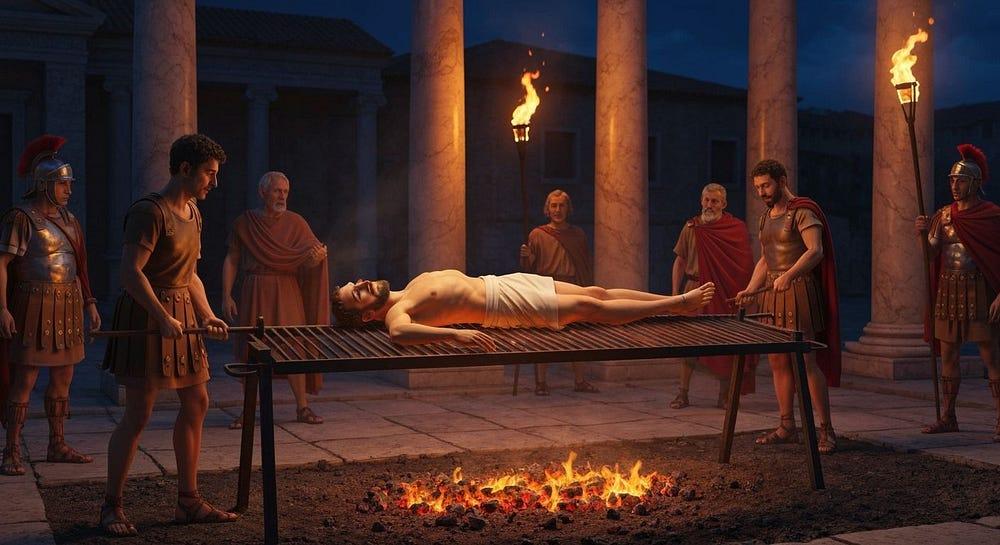
In our last post, we walked with Perpetua and Felicity through the sands of the amphitheatre, their faith outshining Rome’s cruelty. Now for the final part in this series, we turn to another of the Church’s earliest heroes — one whose courage was matched by an unexpected wit. His name was Lawrence, a deacon of Rome, remembered across centuries as the man who kept his humour even while lying on the griddle.
The Setting: Rome, AD 258
Under Emperor Valerian, a fresh persecution of Christians swept through the Empire. Bishops, priests, and deacons were hunted down, their property seized, and their churches closed. The bishop of Rome at that time was Sixtus II — a gentle and wise shepherd who, like the apostles before him, was soon to drink from the same cup as his Lord. Among his closest companions was Deacon Lawrence, entrusted with overseeing the Church’s treasury and distributing alms to the poor.
The Acts of St Lawrence tell us that when Sixtus was arrested and led to execution, Lawrence ran after him, crying out that he would not be left behind.
Where are you going, father, without your son? Where are you going, priest, without your deacon? You never used to offer sacrifice without me as your minister!
To which Sixtus replied:
My son, I’m not leaving you. Greater trials are waiting for you. In three days you’ll follow me.
Sixtus was beheaded soon after. Lawrence, meanwhile, was arrested and brought before the Roman prefect who, hearing that Lawrence had been the keeper of the Church’s wealth, demanded that he hand it over to the empire.
The True Treasure of the Church
The exchange that followed has been remembered ever since, partly for its irony, partly for its courage.
“Bring forth,” said the prefect, “the treasures of the Church — the gold, the silver, and the precious vessels — that the emperor may possess them.”
Lawrence asked for three days to gather them, which the prefect granted, no doubt imagining chests of glittering riches being prepared for him. Instead, Lawrence went through the city, gathering the blind, the crippled, the widows, the orphans, and all who were destitute or suffering. On the third day, he presented them before the prefect and declared:
These are the treasures of the Church. Behold the gold and silver that I promised thee — the eternal jewels in whom Christ dwells.
The prefect, enraged at being mocked, ordered that Lawrence be scourged and tortured, then laid upon an iron gridiron above a slow fire.
The Martyrdom
The ancient texts, mingling reverence and humour, tell the story that has echoed down the ages and had left an impact on me purely for the humour that I find in it!
They laid him upon the iron bed, and beneath it kindled coals, that his flesh might be roasted little by little. And Lawrence, lying there, lifted up his eyes to heaven and gave thanks to God for counting him worthy to suffer.
After some time, the account continues with words that have made Lawrence one of the most memorable of all martyrs:
Having been a long time on the fire, he said to his tormentors with a cheerful countenance: ‘This side is done; turn me over and eat.’
It is difficult to read those words without laughing at how funny it sounds! It matches the kind of dark humour that I can have and often think of, which is probably why the story of Lawrence appeals to me so much, it’s the kind of silly thing I would think to say (though I’m not sure if I would in Lawrence’s place!).
In the face of unbearable agony, Lawrence mocked his tormentors and even death itself. His humour was not flippant, but a final victory over the fear that his persecutors wanted to instil. His joke was an act of defiance against the gods whom Decius implored against the power of Christ within Lawrence. Despite how hot it must have been, Lawrence declares a worse fate on Decius, warning him of the fire he will face because of this, saying that the “burning c...