
Why God Is Necessary For Morality
Guest post by Darwin to Jesus
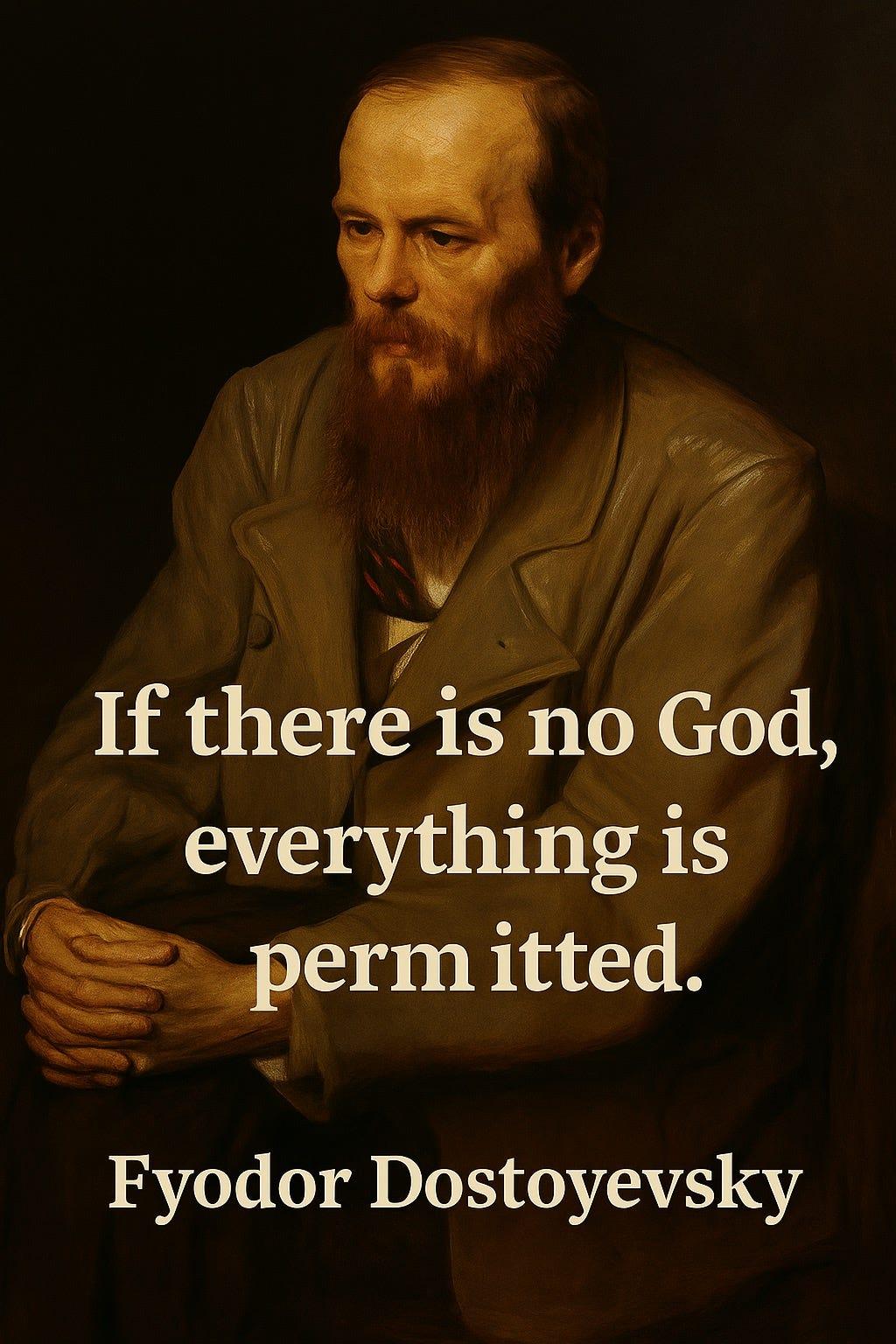
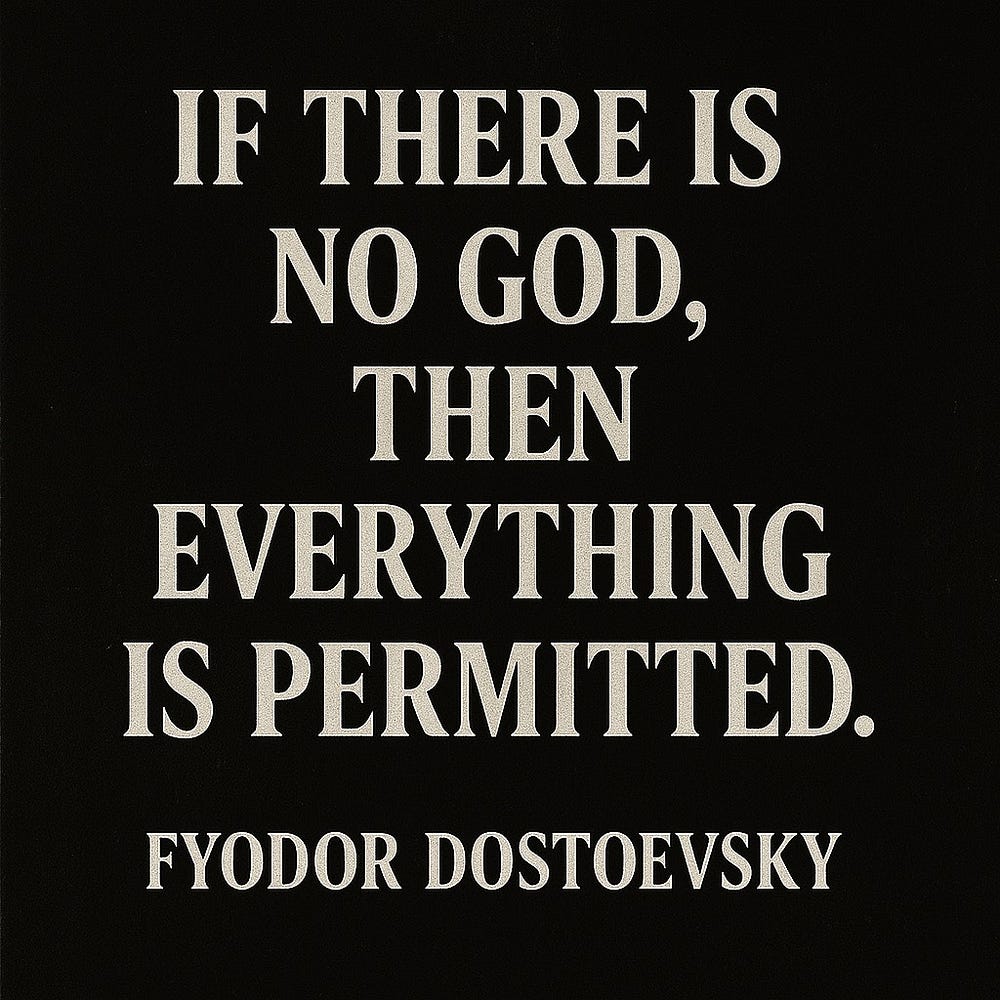
Dostoevsky famously said, “If there is no God, then everything is permitted.”
For years, as an atheist, I couldn’t understand what he meant, but now I do…
Here’s a simple analogy that shows why only theism can make sense of morality:
Imagine you just got hired at a company.
You show up, set up your desk, and decide to use two large monitors.
No big deal, right?
But then some random guy walks up to you and says: “Hey, you’re not allowed to do that.”
You ask, “What do you mean?”
They say, “You’re not permitted* to use monitors that big.”
In this situation, the correct response would be: “Says who?”
We’ll now explore the different kinds of answers you might hear — each one representing a popular moral theory without God — and why none of them actually work.

Subjective Morality
The random guy says, “Well, I personally just happen to not like big monitors. I find them annoying.”
Notice that’s not a reason for you to change your setup.
Their personal preferences don’t impose obligations on you.
This is what subjective morality looks like.
It reduces morality to private taste.
If this were the answer, you’d be correct to ignore this person and get back to work — big monitors are still permitted.

Cultural Relativism
Instead, they say, “It’s not just me — most people here don’t use big monitors. It’s not our culture.”
That’s cultural relativism: right and wrong are just social customs, what is normal behavior.
But notice customs aren’t obligations. If the culture were different, the moral rule would be different, which means it isn’t really moral at all.
You might not fit in. You might not be liked.
But you’re still permitted to use big monitors.

Emotivism
Here after being asked “says who?” the person just blurts out, “Boo, big monitors!”
You reply, “Hurrah, big monitors!”
That’s the entire conversation.
This is emotivism. On this moral theory when we talk about right and wrong we’re actually just expressing our personal feelings towards actions, I boo rape, you hurrah rape.
But shouting “boo!” at someone doesn’t create real obligations.
You’re still permitted to use large monitors.

Utilitarianism
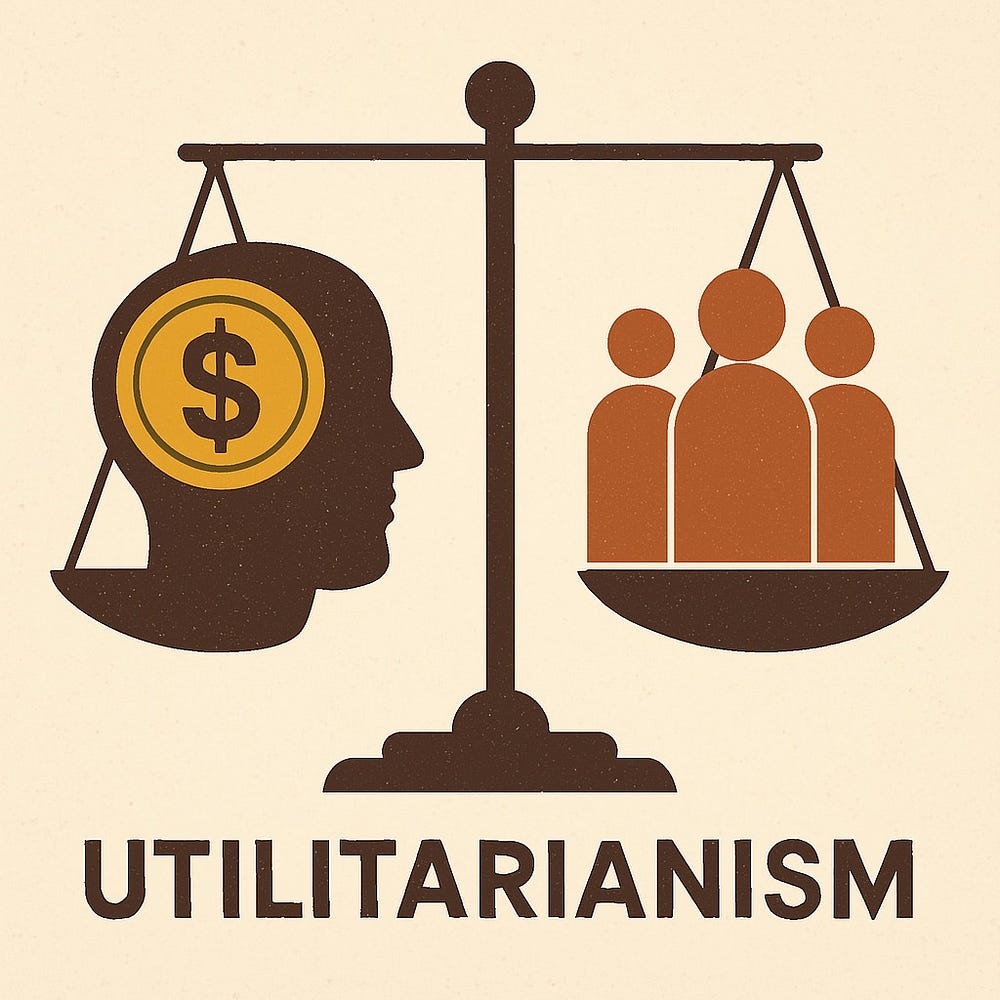
Here, the person says, “Your big monitors lower the overall productivity of the office. You’re not permitted to use them because they lead to worse consequences.”
This is utilitarianism: morality is based on producing the greatest happiness for the greatest number.
But even if that’s true — so what?
Who says you’re obligated to maximize group productivity?
And what if your monitors actually help you work better?
Utilitarianism might tell you what leads to better outcomes, but it doesn’t tell you why you’re morally obligated to follow that path — especially if it comes at your own expense.
You’re still permitted to use large monitors.
Virtue Ethics
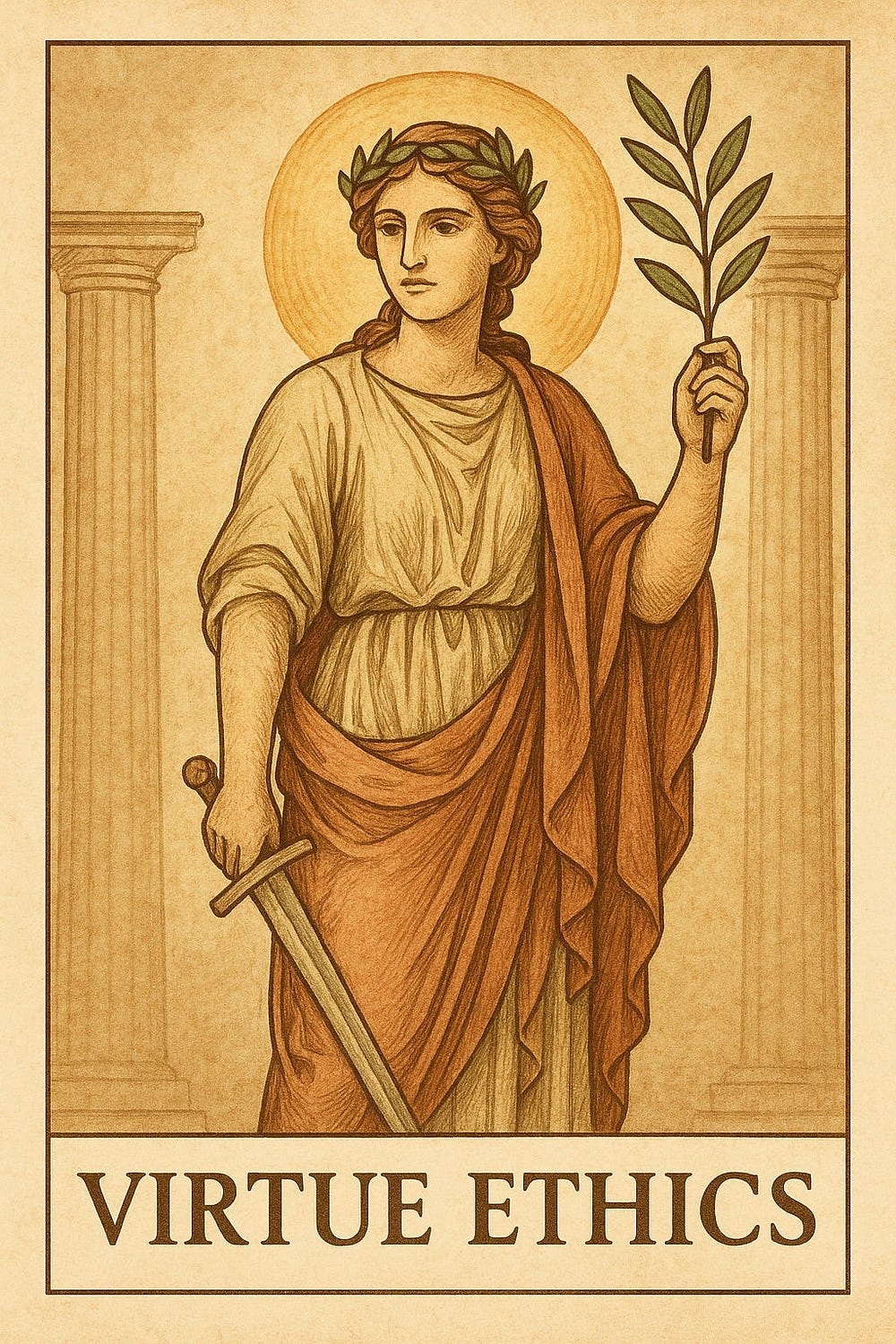
Here they say, “Using big monitors just doesn’t reflect the virtues we admire here — simplicity, humility, restraint.”
This is virtue ethics. Morality is about becoming the right kind of person.
But who defines those virtues?
And why are you obligated to follow them?
What if your idea of a virtuous worker includes productivity and confidence?
Without a transcendent standard, virtues are just cultural preferences dressed up in moral language.
If you don’t care about virtue or their arbitrary standards, then you have no obligation.
You’re still permitted to use large monitors.
Atheist Moral Realism
But what if they say, “Listen, there’s a rule. It’s always been here. It says you can’t use monitors that large.”
You ask, “Who made the rule?”
They say, “No one.”
You ask, “Who owns this company?”
They say, “No one owns it. The company just exists.”
You look around and ask, “Where is the rule?”
They say, “You won’t find it written anywhere. But it’s real. It just exists. Like a law floating in space or something.”
You ask, “Okay, but does this rule have anything to do with the actual function of this company? Did someone put it here for a reason?”
They say, “No. It has no context, it just happens to exist for no reason, and even though we don’t have access to it, we believe this rule says your monitors are too big.”
This is atheist moral realism.
It claims that objective moral facts exist, but they come from nowhere, are grounded in nothing, and are backed by no authority.
It’s like walking into an abandoned building, seeing graffiti on the wall that says “Don’t wear red,” and thinking you’re somehow obligated to obey it.
Even if the rule exists in some strange metaphysical way, why does it have any binding force on you?
You’d be right to say:
“That has nothing to do with me, this company, or what I’m doing.”
That’s the problem with atheist moral realism:
It declares that a rule or principle just “exists,” for no explanation, a “brute fact.”
A law, but no lawgiver.
An obligation, but no authority.
Notice in this situation, you’re still permitted to use your large monitors.

Theistic Moral Realism
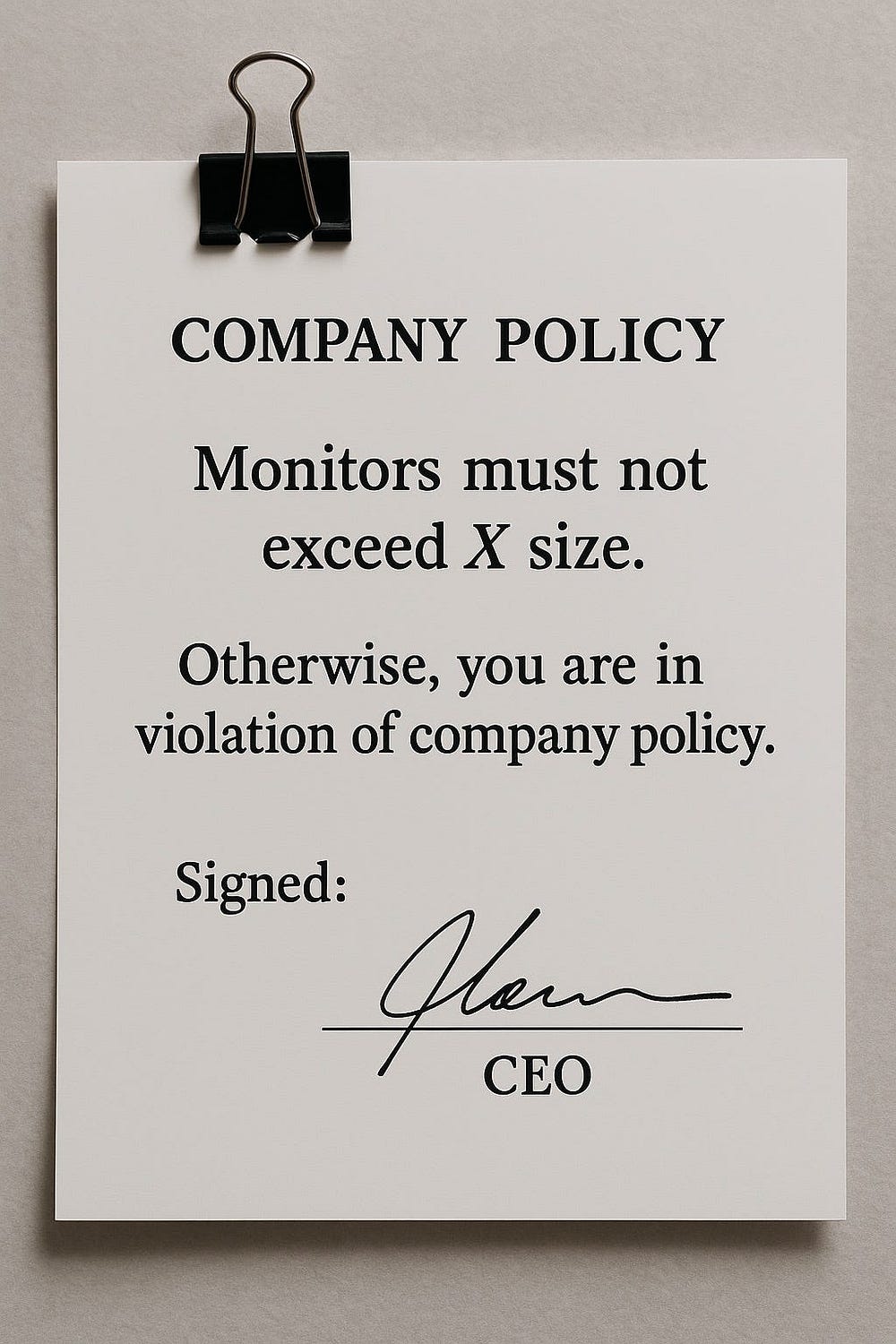
Now, imagine the person says, “The owner of the company has set a policy. It’s in the handbook. He signed it himself.”
Suddenly, everything changes.
You know the owner has the right to set the rules.
You are now under obligation not just because the rule exists, but because someone with legitimate authority made it, and since you work for him, and you’re in HIS company, you’re subject to his rules.
In this situation, you’re no longer permitted to use large monitors.
But notice you are actually in the wrong now.
Big monitors are NOT permitted, the boss says.
Conclusion
That’s the only scenario where moral obligation makes sense:
A rule made by someone with rightful authority, for a reason, in a context you are part of.
And that’s why only theism can make sense of morality.
Because only theism gives you a law and a lawgiver.
A standard and someone with the right to enforce it.
Permission requires authority, and only God has ultimate, transcendent authority.
This is why Dostoevsky was right:
Leave a comment Like Back to Top Seen 1K times Liked 0 times

Enjoying this content?
Support my work by becoming a patron on Patreon!
By joining, you help fund the time, research, and effort that goes into creating this content — and you’ll also get access to exclusive perks and updates.
Even a small amount per month makes a real difference. Thank you for your support!
x
Subscribe to Updates
If you enjoyed this, why not subscribe to free email updates and join over 895 subscribers today!
My new book is out now! Order today wherever you get books
Subscribe to Blog updates
Alternatively, you can subscribe via RSS 
All email subscriptions must be confirmed to comply with GDPR.
Related Posts
Guest Author | 31st July 2026 | Prayer

Guest Post By Fiach OBroin-Molloy My own roots lie in the Catholic tradition, but my workbench has brought me into contact with Christians whose devotional lives differ from mine. I make Catholic rosaries, Anglican prayer beads and other forms of devotional beads by hand. That work has not taught me that distinctions between traditions do not matter. It has taught me that, beneath those distinctions, many of us know the same difficulty: we want to pray, but our attention is restless. I have travelled, lived and worked in a number of countries, from parts of Africa to countries further east. Again and again, I encountered beads or knotted cords held, counted or carried in prayer. The words, beliefs and purposes were not the same, and I would not flatten them into one vague spirituality. What stayed with me was the recurring human instinct to give devotion rhythm and weight—to let the body help the mind and heart remain present. For a Christian, however, that instinct is gathered into a particular faith—the faith confessed in the creeds. Our prayer is addressed to the God made known as Father, Son and Holy Spirit. It is shaped by Scripture and centred on Jesus Christ, the Word made flesh, crucified and risen. Prayer beads do not broaden that confession into something less definite. At their best, they help us stay with it. A faith that takes flesh seriously Christian prayer is never only an activity of the mind. We speak and sing. We stand, kneel and bow. We fold our hands, make the sign of the cross, and receive bread and wine. The Christian faith does not ask us to escape being embodied creatures. At its centre is the astonishing declaration that the Word became flesh and dwelt among us (John 1:14). Material things are not God, but they can serve our attention to God. That is the modest place in which I understand prayer beads. They do not create faith, improve the words of Scripture or make prayer more sincere. They simply give the hands something quiet to do while the heart and mind try to remain present. As a maker, I think about weight, texture, spacing and movement. A bead should pass naturally beneath the thumb. The cord or chain should be strong enough to be returned to repeatedly. A good set of prayer beads should not continually demand admiration for itself. Its purpose is to become quiet in the hand. Over time, beads polish, wood darkens and metal takes on the small marks of use. I rarely know the prayers that have been said with something I have made, but sometimes its wear tells me that it has been held often. That is a different kind of beauty from newness: not decoration, but evidence of return. What the hands bring to Scripture Lectio Divina invites us to read Scripture slowly and receptively. Luke J. Wilson has written much more fully about its four movements—reading, meditation, prayer and contemplation—and I would not try to redefine that teaching here. What interests me as a maker is the point at which a reader’s hand might support that attention. Most of us have become highly practised at moving quickly through words. We skim messages, headlines and pages, often looking for the next piece of information before we have received the one in front of us. Sacred reading asks something different. It asks us to stay. A bead introduces a small resistance to speed. It marks a pause and gives us somewhere to return when the mind has already hurried ahead. The Anglican prayer beads I make contain a cross, an invitatory bead, four cruciform beads and four groups of seven, often called weeks. I know that structure first through the work of my hands, not because I would presume to tell Anglicans how they ought to pray. What strikes me about it is its spaciousness: there are landmarks, passages and repeated opportunities to return to the cross. One possible practice would be to choose a short passage from the Gospels. At the cross, the reader might remember that Christ is the centre of the reading. ...
KingsServant | 12th March 2025 | Islam

This is a guest post by “KingsServant” In 2019 a book called Defying Jihad was published by Tyndale House, the reputable Christian publisher telling the story of “Esther Ahmad” a pseudonym used by the author alongside her co-author Craig Borlase, who has previously written alongside, well known Christian personalities such as Matt Redman the singer and Andrew Brunson, an American pastor imprisoned by the Turkish government. As I began to read this book over this past year I was expecting an encouraging account of how a former Jihadi found Christ and escaped her previous accomplices. Very quickly, however, I became uncomfortable, her descriptions of her background involved allegedly committed Muslims doing very un-Islamic things and the unnamed militant group doing unusual things that didn’t fit my knowledge gained from years of study of Islam and interactions with Muslims, including extremists. As my doubts about the authenticity of the book solidified, and yet I couldn’t find anyone else who had questioned these things before me, or on the other hand provided verification of her story. I decided to contact Craig. During our brief and cordial email exchange he told me that he had been in touch with people who knew Esther after she escaped her family home, but so far has not suggested he has any other lines of evidence confirming any of the key elements of her account before that time. As a result, I am writing this article to draw attention to the aspects that raise suspicion. According to “Esther’s” story, she was raised in Pakistan where she was sent to an extremist madrassa (or Muslim school) for girls, there they were shown images of victims of violence and told that Christians and Jews were responsible - the emphasis on Jews and particularly Christians by a militant group based in Pakistan is strange. All the terrorist groups in Pakistan direct their efforts towards Hindus (especially in Kashmir) or other Muslims, since Christians are such a tiny minority there. Things rapidly become even stranger when a Mullah displays weapons to the group of girls telling them “… one day you will get to handle these” as the book continues describing them being encouraged to aspire to physical violence towards Jews and Christians specifically, the description of “Aunt Selma” volunteering for and dying fighting Jihad is likewise out of place. Islamic terrorist groups very rarely recruit women for combat roles, as Devorah Margolin describes Hamas and ISIS as departing from convention by encouraging female participation in violence and even then in only a very restricted way under particular circumstances with a specific fatwa (or Islamic ruling) being issued.1 On page 33, the militant group leader “Anwar” suggests that Esther could find a husband in the west to bring him to Islam. It is strictly forbidden for a Muslim woman to marry a non Muslim man, the idea that they would be encouraged by a scholar to date is about as unbelievable. In a conservative Pakistani culture, she would more likely find herself the victim of a so-called “honour killing” for such a thing.2 After her initial chance encounters with her future husband “John” (not as a result of trying to follow “Anwar’s” advice), on page 92 it is recorded that he said to her “… I’m not against your faith and beliefs…”, it’s the kind of thing that we might expect a liberal in the west to say, but not a Pakistani believer who knows that Islam denies that Jesus is the Son of God and that he died for sinners. Following her conversion according to her account, she engaged in a number of public debates with clerics in which she defended her decision to leave Islam and follow Christ. It is not uncommon for apostates to have meetings with scholars arranged by their family members in the hope that they might be won back to Islam, but it is very surprising that her influential father would want to give his apostate daughter su...
Charles Meek | 02nd December 2024 | Eschatology
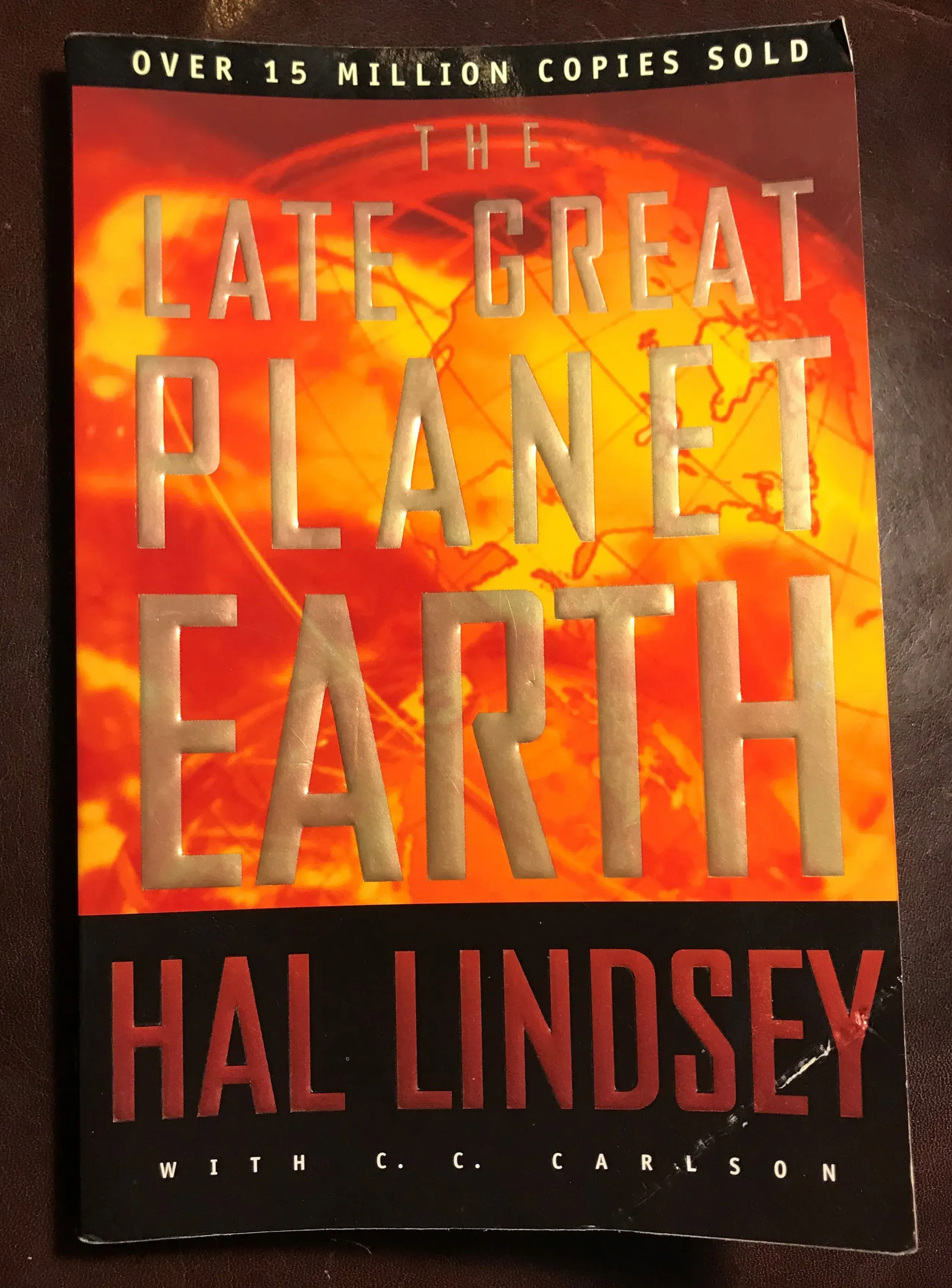
This is a guest post from Charles Meek Hal Lindsey’s bookThe Late Great Planet Earth Hal Lindsey’s book The Late Great Planet Earth, first edition in 1970, sold over 40 million copies. Gullible Christians got sucked into Lindsey’s soon-end-of-the-world cult-like poppycock. As time has passed without his version of Armageddon taking place, we can now objectively analyze where Lindsey went wrong: Lindsey (p. 54, 181), like other dispensationalists, placed the beginning of the end with Israel becoming a nation in 1948. He thought all prophecy would be fulfilled within a 40-year generation (Matthew 24:34). But 1988 came and went, proving him to be a false prophet. (This should be adequate proof that 1948 has nothing to do with Bible prophecy.) Lindsey (p. 44) prophesied a 7-year, world-wide, tribulation. He got this from Revelation 11 which speaks of the “holy city” being trampled for 42 months — and “two witnesses prophesying” for 1,260 days. He simply adds both of these 3 ½-year periods together to get 7 years (of tribulation). There is NO indication in the text that this is a valid interpretation. He was reading something speculative into the text that is not there. Indeed, there is no passage in the Bible that clearly teaches a 7-year tribulation. Further, Jesus limited the time of the trampling of Jerusalem to his own generation (Luke 21:20–22, 32). Interestingly, the final assault on Jerusalem by the Roman army under Titus lasted 42 months from February AD 67 to August AD 70. This is strong supporting evidence for the Great Tribulation being fulfilled at the Jewish-Roman War ending with the fall of Jerusalem in AD 70.) Lindsey (p. 87, etc.) saw the existence of nuclear weapons as an important sign of the end times. However, Jesus taught that the so-called “end times” would be when God’s people would “fall by the edge of the sword” (Luke 21:24). Jesus’ prophecies were about ancient warfare, not modern nuclear weapons. The context of this prophecy by Jesus was about the coming destruction of the temple (Luke 21:6). Jesus told his listeners that it would happen when THEY saw Jerusalem surrounded by armies (Luke 21:20), in THEIR generation (Luke 21:32). This all happened when the Roman armies invaded Jerusalem in AD 67–70. Lindsey (p. 56–57) said, “It is certain that the Temple will be rebuilt. Prophecy demands it.” Problem is, not a single verse of the Bible can be mustered to support a future rebuilding of the temple. This idea is merely an invention of dispensationalists to try to justify their theory. Lindsey (p. 88, 124) even makes this astounding prediction: “The prophetic Scriptures tell us that the Roman Empire will be revived shortly before the return of Christ to this earth. A new Caesar will head this empire.” It’s hard to believe anyone took this charlatan Lindsey seriously. Lindsey (p. 108), in speaking of the Antichrist, “He will have a magnetic personality, be personally attractive, and a powerful speaker. He will be able to mesmerize an audience with his oratory.” But the Antichrist is never mentioned in Revelation, let alone any such description of him. The Antichrist is only mentioned in John’s epistles, which say that the Antichrist was already in the world when John was writing (1 John 4:3). Indeed, John taught that it was already the “last hour” as he wrote (1 John 2:18). If you believe John was an inspired writer, this precludes any future fulfillment. Lindsey (p. 125, 126) said that modern drug addiction and witchcraft is evidence of the “sorceries” of Revelation 9:21. He quoted a TV station that “Nearly every respectable high school these days has its own witch.” (Besides the obvious problem of nonsense, Revelation itself teaches that it is about things that MUST SHORTLY TAKE PLACE (Revelation 1:1; 22:6). Indeed, there are over 30 passages in Revelation that reiterate that its fulfillment was “near,” “soon,” or ...
KingsServant | 01st February 2023 | Apologetics
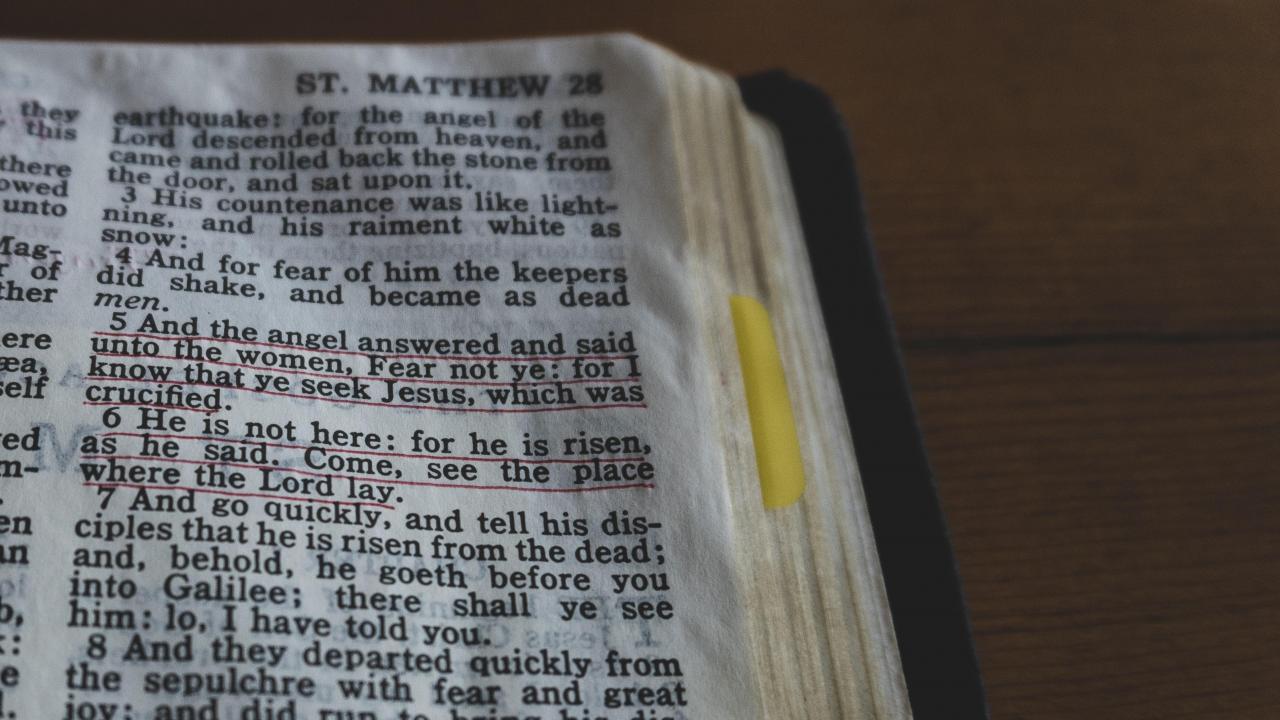
Matthew's theme - The divine presence of Jesus This is a guest post by “KingsServant”, see Part 1 here. Having covered Matthew’s introduction to his gospel in his nativity account, we will now consider the way Matthew “bookends” the gospel by beginning his work with the promise of God dwelling with his people (fulfilled in the incarnation) and ending it in the same way with Jesus’ comforting promise never to leave his followers. This theme of Matthew begins with his quotation of Isaiah 7:14, which we have already analysed in the previous article with regard to how it reveals Matthew’s teaching that Jesus is God. As noted before, in Matthew 1:23, Matthew draws special attention to the meaning of the name Immanuel and sees the birth of Jesus as necessary for its ultimate fulfilment. Matthew 1:23: “Behold, the virgin will conceive and give birth to a Son, and they shall name Him Immanuel,” which translated means, “God with us.” Matthew also ends his gospel, following the resurrection, with this promise of Jesus; (Matthew 28:20): “…teaching them to follow all that I commanded you; and behold, I am with you always, to the end of the age.” Matthew emphasises the point at both beginning and end that Jesus is “with us”. First, in 1:23 he combines this with calling Jesus God. Second, he records Jesus as claiming his perpetual presence with his people wherever they are. To understand the importance of Matthew’s choice of this theme an overview of this subject in the Old Testament is needed. In the book of Genesis man is created (and woman from his side), then they are placed in the garden of Eden where they enjoy the presence of God who walked with them, until they act disobediently to him after which he came to them and it is written; (Genesis 3:8): “Now they heard the sound of the Lord God walking in the garden in the cool of the day, and the man and his wife hid themselves from the presence of the Lord God among the trees of the garden.” The result is a curse on the ground and the tempter who led them to sin. Along with this curse God pronounced judgement on them, man was driven out of the garden, separated from the presence of God and the tree of life that could enable them to live forever as sinners. (Genesis 3:24): “So He drove the man out; and at the east of the Garden of Eden He stationed the cherubim and the flaming sword which turned every direction to guard the way to the tree of life.” Since then God has been working towards reversing this event, undoing the effects of sin, chief among them the broken fellowship mankind has with God. God chose Abraham as the one through whom his blessing will reach all nations (Genesis 12:3) and after calling his descendants out of Egypt orders the construction of the tabernacle saying (Exodus 25:8): “Have them construct a sanctuary for Me, so that I may dwell among them.” The tabernacle construction included details for how priests could enter the presence of God as representatives of Israel. Part way through this, Jehovah again comments on his purpose: (Exodus 29:42–45): “…where I will meet with you, to speak to you there. 43 I will meet there with the sons of Israel, and it shall be consecrated by My glory. 44 I will consecrate the tent of meeting and the altar; I will also consecrate Aaron and his sons to serve as priests to Me. 45 And I will dwell among the sons of Israel and will be their God. 46 And they shall know that I am the Lord their God who brought them out of the land of Egypt, so that I might dwell among them; I am the Lord their God.” King David wanted to build a more permanent building for God to dwell in, but this request was denied to him although permitted to his son Solomon. Notice the words of Jehovah through the prophet Nathan to David: (2 Samuel 7:5–7): “Go and say to My servant David, ‘This is what the Lord says: “Should you build Me a house for My dwelling? 6 For I have not dwe...
Recent Posts
Luke J. Wilson | 25th August 2026 | William Lane Craig
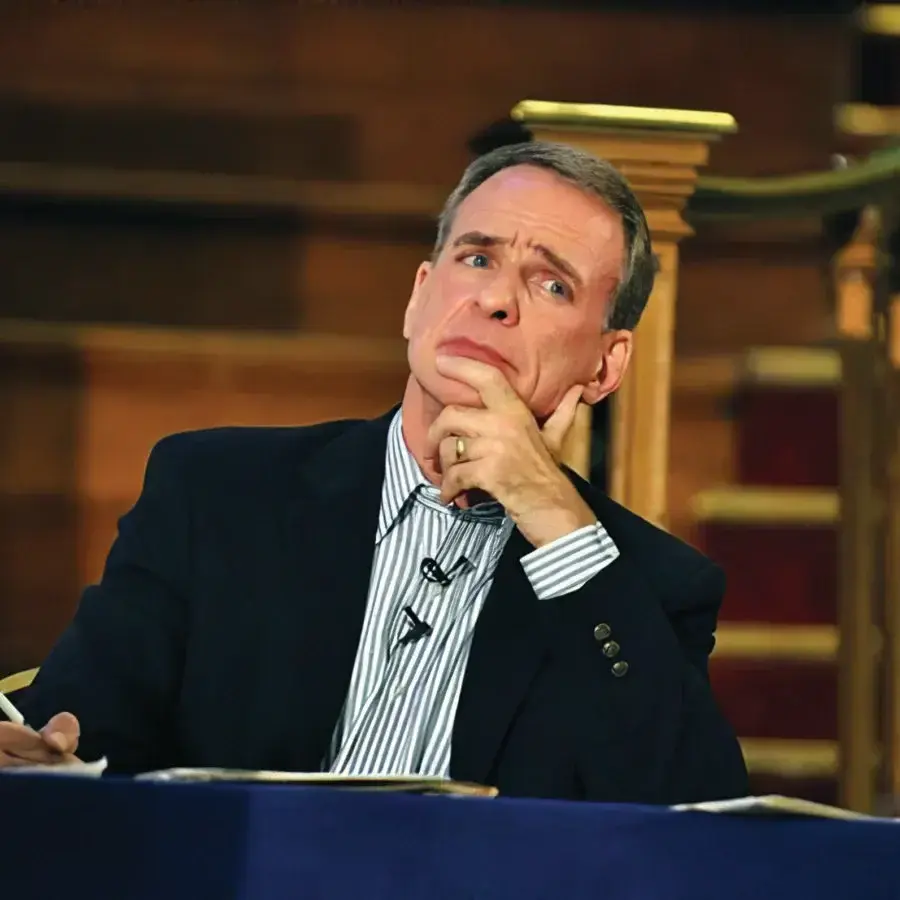
If you’ve been on Christian social media this week, you’ve probably seen it: William Lane Craig — one of the most respected Protestant apologists of our time— flatly denying a core line of the Nicene Creed. In his own words, he does not believe or confess that the Son is eternally begotten from the Father in his divine nature. Human nature, yes. But divine? Nope. For a lot of readers, that’s a jarring sentence. Isn’t “eternally begotten of the Father” literally in the Creed we recite? How can someone who has spent decades defending the resurrection and the existence of God turn around and reject something so central? I want to walk through what’s actually going on here, because it’s more interesting — and older — than a single viral clip suggests. What Craig is actually rejecting The doctrine in question is called eternal generation: the idea that the Son is eternally derived from the Father, “begotten, not made,” sharing the Father’s nature without there ever being a time he didn’t exist. It’s not saying the Son had a beginning; it’s saying the Son’s very being is eternally from the Father, the way light is eternally from the sun. Craig has argued for years, most fully in his paper Is God the Son Begotten in His Divine Nature? (2019), that this idea owes more to Greek philosophical categories borrowed by the second-century Apologists than to anything the biblical writers themselves teach. He calls it a vestige of “Logos Christology” and prefers a model where Father, Son, and Spirit are simply co-equal and co-eternal, without one eternally generating another. William Lane Craig disavows the Nicene Creed Why I think this gets the history backwards Here’s where I’d push back, and where I think this whole debate needs a bit more historical texture than a viral post can give it. Long before Nicaea formalised its language, the earliest post-apostolic Christians were already working with something like what’s called the Monarchy of the Father (or Monarchical Trinitarianism) — a framework that takes the Father’s monarchia (his unique, self-existent source of divinity, or autotheos) seriously as the fountainhead from which the Son is begotten and the Spirit proceeds. This is worth distinguishing carefully from Monarchianism, the second/third-century heresy that collapsed the persons of the Trinity into one another to protect God’s oneness — the Monarchy of the Father is the orthodox opposite of that, affirming three distinct, co-eternal persons while still honouring the Father as their singular source. On this reading, the Son and Spirit aren’t lesser, but they do find the very source of their divinity in the Father — not as effects of a philosophical system layered onto scripture, but as a way of taking John’s own language (the Word who was with God and was God, yet distinct from “the Father”) with full seriousness. That’s the thing I think gets lost when eternal generation gets dismissed as a “leftover.” Logos Christology isn’t an embarrassing accretion — it’s arguably what John 1 is doing from verse one. The Church didn’t import that idea to explain the text; the text seems to be why the Church needed the idea. None of this makes Craig any less serious a thinker, and it’s worth saying plainly: this isn’t the first time he’s stepped outside Nicene orthodoxy — he’s made similar moves on Christ’s two wills (dyothelitism) in the past. But it is, I think, a real departure, not just a “minor unorthodoxy.” Why it matters beyond the argument It would be easy to turn this into another “gotcha” moment — ‘look, even the great apologist gets it wrong!’ I don’t think that’s the right response. Craig has done more than most to defend the reasonableness of the Christian faith to a sceptical world, and disagreeing with him on this doesn’t erase that. But it is a good reminder that ev...
Guest Author | 31st July 2026 | Prayer
Guest Post By Fiach OBroin-Molloy My own roots lie in the Catholic tradition, but my workbench has brought me into contact with Christians whose devotional lives differ from mine. I make Catholic rosaries, Anglican prayer beads and other forms of devotional beads by hand. That work has not taught me that distinctions between traditions do not matter. It has taught me that, beneath those distinctions, many of us know the same difficulty: we want to pray, but our attention is restless. I have travelled, lived and worked in a number of countries, from parts of Africa to countries further east. Again and again, I encountered beads or knotted cords held, counted or carried in prayer. The words, beliefs and purposes were not the same, and I would not flatten them into one vague spirituality. What stayed with me was the recurring human instinct to give devotion rhythm and weight—to let the body help the mind and heart remain present. For a Christian, however, that instinct is gathered into a particular faith—the faith confessed in the creeds. Our prayer is addressed to the God made known as Father, Son and Holy Spirit. It is shaped by Scripture and centred on Jesus Christ, the Word made flesh, crucified and risen. Prayer beads do not broaden that confession into something less definite. At their best, they help us stay with it. A faith that takes flesh seriously Christian prayer is never only an activity of the mind. We speak and sing. We stand, kneel and bow. We fold our hands, make the sign of the cross, and receive bread and wine. The Christian faith does not ask us to escape being embodied creatures. At its centre is the astonishing declaration that the Word became flesh and dwelt among us (John 1:14). Material things are not God, but they can serve our attention to God. That is the modest place in which I understand prayer beads. They do not create faith, improve the words of Scripture or make prayer more sincere. They simply give the hands something quiet to do while the heart and mind try to remain present. As a maker, I think about weight, texture, spacing and movement. A bead should pass naturally beneath the thumb. The cord or chain should be strong enough to be returned to repeatedly. A good set of prayer beads should not continually demand admiration for itself. Its purpose is to become quiet in the hand. Over time, beads polish, wood darkens and metal takes on the small marks of use. I rarely know the prayers that have been said with something I have made, but sometimes its wear tells me that it has been held often. That is a different kind of beauty from newness: not decoration, but evidence of return. What the hands bring to Scripture Lectio Divina invites us to read Scripture slowly and receptively. Luke J. Wilson has written much more fully about its four movements—reading, meditation, prayer and contemplation—and I would not try to redefine that teaching here. What interests me as a maker is the point at which a reader’s hand might support that attention. Most of us have become highly practised at moving quickly through words. We skim messages, headlines and pages, often looking for the next piece of information before we have received the one in front of us. Sacred reading asks something different. It asks us to stay. A bead introduces a small resistance to speed. It marks a pause and gives us somewhere to return when the mind has already hurried ahead. The Anglican prayer beads I make contain a cross, an invitatory bead, four cruciform beads and four groups of seven, often called weeks. I know that structure first through the work of my hands, not because I would presume to tell Anglicans how they ought to pray. What strikes me about it is its spaciousness: there are landmarks, passages and repeated opportunities to return to the cross. One possible practice would be to choose a short passage from the Gospels. At the cross, the reader might remember that Christ is the centre of the reading. ...
Luke J. Wilson | 29th July 2026 | Faith & Reason

��Pilate asked him, ‘What is truth?’ (John 18:38) What is “truth”? A question famously asked by Pilate to Jesus during his trial. Ironically, Pilate was speaking to the embodiment of Truth itself. John 14:6Jesus said to him, ‘I am the way, and the truth, and the life.’ Here’s a little ‘riddle’ to think about while you read this; see if you agree or not: “all truth is fact, but not all facts are truth”. I’ll explain it at the end if you’re confused. Jesus is the ultimate Truth, but in a world and society that is becoming increasingly more relative, how do we test the truth and know what’s real or not? Especially with the sudden rise of AI video and photos getting more and more realistic, that old adage “the camera never lies” is completely false now. This makes sifting and filtering facts from fiction on social media all the more difficult. Memes and images are shared stating claims bluntly and authoritatively as truth, which people just assume are accurate and then share it hundreds of thousands of times. Truth has been replaced by opinion masquerading as truth. “Your truth”, “my truth”, “their truth”. But we can’t just blindly accept everything we see and are told. We must use our brains, check the sources and use our reasoning. God gave us intellect and reasoning to be used. In Isaiah 1:18, God invites us to come and reason together with him. We don’t follow a blind faith, we’re never asked to believe “just because”. The Old Testament is full of times when the historical examples of God’s actions are used as an anchor and reason for faith, and the same is true in the New Testament where we have the Gospels as eyewitness accounts, rooted in history. Paul writes to say that 500 people saw the risen Christ and that many are still alive so you can go and verify it for yourself and that he is passing on what he received from trusted people. The resurrection itself is grounded in it being a real event that if shown otherwise would make our faith “futile” and that we would be people to be most pitied. 1 Corinthians 15:17“If Christ has not been raised, your faith is futile and you are still in your sins.” So with this in mind about our faith being grounded, all the more we should aim to do the same in other aspects of our lives. “Do your own research” is a common mantra online, but that in itself isn’t just Googling something and taking the first result that pops up. Especially now as most search engines give an AI overview first, which is just a compilation of the top results, not anything verified or fact-checked. And top results don’t always mean best results, or even accurate results. It typically just means the best keyworded and SEO-optimised result, which could be anything. To properly research, you must know which are trusted sources, reputable websites as well as looking up people who are experts and authorities in their fields. Now this doesn’t always mean they are right but at least you’ll be better informed to make up your own mind and make decisions based on well-researched information, rather than the first blog you find online, or the most viewed YouTube video with someone yelling “facts” at you. Doing your own research means doing the leg-work in tracing down sources and footnotes and citations to see who said what and where it originated to ensure its faithful and trustworthy, and used in context. The answer and example of the riddle The “Black Swan Problem” Strictly speaking, it highlights the difference between observed facts and absolute truth: The “Fact” (at the time): For thousands of years, every recorded, verified observation of a swan in Europe was white. As far as European zoologists were concerned, “all swans are white” was a well-documented, empirically backed fact. The Truth: Millions of black swans were happily swimming around in Western Australia. The truth was always that black swan...
Luke J. Wilson | 27th July 2026 | Archaeology
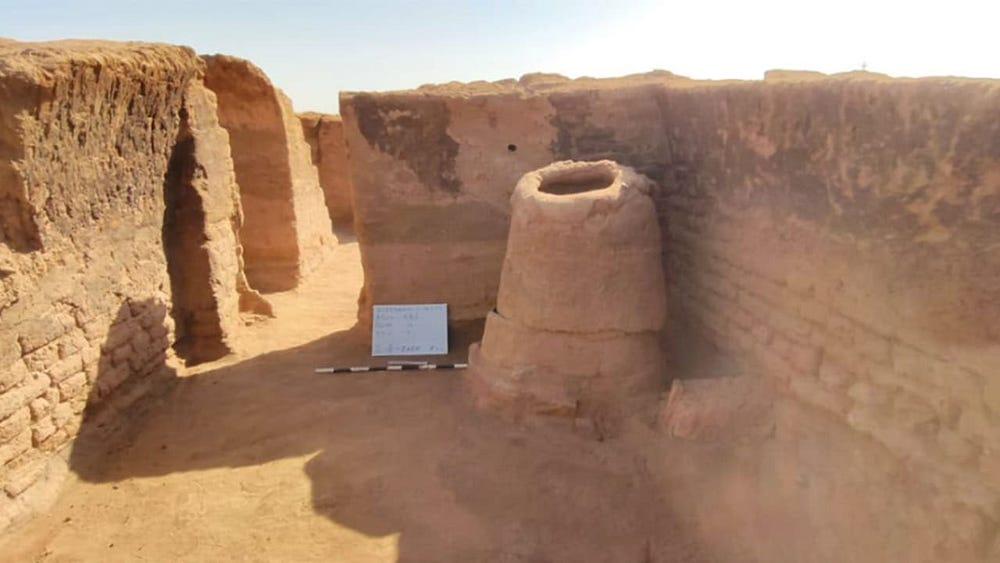
In early July 2026, Egypt’s Ministry of Tourism and Antiquities announced something pretty amazing: an entire Byzantine-era city, buried beneath the sands of the Dakhla Oasis, had been uncovered almost intact! Streets, homes, bread ovens, a fortress, and at its heart, a fourth-century basilica church. That might not seem very exciting on first glance. But this find deserves a closer look, because it puts flesh on something we usually only encounter in the abstract: what it actually looked like when Christianity took root, house by house, in an ordinary town far from the centres of imperial power. What Was Found The excavation, carried out by an Egyptian mission under the Supreme Council of Antiquities at the Ain El-Sabil site in the New Valley Governorate, roughly 185 miles west of Luxor, has been underway for several seasons. According to Hisham El Leithy, secretary-general of the Supreme Council of Antiquities, the settlement was laid out on a deliberate grid — north-south thoroughfares crossed by east-west streets, forming open squares and public spaces. This wasn’t a huddle of huts; it was a planned town. At the centre of that plan stood a basilica church dating to the mid-fourth century AD, overlooking one of the main streets. Around it, archaeologists found the remains of two watchtowers, a heavily fortified structure with thick defensive walls, and houses with spacious reception halls and vaulted roofs — complete with bread ovens, kitchens, and grinding stones for processing grain. Everyday life, preserved almost exactly as it was left. Two houses stand out that have been identified. One belonged to a man named Tisous,* identified as a church deacon, dating to the second half of the fourth century. The other belonged to a man named Tabibos. Over a thousand years later and we know the name of who owned a house and a home-church; I always find it fascinating! Archaeologists believe Tabibos’s house, which dates to the early fourth century, functioned as a house church before the basilica was ever built. A collection of coins bearing Byzantine emperors, Christian symbols and Latin inscriptions was uncovered during the excavation. (Egyptian Ministry of Tourism and Antiquities via Facebook; Dea Picture Library/De Agostini via Getty Images) There’s also a documentary find that’s easy to skim past but genuinely significant: nearly 200 ostraca — broken pieces of pottery and limestone used as everyday writing material — inscribed in Coptic and Greek. Diaa Zahran, head of the Islamic, Coptic and Jewish Antiquities Sector, described them as recording sales transactions, correspondence, and other mundane details of daily life. Things we rarely get a glimpse into as the mundane rarely makes history. Alongside these, the mission recovered a substantial haul of bronze coins bearing Byzantine emperors and Christian symbols, plus gold coins from the reign of Constantius II (337–361 AD) — coinage that anchors the site’s prosperity firmly within the fourth century. Before the Basilica: The House Church at Ain El-Sabil What makes Tabibos’s house the most theologically interesting part of this discovery is timing. If it predates the basilica and dates to the early fourth century, it sits right at — or just before — the pivot point of Roman-Egyptian Christian history: the years surrounding Constantine’s Edict of Milan in 313 AD, when Christianity moved from a persecuted minority faith to a tolerated, and increasingly favoured, one. A time of transition between a house church and a purpose-built basilica when the threat of persecution no longer loomed over the Church. We know from Paul’s letters that the earliest churches met in homes — Romans 16:5 greets “the church in [Prisca and Aquila’s] house,” and similar greetings appear in 1 Corinthians 16:19 and Colossians 4:15. If we were to imagine how a letter from Paul to this house church might...

Powered by WebBoss.io 3.7.1
Copyright © 2026 The Sacred Faith: Timeless Truths for Modern Minds. All Rights Reserved.
