In early July 2026, Egypt’s Ministry of Tourism and Antiquities announced something pretty amazing: an entire Byzantine-era city, buried beneath the sands of the Dakhla Oasis, had been uncovered almost intact! Streets, homes, bread ovens, a fortress, and at its heart, a fourth-century basilica church.
That might not seem very exciting on first glance. But this find deserves a closer look, because it puts flesh on something we usually only encounter in the abstract: what it actually looked like when Christianity took root, house by house, in an ordinary town far from the centres of imperial power.
What Was Found
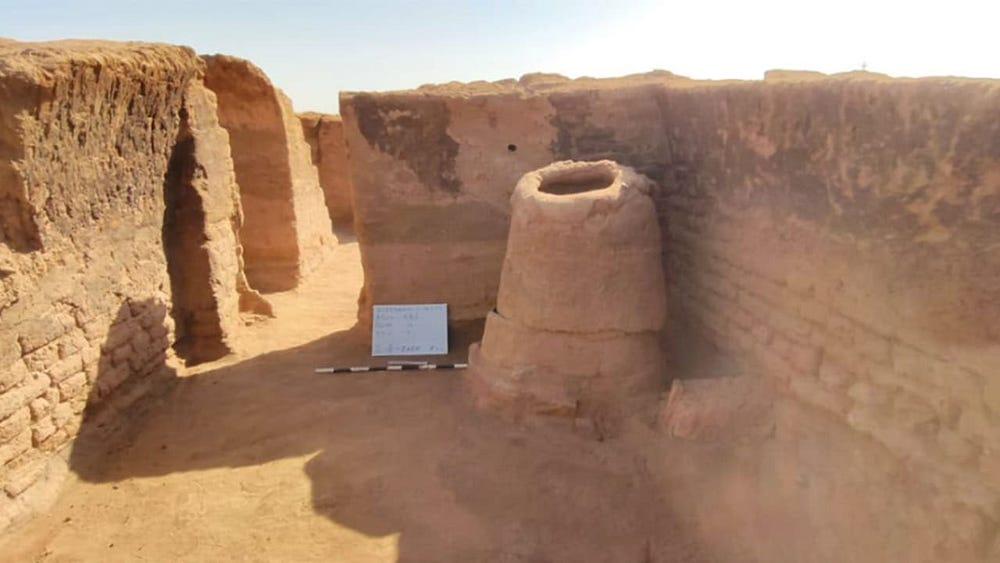
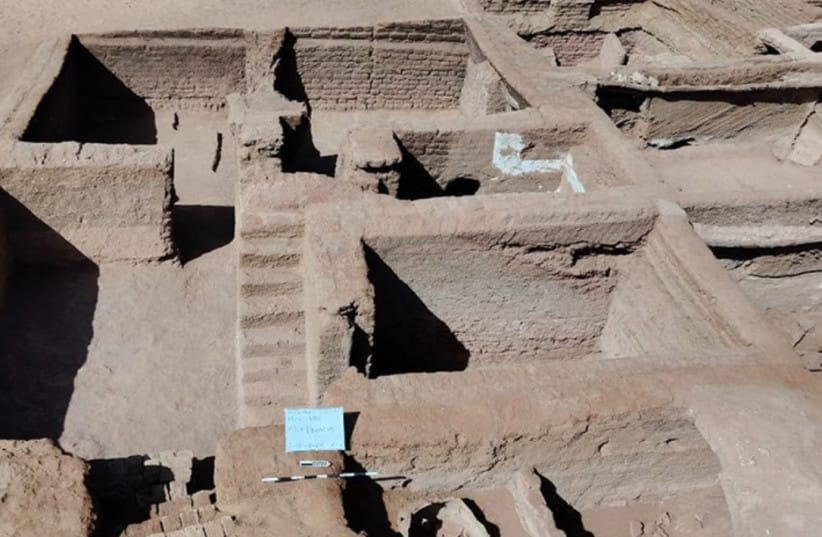
The excavation, carried out by an Egyptian mission under the Supreme Council of Antiquities at the Ain El-Sabil site in the New Valley Governorate, roughly 185 miles west of Luxor, has been underway for several seasons. According to Hisham El Leithy, secretary-general of the Supreme Council of Antiquities, the settlement was laid out on a deliberate grid — north-south thoroughfares crossed by east-west streets, forming open squares and public spaces. This wasn’t a huddle of huts; it was a planned town.
At the centre of that plan stood a basilica church dating to the mid-fourth century AD, overlooking one of the main streets. Around it, archaeologists found the remains of two watchtowers, a heavily fortified structure with thick defensive walls, and houses with spacious reception halls and vaulted roofs — complete with bread ovens, kitchens, and grinding stones for processing grain. Everyday life, preserved almost exactly as it was left.
Two houses stand out that have been identified. One belonged to a man named Tisous,* identified as a church deacon, dating to the second half of the fourth century. The other belonged to a man named Tabibos. Over a thousand years later and we know the name of who owned a house and a home-church; I always find it fascinating! Archaeologists believe Tabibos’s house, which dates to the early fourth century, functioned as a house church before the basilica was ever built.
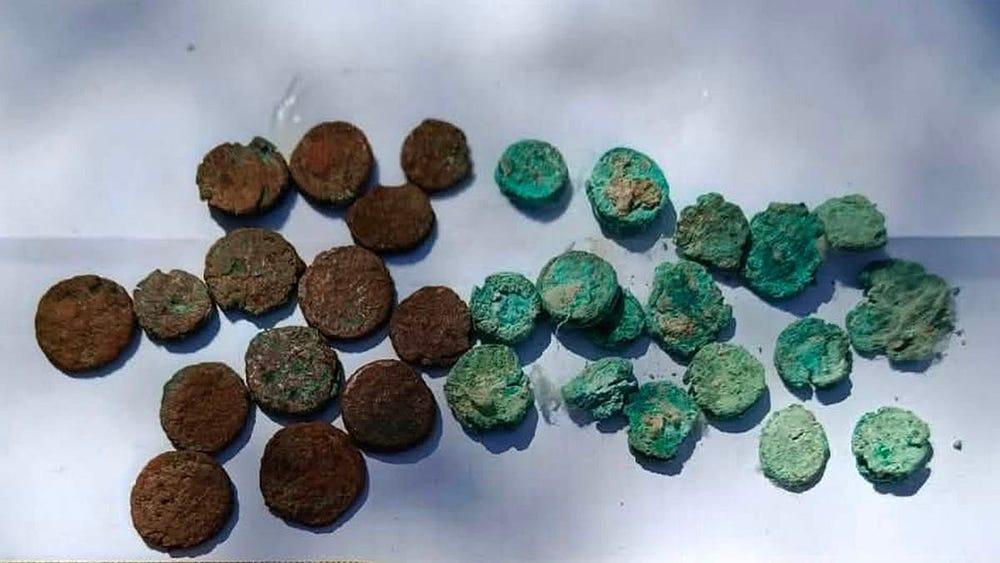
There’s also a documentary find that’s easy to skim past but genuinely significant: nearly 200 ostraca — broken pieces of pottery and limestone used as everyday writing material — inscribed in Coptic and Greek. Diaa Zahran, head of the Islamic, Coptic and Jewish Antiquities Sector, described them as recording sales transactions, correspondence, and other mundane details of daily life. Things we rarely get a glimpse into as the mundane rarely makes history. Alongside these, the mission recovered a substantial haul of bronze coins bearing Byzantine emperors and Christian symbols, plus gold coins from the reign of Constantius II (337–361 AD) — coinage that anchors the site’s prosperity firmly within the fourth century.
Before the Basilica: The House Church at Ain El-Sabil
What makes Tabibos’s house the most theologically interesting part of this discovery is timing. If it predates the basilica and dates to the early fourth century, it sits right at — or just before — the pivot point of Roman-Egyptian Christian history: the years surrounding Constantine’s Edict of Milan in 313 AD, when Christianity moved from a persecuted minority faith to a tolerated, and increasingly favoured, one. A time of transition between a house church and a purpose-built basilica when the threat of persecution no longer loomed over the Church.
We know from Paul’s letters that the earliest churches met in homes — Romans 16:5 greets “the church in [Prisca and Aquila’s] house,” and similar greetings appear in 1 Corinthians 16:19 and Colossians 4:15.
If we were to imagine how a letter from Paul to this house church might look, we need only follow the pattern he already gives us. In 1 Corinthians 16:19 he writes, “Aquila and Prisca, together with the church in their house, greet you warmly.” A near-identical line could just as easily have closed a letter to Ain El-Sabil, a generation or two later and several hundred miles further south: “Tabibos, together with Tisous the deacon, and the church that meets in his house, greets you warmly.” The domestic shape of the earliest Christian gatherings that Paul’s letters describe is exactly what the excavation has now uncovered in mud bricks and sand.
What stands out about Ain El-Sabil is that it gives us the physical version of that pattern, out at the edge of empire, in a desert oasis hundreds of miles from Alexandria. A private home functioning as a gathering place before congregations had the numbers, resources, or social permission to build something as visible as a basilica. Once that permission arrived — and once the community could afford it — the church moved from Tabibos’s front room to a building with its own address on the town’s main street right in the centre of the town.
That’s not a dramatic story like many other examples from church history. No martyrdoms or persecution, no imperial edicts issued from this particular spot, no Church Father of any renown lived here. But it’s exactly the kind of unglamorous, granular evidence that historians of early Christianity often lack. We have plenty of theological argument from the fourth century — Nicaea, Athanasius, the Arian controversy — and comparatively little evidence of how an ordinary provincial congregation actually lived, worshipped, and organised itself in that same window of time.
Egypt as Christian Heartland
It’s worth remembering that Egypt was never a peripheral outpost of early Christianity — it was one of its engines. Alexandria produced Origen and Clement; the Egyptian desert produced Antony and the beginnings of Christian monasticism; Coptic Christianity has an unbroken lineage stretching back to the earliest centuries of the faith. Discoveries like Ain El-Sabil, or the Byzantine-era monastery found at Wadi El-Natrun earlier this year, keep adding detail to that picture, showing Christianity didn’t just take hold in Alexandria’s lecture halls but reached deep into the western oases, among grain-grinders and coin-users and letter-writers with no particular claim to historical importance.
That’s worth stopping and thinking about for a little while. The people who worshipped in Tabibos’s front room, and later in the basilica down the street, left no theological treatises. We know them only through an oven, a coin hoard, and a handful of broken pottery shards recording who owed what to whom. And yet they were the Church, every bit as much as Athanasius was. The ordinary, unrecorded faithfulness of people whose names survive only as labels on excavated houses is itself a kind of witness — a rare one archaeology occasionally lets us glimpse, however briefly, before the sand closes back over it.
Things like this often remind me of the instructions Paul gave to the Thessalonians “to aspire to live quietly, to mind your own affairs, and to work with your hands” (1 Thess. 4:11). These people met in this town, in a house (and later a basilica), and worshipped the Lord Jesus together just as we do now. Then they went back to their daily lives and likely didn’t do anything noteworthy for the history books, weren’t involved in the great theological debates of the fourth century, and didn’t produce any treatise on the faith. We only know they existed due to this recent discovery. And yet, their faith was just as valid and true as any other — even on the days when it’s not quite as dramatic as we sometimes read in the Scriptures. Just something to think about.
*(A note on names: transliterations vary slightly between reports — you may see “Tisos”/”Tisous” and “Tapibos”/”Tabibos”/”Tabipus” depending on the outlet. I’ve followed Ahram Online’s spelling, as their coverage draws most directly on the excavation team’s own statements.)